
Publishing random blog posts is not an SEO strategy.
Neither is installing an SEO plugin, adding keywords to pages, or checking rankings once a month.
A real SEO strategy is a structured plan for deciding:
- Who you want to reach
- What they search for
- Which topics your website should own
- What pages you need
- How those pages should connect
- Which technical issues must be fixed
- How authority will be built
- How success will be measured
- What should be improved over time
The purpose of SEO strategy is to turn search visibility into useful business outcomes.
That could mean:
- Qualified leads
- Ecommerce sales
- Newsletter subscribers
- Product trials
- Affiliate revenue
- Local customers
- Brand visibility
A strong strategy connects search behavior with business priorities.
It does not begin with “How many articles should we publish?”
It begins with:
Who are we trying to help, and what valuable problems can we solve better than the alternatives?
What Is an SEO Strategy?
An SEO strategy is a long-term plan for increasing relevant organic visibility through coordinated improvements to content, website structure, technical performance, internal linking, authority, and measurement.
A good SEO strategy should answer five questions:
- Who is our target audience?
- What are they searching for?
- Which pages should satisfy those searches?
- Why should our pages deserve visibility?
- How will we know whether the strategy is working?
SEO tactics sit underneath the strategy.
For example:
Strategy: Build topical authority around local SEO for small businesses.
Possible tactics:
- Publish a local SEO pillar guide
- Build Google Business Profile tutorials
- Create review-management content
- Publish local SEO checklists
- Build location-page guidance
- Earn relevant industry links
- Improve internal linking
- Track leads from organic search
The tactics may change.
The strategic objective stays clear.
Why SEO Strategy Matters
Without a strategy, SEO often becomes reactive.
Teams may:
- Publish whatever topic sounds interesting
- Chase high-volume keywords
- Create duplicate pages
- Buy unnecessary tools
- Build irrelevant backlinks
- Redesign URLs without a plan
- Optimize pages that have no business value
- Report rankings without measuring conversions
This creates activity without direction.
An SEO strategy forces you to prioritize.
Instead of asking:
Can we rank for this keyword?
ask:
Should we rank for this keyword?
That second question is much more important.
SEO Strategy vs SEO Tactics
SEO strategy and SEO tactics are related, but they are not the same thing.
SEO Strategy
Defines:
- Direction
- Priorities
- Audience
- Business outcomes
- Topic ownership
- Resource allocation
SEO Tactics
Include:
- Updating title tags
- Adding internal links
- Fixing redirects
- Publishing articles
- Creating schema
- Building backlinks
- Improving page speed
A tactic should support a strategic goal.
Otherwise, you may spend time improving something that does not matter.
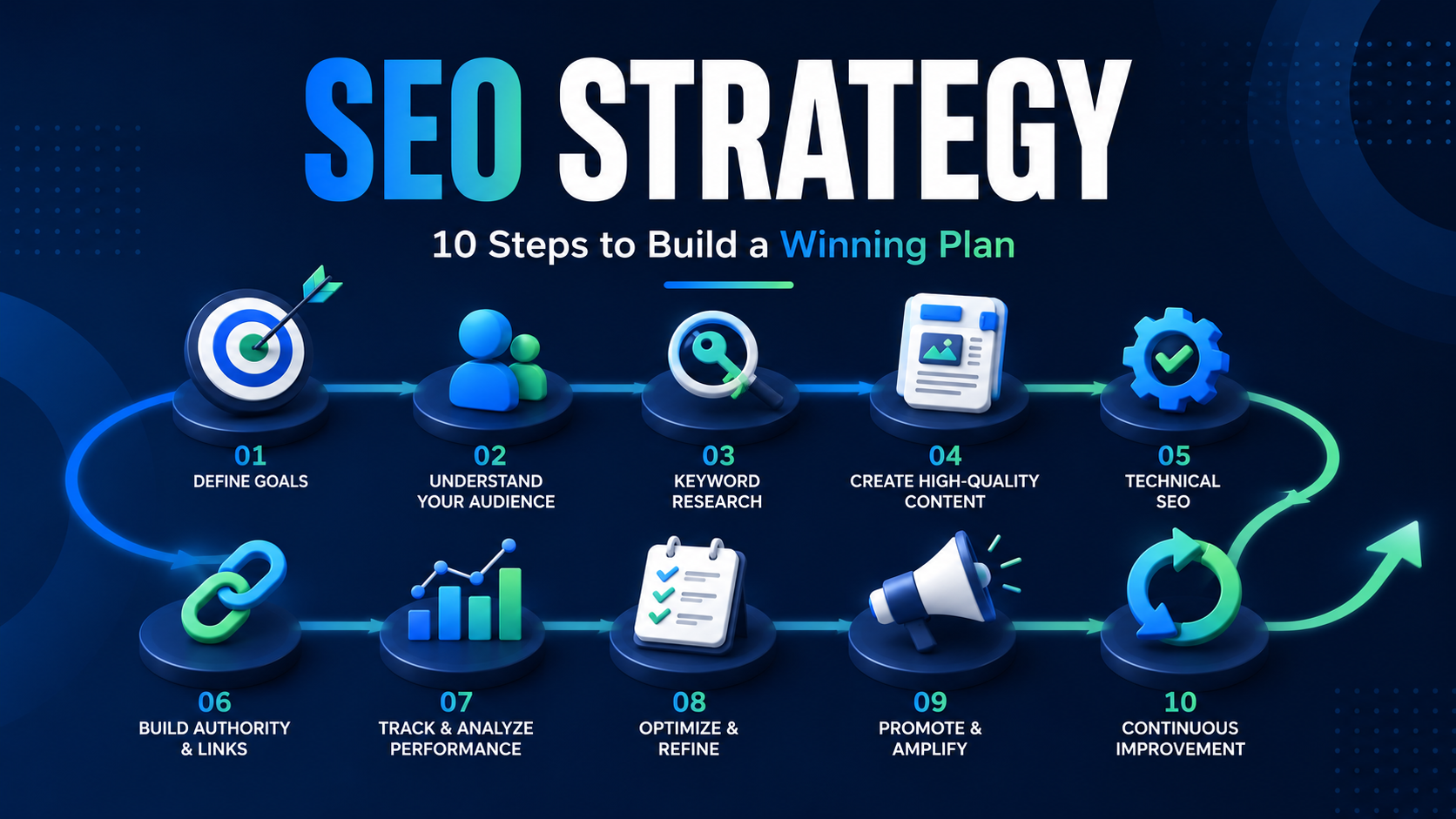
Step 1: Define Your Business Goals
Every SEO strategy should begin with business goals.
Examples include:
- Generate 50 qualified leads per month
- Increase ecommerce revenue
- Grow newsletter subscribers
- Build visibility for a new service
- Reduce dependence on paid advertising
- Increase local appointments
- Grow affiliate revenue
- Become a recognized resource in a niche
Avoid vague goals such as:
Get more SEO traffic.
More traffic is not always better.
Ten thousand irrelevant visitors may be less valuable than 500 visitors who are actively looking for the service you offer.
Translate Business Goals Into SEO Goals
Example:
Business goal:
Generate more SEO consulting leads.
SEO goals:
- Improve visibility for consulting-related queries
- Create commercial service pages
- Publish informational content supporting those services
- Build authority around relevant topics
- Track qualified form submissions from organic traffic
This creates a direct relationship between SEO work and the business.
Step 2: Define Your Target Audience
SEO strategy should be audience-first.
Before choosing keywords, identify who you want to reach.
Ask:
- Who are they?
- What industry are they in?
- What problems do they have?
- What do they already know?
- What would make them search?
- What information do they need before acting?
- What objections might prevent them from buying?
- Which platforms and tools do they already use?
For example, “small business owner” is still too broad.
A more useful profile might be:
A local service-business owner with a WordPress website who depends on Google for leads but does not understand technical SEO.
That audience will have different needs from:
An in-house SEO manager responsible for a 100,000-page ecommerce website.
Your strategy should reflect that difference.
Step 3: Audit Your Current Website
Before creating more content, understand what already exists.
An SEO audit should examine several areas.
Content Inventory
Identify:
- Existing pages
- Traffic
- Rankings
- Conversions
- Duplicate topics
- Outdated content
- Weak pages
- Strong pages
Technical Health
Review:
- Crawling
- Indexing
- Canonicals
- Redirects
- Status codes
- XML sitemaps
- Robots.txt
- Mobile usability
- Performance
- HTTPS
- Structured data
Site Architecture
Ask:
- Are categories clear?
- Are important pages easy to reach?
- Are there orphan pages?
- Are internal links logical?
- Do users understand where they are?
Authority
Review:
- Existing backlinks
- Brand mentions
- Industry relationships
- Strongest linked pages
Analytics
Confirm that you can measure:
- Organic clicks
- Landing pages
- Leads
- Sales
- Affiliate clicks
- Newsletter signups
Do not begin a major SEO campaign without a reliable measurement baseline.
Step 4: Research Search Demand
Keyword research helps you understand how your audience expresses its needs.
But do not collect keywords simply because they have search volume.
Group them by:
- Topic
- Search intent
- Business relevance
- Funnel stage
- Page type
For example:
Topic: Technical SEO
Potential queries:
- what is technical SEO
- technical SEO checklist
- technical SEO audit
- technical SEO tools
- technical SEO consultant
- ecommerce technical SEO
These queries should not necessarily belong on one page.
Their intents differ.
Step 5: Build a Topic Architecture
A strong SEO strategy organizes content into logical subject areas.
A practical hierarchy can be:
Category
    ↓
Pillar
    ↓
Cluster
    ↓
Supporting Article
Example:
SEO
│
├── SEO Foundations
│   ├── SEO Fundamentals
│   ├── How Search Engines Work
│   ├── Search Intent
│   ├── SEO Glossary
│   └── SEO Strategy
│
├── Keyword Research
│   ├── Seed Keywords
│   ├── Long-Tail Keywords
│   ├── Keyword Difficulty
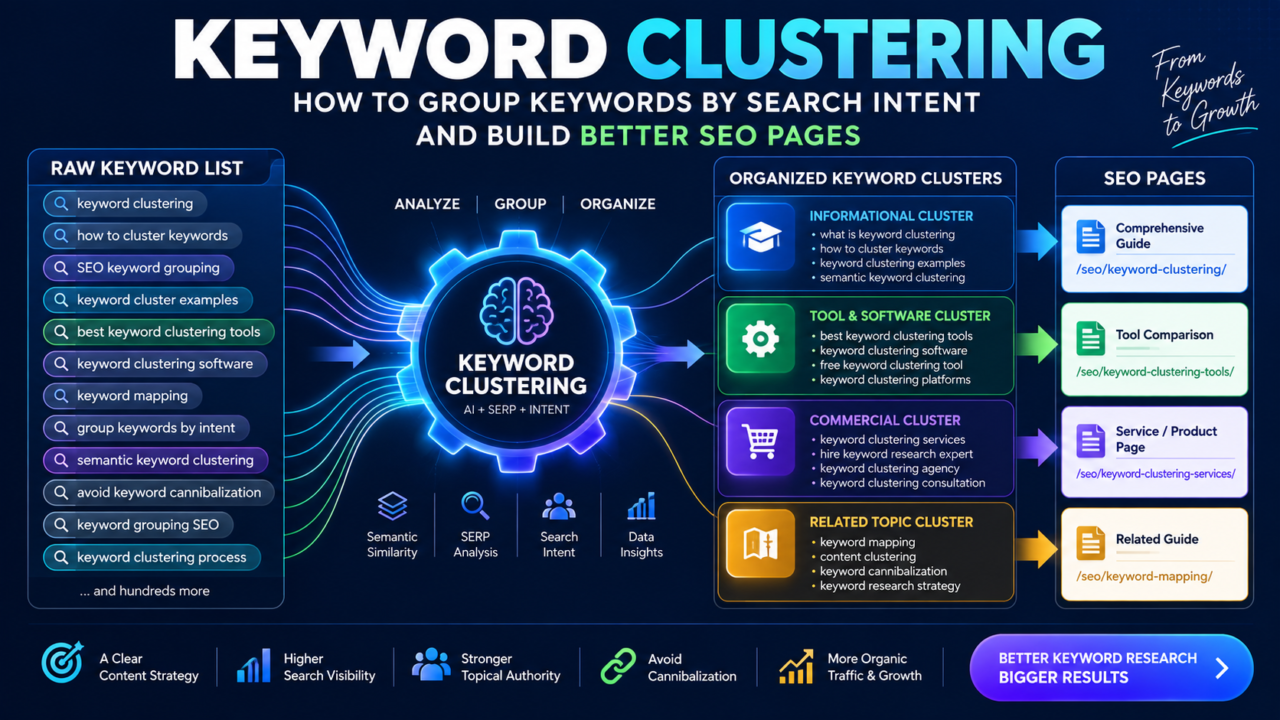
│   └── Keyword Clustering
│
└── Technical SEO
    ├── Crawling
    ├── Indexing
    ├── Canonicals
    └── Sitemaps
This is much stronger than publishing isolated articles with no relationship to one another.
Step 6: Assign One Search Intent to Each Page
One of the most important parts of SEO planning is page ownership.
Each important page should have a clearly defined purpose.
For example:
SEO fundamentals
→ /seo/seo-fundamentals/

how search engines work
→ /seo/how-search-engines-work/

search intent
→ /seo/search-intent/

SEO glossary
→ /seo/seo-glossary/
Do not create multiple pages that answer the same question unless they genuinely serve different intents.
This helps reduce unnecessary cannibalization.
Step 7: Prioritize Content by Business Value
Not every keyword deserves equal effort.
A useful prioritization model considers:
Business Relevance
Does the topic support your services, products, or audience?
Search Intent
Is the visitor likely to be relevant?
Strategic Importance
Does the topic strengthen an important pillar?
Authority Potential
Can you create something genuinely stronger or more useful?
Conversion Potential
Could the page realistically contribute to:
- Leads
- Sales
- Email signups
- Affiliate clicks
- Trials
Resource Requirement
How difficult will it be to produce properly?
You can turn these factors into a simple priority score.
But do not let a spreadsheet replace judgment.
Step 8: Create Better Content, Not Just More Content
Publishing frequency is less important than publishing useful pages.
Google’s current guidance continues to emphasize unique, useful, people-first content rather than content produced primarily for search engines.
A strong article may include:
- First-hand experience
- Original screenshots
- Examples
- Templates
- Processes
- Data
- Comparisons
- Limitations
- Warnings
- Real-world lessons
Before publishing, ask:
What does this page provide that a generic AI-generated summary does not?
That question is increasingly important.
Step 9: Strengthen Internal Linking
Internal links should be part of the strategy from the beginning.
They help:
- Users discover related content
- Crawlers discover pages
- Establish topic relationships
- Move readers through a learning journey
- Connect informational pages with commercial pages
A useful pattern is:
Category Hub
    ↓
Pillar Article
    ↓
Supporting Tutorial
    ↓
Advanced Guide
    ↓
Commercial Resource
For example:
SEO Fundamentals
      ↓
SEO Strategy
      ↓
Keyword Research
      ↓
Best SEO Tools
      ↓
SEO Audit Service
Do not force links just because two pages contain similar words.
Link when the destination helps the reader take the next logical step.
Step 10: Measure, Review and Improve
SEO strategy is not finished when pages are published.
You need a review cycle.
Track:
- Organic impressions
- Clicks
- CTR
- Rankings
- Indexed pages
- Conversions
- Leads
- Revenue
- Affiliate clicks
- Newsletter signups
Then ask:
- Which pages are growing?
- Which pages are declining?
- Which pages generate business outcomes?
- Which articles receive traffic but no conversions?
- Which topics need expansion?
- Which pages overlap?
- Which pages should be refreshed?
- Which pages should be consolidated?
A practical decision framework is:
Keep
The page is performing well.
Refresh
The page is useful but outdated.
Expand
The topic has additional opportunity.
Consolidate
Multiple pages overlap.
Redirect
The old page is no longer necessary.
Retire
The page has no useful purpose.
Build an SEO Strategy Around Authority Waves
For a new website, trying to cover every marketing topic simultaneously is usually inefficient.
A stronger approach is to build authority in waves.
For example:
Wave 1: SEO Foundations
Publish:
- SEO Fundamentals
- How Search Engines Work
- Search Intent
- SEO Glossary
- SEO Strategy
- SEO Audits
- SEO Reporting
Wave 2: Keyword Research
Publish:
- Keyword Discovery
- Seed Keywords
- Long-Tail Keywords
- Keyword Difficulty
- Keyword Clustering
- SERP Analysis
- Keyword Mapping
Wave 3: Technical SEO
Then expand into:
- Crawling
- Indexing
- Sitemaps
- Canonicals
- Redirects
- JavaScript SEO
- Core Web Vitals
This approach creates deeper topical relationships instead of spreading the site too thin.
SEO Strategy for a New Website
If your site is new, begin with a small number of priorities.
1. Establish Clear Categories
Avoid creating dozens of empty categories.
2. Publish Foundational Pillar Pages
Create the major resources readers will repeatedly need.
3. Add Supporting Articles
Build depth around those pillars.
4. Create Strong Internal Links
Every new article should connect to the existing architecture.
5. Build Original Evidence
Use:
- Screenshots
- Tests
- Processes
- Templates
- Case studies
6. Measure Early
Install analytics and Search Console before the content library becomes large.
7. Expand Only After the Foundation Exists
Do not rush into unrelated topics simply to increase article count.
SEO Strategy for an Existing Website
Existing websites often need a different approach.
Before publishing aggressively:
Audit Existing Pages
You may already have useful content hidden inside:
- Old articles
- Service pages
- Product pages
- FAQs
Consolidate Duplicate Content
Three weak overlapping pages may be better as one strong page.
Improve Strong Pages First
Updating an article that already ranks may produce results faster than publishing an unrelated new article.
Fix Technical Problems
Do not ignore indexing, redirects, duplication, or performance issues.
Improve Internal Links
Older websites often accumulate disconnected pages.
Content Strategy and SEO Strategy Are Not the Same
Content strategy is part of SEO strategy.
SEO also includes:
- Technical health
- Architecture
- Internal linking
- Authority
- Analytics
- Conversion paths
- Maintenance
A website can publish excellent content and still struggle if its technical foundation or architecture is poor.
Likewise, perfect technical SEO cannot compensate for weak content.
Both have to work together.
SEO Strategy and AI Search
Search experiences continue to evolve through AI-powered features.
Google’s 2026 guidance for generative AI search specifically states that standard SEO best practices remain relevant and emphasizes valuable, unique, non-commodity content.
That means you do not need a completely separate “AI SEO” strategy.
You need a strong information strategy that includes:
- Clear site structure
- Accessible pages
- Useful content
- Original experience
- Strong media
- Accurate information
- Meaningful internal relationships
- Brand credibility
Avoid chasing new acronyms while ignoring fundamentals.
Common SEO Strategy Mistakes
Chasing Search Volume
Large search volume does not mean business value.
Publishing Too Many Topics
A new site that covers SEO, finance, fitness, travel, and software simultaneously will struggle to establish a clear identity.
Copying Competitors
Competitor analysis helps reveal expectations.
It should not become an instruction to reproduce their content.
Ignoring Existing Content
Sometimes the best SEO opportunity is improving something you already published.
Treating Backlinks as the Entire Strategy
Links matter, but they are only one part of SEO.
Publishing Without Measurement
If you cannot track performance, you cannot manage the strategy effectively.
Changing URLs Unnecessarily
URL changes create additional technical risk.
Keep good URLs stable whenever possible.
Building for Plugins Instead of Users
An SEO plugin provides useful checks.
It does not know whether your article genuinely satisfies the reader.
Do not compromise clarity just to achieve a perfect plugin score.
A Practical SEO Strategy Framework
Use this sequence:
Phase 1: Research
- Define business goals
- Define audience
- Audit the website
- Research keywords
- Analyze competitors
- Analyze SERPs
Phase 2: Architecture
- Define categories
- Define pillars
- Define clusters
- Map queries to pages
- Plan URLs
- Plan internal links
Phase 3: Production
- Create briefs
- Collect evidence
- Write
- Edit
- Optimize
- Add media
- Perform QA
Phase 4: Promotion
- Share useful resources
- Build relationships
- Conduct digital PR
- Earn relevant links
- Distribute content
Phase 5: Measurement
- Track Search Console
- Track analytics
- Monitor conversions
- Review revenue
- Identify opportunities
Phase 6: Improvement
- Refresh
- Expand
- Consolidate
- Redirect
- Retire
SEO is a cycle, not a one-time project.
SEO Strategy Checklist
Before finalizing your strategy, confirm:
Business
- Is the business goal clear?
- Are conversions defined?
- Do we know what success means?
Audience
- Do we know who we are targeting?
- Do we understand their problems?
- Do we understand their buying journey?
Keywords
- Have we researched real search behavior?
- Is search intent documented?
- Does every important page have clear keyword ownership?
Architecture
- Are categories logical?
- Are pillars clearly defined?
- Are clusters connected?
- Are URLs simple?
- Are internal links planned?
Content
- Does every article solve a real problem?
- Is there original value?
- Do we have first-hand evidence?
- Are we avoiding unnecessary duplication?
Technical SEO
- Can search engines crawl the site?
- Are important URLs indexable?
- Are canonicals correct?
- Are redirects clean?
- Are sitemaps configured?
Authority
- Do we have a realistic promotion strategy?
- Can we earn legitimate links and mentions?
Measurement
- Is Search Console configured?
- Is analytics configured?
- Are conversions tracked?
- Do we have a review schedule?
Final Thoughts
A successful SEO strategy is not built around hacks.
It is built around disciplined decision-making.
The process is:
Understand the business → Understand the audience → Understand search demand → Build the right pages → Connect them logically → Establish credibility → Measure results → Improve continuously
Your strategy should help you decide what not to do just as much as what to do.
You do not need to publish every possible keyword.
You need to build the pages that matter most for your audience and business, then make those pages genuinely worth discovering.
That is the foundation of sustainable SEO.