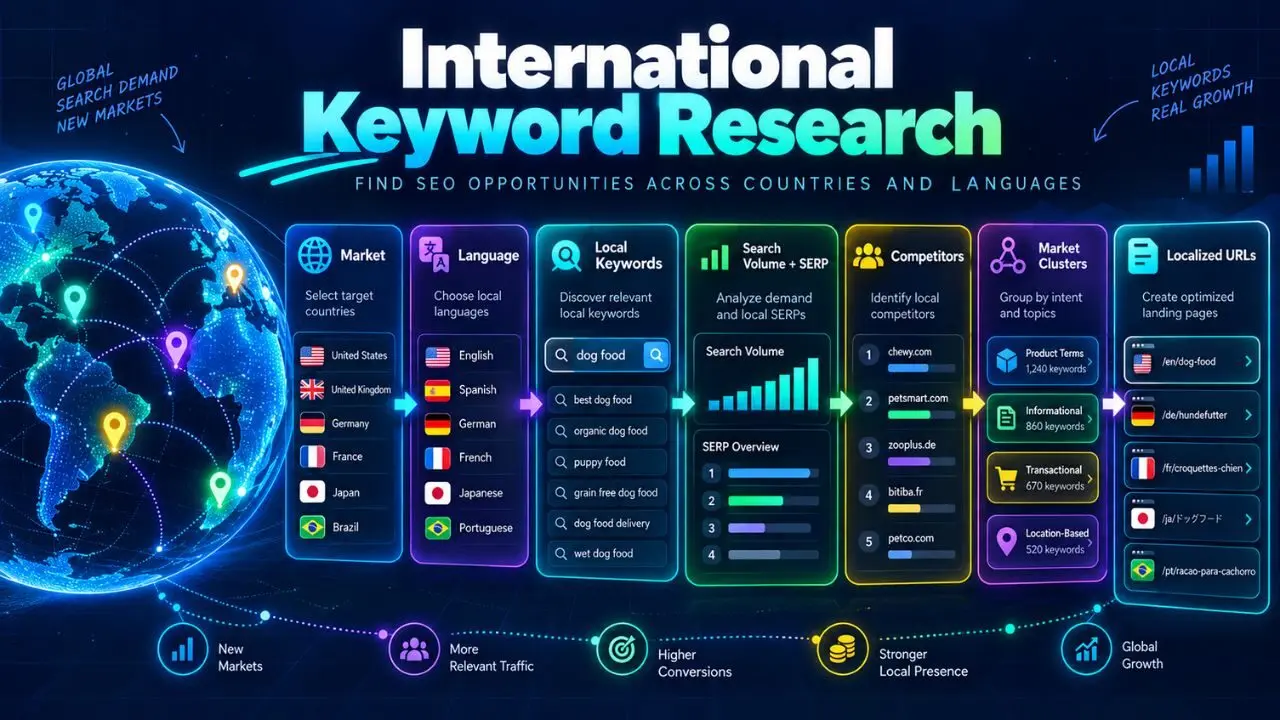

Keyword research changes when you move beyond one country.
A phrase that performs well in the United States may have completely different demand in the United Kingdom.
A keyword used in English may not be the phrase people naturally use in Spanish, Arabic, German, or French.
Even when two markets speak the same language, search behaviour can differ because of:
- vocabulary
- spelling
- cultural preferences
- buying habits
- local competitors
- search intent
- product availability
- regional terminology
- currency
- geography
That is why international keyword research should not be treated as simple translation.
It is the process of identifying how people in different countries, languages, and markets search for the same products, services, problems, and topics.
The goal is not to take one English keyword list and translate every term.
The goal is to understand:
How does this audience actually search in this market?
A practical workflow looks like:
Market Selection → Language Research → Local Search Behavior → Keyword Discovery → Search Intent → SERP Validation → Keyword Clustering → URL Mapping
This guide explains how to perform international keyword research step by step, compare country-level demand, handle language differences, avoid translation mistakes, and build SEO strategies that match how real users search in each market.
What Is International Keyword Research?
International keyword research is the process of discovering, evaluating, and organizing search queries for different countries, regions, or languages.
It helps answer questions such as:
- Which terms are used in each market?
- How much search demand exists?
- Does search intent change by country?
- Which competitors rank locally?
- Which language variation should be used?
- Should different markets share one page or have localized URLs?
- Does the same keyword mean the same thing everywhere?
For example, consider footwear.
In the United States, users may search:
sneakers
In the United Kingdom, users may search more often for:
trainers
Both refer to similar products.
A direct translation or global keyword list may miss this difference.
International SEO therefore requires local research, not only linguistic conversion.
Why International Keyword Research Matters
International expansion creates opportunities.
But it can also create large amounts of irrelevant content if research is weak.
A global company may see strong demand in one market and assume that the same keyword strategy will work everywhere.
That assumption can fail.
Search Volume Can Change by Country
A keyword with:
20,000 searches per month
in one market might have:
800 searches
in another.
Country-level demand changes prioritization.
Search Intent Can Change
A query can produce informational results in one market and commercial results in another.
That means the same keyword may require different page types.
Language Can Change Without Translation
People often search using:
- local vocabulary
- abbreviations
- mixed languages
- industry-specific terminology
Good international research discovers that language rather than assuming it.
International Keyword Research vs Translation
This distinction is fundamental.
Translation
Changes words from one language into another.
International Keyword Research
Finds the phrases people actually search in the target market.
Suppose your English keyword is:
digital marketing agency
A literal translation might be grammatically correct.
But local users may prefer a completely different phrase.
Search demand, terminology, and commercial intent must be validated independently.
A translated phrase can be linguistically accurate and still be a poor SEO keyword.
12 Steps to Perform International Keyword Research
1. Choose the Target Market
Start with a country or region.
Do not begin with:
“We want to rank worldwide.”
That is too broad.
Instead define:
- country
- language
- audience
- product or service
Examples:
- United Kingdom — English
- United Arab Emirates — English + Arabic
- Germany — German
- Pakistan — English + Urdu
- Canada — English + French
One country can contain several language audiences.
One language can also span multiple countries.
Treat market and language as separate dimensions.
2. Define the Business Opportunity
Before researching keywords, understand why the market matters.
Ask:
- Do we sell there?
- Can we serve customers there?
- Is shipping available?
- Do we have local pricing?
- Is the product legally available?
- Can support handle the language?
SEO should not create demand for a business experience you cannot deliver.
For example, ranking for:
SEO consultant Dubai
is of limited value if you do not actually serve that market.
3. Start With Core Seed Topics
Use your main products, services, and topics as seeds.
For an SEO business:
- SEO
- technical SEO
- keyword research
- local SEO
- SEO consultant
Then research these concepts independently within the target market.
Your Seed Keywords guide explains how broad topics create the starting structure for deeper research.
Do not translate hundreds of long-tail keywords before validating the core market terminology.
4. Research Local Terminology
This is one of the most important steps.
Ask:
What does the local audience call this product, service, or problem?
Examples can include:
- different spelling
- local slang
- alternative product names
- different professional terminology
For example:
United States
vacation
United Kingdom
holiday
Or:
United States
apartment
United Kingdom
flat
These differences can completely change keyword demand.
5. Compare Country-Level Search Volume
Keyword volume should be checked for the target country.
Do not rely on global search volume.
Suppose:
| Keyword | US | UK | Australia |
|---|---|---|---|
| SEO agency | 10,000 | 3,500 | 1,200 |
| SEO consultant | 6,000 | 4,000 | 900 |
| search engine optimisation | 500 | 2,500 | 700 |
The relative importance of each term changes by market.
This is why your Keyword Metrics guide should be applied separately to every major target market.
6. Analyze Search Intent Locally
Do not assume the same phrase carries the same intent globally.
Search the keyword from the target market.
Look at:
- ranking page types
- local competitors
- ads
- maps
- ecommerce results
- comparison pages
Your SERP Analysis guide provides the framework.
If one country shows:
- service pages
while another shows:
- educational guides
then the content strategy may need to differ.
7. Study Local Competitors
Your strongest competitor in one country may be irrelevant in another.
Identify:
- local brands
- regional publishers
- local marketplaces
- industry specialists
Then analyze:
- their ranking keywords
- category structure
- service pages
- content gaps
Your Competitor Keyword Research guide explains how to find competitor opportunities without copying their strategy.
International research should repeat that process for each market.
8. Research Language Variants
Some markets use the same language but different spelling or phrasing.
Examples:
US English
optimization
UK English
optimisation
Or:
US
cell phone
UK
mobile phone
You do not necessarily need separate pages for every spelling difference.
But you should understand which variation dominates the target market.
The page should read naturally for that audience.
9. Find Local Long-Tail Keywords
Long-tail research becomes especially useful internationally.
For example:
Broad:
SEO consultant
More specific:
SEO consultant for ecommerce businesses in Dubai
Or:
German SEO consultant for SaaS companies
These queries may have lower reported volume but clearer market-specific intent.
Your Long-Tail Keywords guide explains how specificity can reveal stronger audience needs.
10. Validate Zero-Volume International Queries
International keyword tools often have weaker data in smaller markets.
That means relevant terms may show zero volume.
Do not reject them immediately.
Apply the framework from your Zero-Volume Keywords guide.
Check:
- Search Console
- customer inquiries
- local communities
- competitor pages
- SERPs
Smaller international markets often require more qualitative validation.
11. Cluster Keywords by Market and Intent
Do not mix every country into one giant cluster.
For example:
UK Cluster
- SEO agency UK
- SEO agency London
- SEO consultant UK
UAE Cluster
- SEO agency Dubai
- SEO company Dubai
- SEO consultant UAE
These may require different pages or regional structures.
Your Keyword Clustering guide explains how to organize keywords by shared intent.
For international SEO, add another dimension:
Intent + Market + Language
12. Map Keywords to Localized URLs
Finally, assign each cluster to the appropriate page.
Your Keyword Mapping guide explains the basic process.
International mapping may look like:
| Market | Keyword | URL |
|---|---|---|
| US | SEO services | /us/seo-services/ |
| UK | SEO services | /uk/seo-services/ |
| Germany | SEO Agentur | /de/seo-agentur/ |
The exact site structure depends on your international architecture.
The important point is that each localized search intent needs clear ownership.
Country vs Language Targeting
These are not the same thing.
Consider:
Country
Canada
Languages
- English
- French
Or:
Country
UAE
Languages
- Arabic
- English
Your keyword research should distinguish:
market
from:
language
This can produce separate research sets.
For example:
UAE — English
SEO company Dubai
UAE — Arabic
Arabic equivalent used naturally by local searchers.
Do not assume one language represents the entire country.
Same Language, Different Markets
Even when the language is the same, search behavior can differ.
Consider English markets:
- United States
- United Kingdom
- Australia
- Canada
Differences can appear in:
- vocabulary
- spelling
- products
- regulations
- brands
- seasonal behavior
Therefore, a single English keyword list should not automatically be reused globally.
Multilingual Keyword Research
When working in another language, avoid relying entirely on machine translation.
A better process is:
Original Topic → Native Translation → Local Keyword Research → SERP Validation → Native Review
The translated keyword is only a starting point.
You need to understand how real users search.
Use Native Speakers When Possible
Native speakers can identify:
- unnatural translations
- idioms
- commercial terminology
- regional differences
This becomes especially important for:
- high-value pages
- legal topics
- medical topics
- product descriptions
Language quality affects both SEO and trust.
International Keyword Research and Search Intent
Search intent may vary significantly by market.
Consider:
CRM software
In one country, the SERP may be dominated by global SaaS brands.
In another, it may contain:
- local software companies
- comparison websites
- regional directories
That difference affects:
- competition
- content type
- conversion strategy
Intent must therefore be validated at the local SERP level.
International Keyword Research and Local Search
International and local SEO often overlap.
For example:
SEO consultant Dubai
includes:
- international market targeting
- local commercial intent
The SERP may show:
- local service companies
- maps
- directories
Your content strategy must account for both dimensions.
International Keyword Research for Ecommerce
Ecommerce expansion requires country-specific research around:
- categories
- products
- attributes
- currencies
- sizing
- delivery
For example, clothing sizes may differ by market.
Users may also search differently around:
- shipping
- returns
- duties
- local availability
A successful international ecommerce strategy therefore goes beyond translated category names.
International Keyword Research for SaaS
SaaS websites often have global demand.
Research:
- software category terminology
- local competitors
- pricing language
- integration demand
- data regulations
For example, users in Europe may care more strongly about:
- GDPR
- EU hosting
- data residency
These related concepts can influence search behavior.
International Keyword Research for B2B
B2B expansion may have low volume but high customer value.
For example:
ERP software for manufacturers Germany
may not have enormous search volume.
But one qualified enterprise customer can justify substantial SEO investment.
Evaluate:
- contract value
- target industries
- job roles
- local terminology
Do not reject international B2B opportunities solely because keyword volume looks small.
International Keyword Research for Local Services
Local services should not create pages for countries or cities they do not serve.
Before mapping:
plumber Dubai
confirm:
- service availability
- physical coverage
- licensing where relevant
SEO should reflect the real business.
Do not manufacture international location pages merely for traffic.
International Keyword Research and Competitor Gaps
A topic may be highly competitive in one market and underdeveloped in another.
For example:
Market A
Ten strong guides exist.
Market B
Only weak, outdated content exists.
The second market may present a better opportunity.
Your Content Gap Analysis guide can therefore be applied market by market.
International Search Volume Is Not Revenue
A country may show high search demand but weak commercial fit.
Factors can include:
- customer purchasing power
- product availability
- logistics
- pricing
- competition
Do not choose international markets solely by volume.
Evaluate:
Search Opportunity + Business Viability
Build an International Keyword Matrix
A useful spreadsheet can include:
| Field | Purpose |
|---|---|
| Market | Country/region |
| Language | Search language |
| Keyword | Local query |
| English Reference | Internal comparison |
| Intent | User goal |
| Volume | Local demand |
| Difficulty | Competition |
| CPC | Commercial signal |
| SERP Type | Local result pattern |
| Cluster | Topic group |
| URL | Target page |
| Status | Planned/published |
This keeps international research organized.
Use One Global Keyword or Separate Local Keywords?
It depends on search behavior.
Suppose:
US
digital marketing agency
UK
digital marketing agency
If search behavior and intent are similar, localization may be limited.
Now suppose:
US
sneakers
UK
trainers
The keyword strategy should reflect those differences.
Research first.
Architecture comes second.
International Keyword Cannibalization
International sites can create cannibalization if localized pages are poorly differentiated.
For example:
/us/seo-services//uk/seo-services/
If both pages contain almost identical generic content, search engines may have difficulty understanding the intended market.
Localized pages should provide genuinely relevant market context.
That can include:
- terminology
- pricing
- examples
- services
- local information
International Keyword Research and Hreflang
Keyword research determines which local pages should exist.
Hreflang is a technical implementation used on multilingual or multi-regional sites to help search engines understand language and regional alternatives.
Do not create hreflang simply because you discovered keywords in another country.
First ensure:
- corresponding pages exist
- translations are valid
- markets are genuinely supported
Technical international SEO comes after strategic research.
International Keyword Research and Entities
Entities can vary in importance across markets.
For example, a fintech topic may involve different:
- banks
- regulations
- currencies
- payment platforms
Your Entity Research guide helps identify the important concepts associated with each market.
This is especially useful when localization involves more than changing language.
International Keyword Research Tools
Useful tools can help with:
- country-level search volume
- competitor rankings
- local SERPs
- trends
But no platform perfectly captures every market.
Smaller countries and languages may have less reliable data.
Combine tools with:
- Search Console
- local customer research
- SERP analysis
- native-language review
Can AI Translate Keyword Research?
AI can help with early expansion.
For example, it can:
- translate seed topics
- suggest local variations
- organize keyword sets
- group terminology
But AI should not be treated as a substitute for local validation.
It may produce:
- grammatically correct but unnatural phrasing
- terminology nobody searches
- incorrect regional language
Use AI to accelerate research.
Use real search evidence to validate it.
Search Trends Across Markets
International demand can be seasonal.
Examples:
- holidays
- tourism
- school calendars
- climate
- regional events
A keyword may peak in:
- summer in one country
- winter in another
This becomes important when planning publishing dates and campaigns.
Prioritize International Markets
You may discover opportunities across ten countries.
That does not mean you should launch all ten.
Score markets based on:
Search Demand
How large is the opportunity?
Business Value
Can the market generate meaningful customers?
Competition
Can you realistically rank?
Operational Readiness
Can you support customers there?
Language Capability
Can you create high-quality content?
A market with lower volume may be more attractive if operational fit is stronger.
Common International Keyword Research Mistakes
Translating Keywords Literally
Search behavior is not translation.
Using Global Search Volume
Analyze the actual target market.
Ignoring Local Vocabulary
Users may use different words.
Assuming One Language Equals One Country
Many countries are multilingual.
Ignoring Search Intent Differences
Local SERPs may favor different page types.
Copying Your Domestic Competitors
Local competitors may be more relevant.
Creating Country Pages Without Business Support
Only target markets you can genuinely serve.
Publishing Low-Quality Machine Translation
Language quality affects credibility.
Ignoring Local Commercial Signals
CPC and buyer behavior vary by market.
Launching Too Many Markets at Once
Prioritize strategically.
A Practical International Keyword Research Workflow
Use this process:
1. Choose the Market
Define country, language, and audience.
2. Validate Business Fit
Confirm you can serve the market.
3. Identify Seed Topics
Start from core products and services.
4. Research Local Terminology
Find how users actually describe them.
5. Measure Local Demand
Use country-specific metrics.
6. Study Local SERPs
Validate intent and page type.
7. Analyze Local Competitors
Discover market-specific opportunities.
8. Find Long-Tail Variations
Expand audience and use-case terms.
9. Validate Low-Data Queries
Use first-party and qualitative evidence.
10. Cluster by Intent and Market
Keep regional datasets organized.
11. Map Clusters to URLs
Define clear local ownership.
12. Prioritize Markets and Pages
Align SEO with business capability.
International Keyword Research Checklist
Before targeting a new country or language, confirm:
Market
- target country defined
- audience identified
- business can serve the location
Language
- primary language researched
- regional vocabulary reviewed
- translation validated
Keywords
- seed topics researched locally
- search volume localized
- long-tail searches reviewed
Intent
- local SERPs analyzed
- page type confirmed
- mixed intent considered
Competition
- local competitors identified
- difficulty reviewed
- content gaps identified
Architecture
- keywords clustered by market
- URLs mapped
- cannibalization considered
Quality
- native-language quality reviewed where necessary
- cultural context considered
- page is genuinely localized
Business
- commercial value assessed
- operational readiness confirmed
- market priority established
Final Thoughts
International keyword research is not simply keyword translation.
It is market research through search behavior.
A useful process looks like:
Market → Language → Local Terminology → Demand → Intent → SERP → Competition → Cluster → URL
The most important principle is simple:
Research how people actually search in each market.
Do not assume that:
- the same keyword has the same demand
- the same language uses the same vocabulary
- the same search intent appears globally
- the same competitors dominate everywhere
International SEO works best when research respects local behavior.
Start with one market.
Understand the audience.
Validate terminology.
Study local search results.
Then build content around the way that audience actually searches.
The next article in this Keyword Research pillar brings the entire research process together into a repeatable system through keyword research workflows.