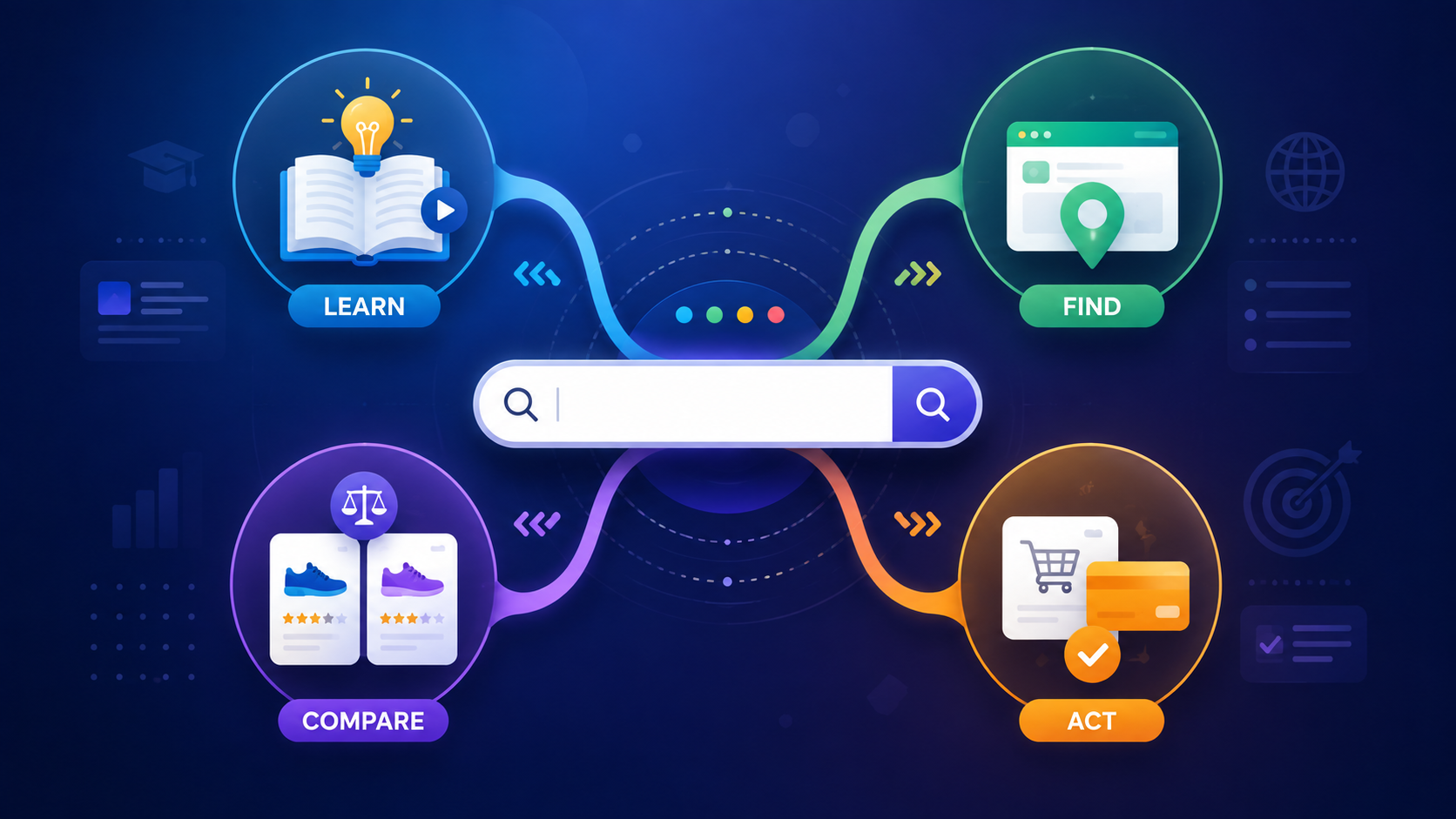

Ranking for a keyword is not only about mentioning that keyword on a page.
You also need to understand why someone searched for it.
A person searching for:
“what is technical SEO”
probably wants an explanation.
Someone searching for:
“best technical SEO tools”
is more likely comparing products.
And someone searching for:
“technical SEO consultant near me”
may already be looking to hire someone.
The words are related, but the expected result is completely different.
This underlying purpose is called search intent.
Understanding search intent helps you choose the right page type, content format, angle, level of detail, call to action, and internal links for a search query.
It is one of the most important foundations of modern SEO.
Google’s current guidance continues to emphasize creating content that helps people achieve their goals and leaves them with a satisfying experience rather than producing pages primarily for search-engine traffic.
That principle is closely connected to search intent.
If your page does not provide what the searcher actually needs, keyword optimization alone is unlikely to make it a strong result.
What Is Search Intent?
Search intent is the purpose or goal behind a search query.
It answers the question:
What is this person actually trying to accomplish?
A user may want to:
- Learn something
- Find a particular website
- Compare solutions
- Research a product
- Visit a local business
- Buy something
- Hire a service
- Download a resource
- Troubleshoot a problem
- Complete a task
Consider the keyword:
“WordPress speed optimization”
Different users might mean different things.
One person may want:
- A beginner guide
Another may want:
- A WordPress speed optimization service
Another may want:
- A plugin recommendation
Another may simply want:
- A checklist
Your SEO strategy should identify the dominant intent shown by the search results and determine whether your proposed page belongs there.
Why Search Intent Matters for SEO
Search engines are trying to connect users with useful results.
Google describes SEO as helping search engines understand your content while helping users find your site.
That means relevance is not limited to individual words.
A page can contain the target keyword many times and still be a poor result if it solves the wrong problem.
For example, imagine this query:
“best CRM for small business”
Suppose you create a 4,000-word article titled:
What Is a CRM? Complete Beginner’s Guide
The article may be excellent.
But someone searching for the best CRM for small business probably expects:
- Product options
- Comparisons
- Pricing considerations
- Strengths and weaknesses
- Recommendations by business type
Your beginner definition does not fully satisfy that intent.
Now consider the opposite problem.
A person searches:
“what is CRM”
and lands on a page that immediately pushes:
- Start a free trial
- Book a demo
- Compare pricing plans
without properly explaining CRM.
Again, the page and intent do not match.
Search Intent Is More Than a Keyword
One of the biggest SEO mistakes is treating keywords as isolated phrases.
A keyword should be interpreted in context.
For example:
“Shopify SEO”
could potentially mean:
- What Shopify SEO is
- How to optimize a Shopify store
- Shopify SEO services
- Shopify SEO apps
- Shopify SEO checklist
- Shopify SEO agency
- Shopify SEO course
Before creating the page, determine which interpretation the current search results support.
This is why keyword research and SERP analysis should work together.
The Four Common Types of Search Intent
The SEO industry commonly groups search intent into four broad categories:
- Informational
- Navigational
- Commercial investigation
- Transactional
These categories are useful planning models, but they should not be treated as an official Google classification system.
Real searches can also contain mixed intent.
1. Informational Search Intent
Informational searches occur when users want to learn something.
Examples:
- What is SEO?
- How do search engines work?
- What is keyword research?
- How to create a sitemap
- Why is my website slow?
- How does email automation work?
- What is Google Tag Manager?
The user is usually looking for knowledge rather than immediately trying to buy something.
Common Content Formats
Informational intent often works well with:
- Guides
- Tutorials
- Explanations
- Checklists
- Definitions
- Videos
- FAQs
- Troubleshooting articles
- Research
- Examples
Example
Query:
“how to create an XML sitemap”
A strong page might include:
- What an XML sitemap is
- When you need one
- How to create it
- WordPress instructions
- Shopify instructions
- How to validate it
- How to submit it to Search Console
- Common errors
A generic sales page for an SEO service would not be the best match.
2. Navigational Search Intent
Navigational intent occurs when users already know which website, brand, product, or page they want.
Examples:
- Google Search Console
- YouTube
- Shopify login
- Semrush
- Ahrefs pricing
- GoHighLevel login
- Facebook Ads Manager
The search engine is being used as a navigation tool.
Should You Target Navigational Keywords?
Sometimes.
If the query refers to your own brand, you should make it easy for users to reach the correct destination.
However, trying to rank for another company’s strongly branded navigational query is often not the best content opportunity.
For example:
“Google Analytics login”
is overwhelmingly navigational.
A 3,000-word guide about Google Analytics is unlikely to replace the destination users clearly want.
3. Commercial Investigation Intent
Commercial investigation happens when someone is researching options before making a decision.
Examples:
- Best SEO tools
- Best CRM for small business
- Shopify vs WooCommerce
- Semrush vs Ahrefs
- Best WordPress hosting
- GoHighLevel alternatives
- Best email marketing platform
- Best landing page builders
The person may not be ready to purchase yet, but they are much closer to a commercial decision.
Common Content Formats
Commercial intent often matches:
- Comparison articles
- Product reviews
- Alternatives pages
- “Best” lists
- Buying guides
- Pricing comparisons
- Case studies
- Product demonstrations
Example
Query:
“best CRM for marketing agency”
Useful content could compare:
- CRM capabilities
- Pipeline management
- Automation
- Reporting
- Integrations
- Pricing
- Ease of setup
- Agency-specific features
- Limitations
A good commercial article helps the reader make a decision rather than merely defining what CRM means.
4. Transactional Search Intent
Transactional intent occurs when users appear ready to take an action.
That action could involve:
- Buying
- Hiring
- Booking
- Signing up
- Downloading
- Starting a trial
- Requesting a quote
Examples:
- Hire SEO consultant
- Buy WordPress hosting
- GoHighLevel free trial
- Book SEO audit
- Shopify development services
- Download SEO checklist
Common Page Types
Transactional intent often matches:
- Product pages
- Service pages
- Pricing pages
- Signup pages
- Lead-generation landing pages
- Trial pages
- Booking pages
Example
Query:
“local SEO services Toronto”
The user probably does not need a 5,000-word explanation of local SEO before seeing how to hire someone.
A strong service page could include:
- Who the service is for
- Problems solved
- Deliverables
- Process
- Experience
- Case studies
- FAQs
- Pricing approach
- Contact or booking CTA
Search Intent Can Be Mixed
Not every keyword fits neatly into one category.
Consider:
“WordPress hosting”
Search results could include:
- Hosting companies
- Comparison articles
- Reviews
- Educational guides
That suggests mixed commercial and transactional intent.
Another example:
“technical SEO audit”
The searcher may want:
- A definition
- A checklist
- A template
- A tool
- A professional service
In these situations, the SERP provides valuable information about what Google currently believes users may find useful.
Search Intent vs Search Query
A search query is what someone types.
Search intent is the goal behind it.
For example:
Query:
best seo tools for small business

Intent:
Compare SEO software before choosing a tool
Another:
Query:
how to fix 404 errors

Intent:
Learn how to diagnose and repair broken URLs
Understanding the query without understanding the intent only gives you half the picture.
Search Intent vs Keyword Difficulty
Search intent and keyword difficulty are separate concepts.
A keyword could have relatively low competition but still be a poor target if you create the wrong page type.
Likewise, a highly competitive keyword may still be strategically valuable when:
- The topic fits your business
- You have strong expertise
- You can add original value
- You can build supporting content
- The commercial opportunity justifies the investment
Do not choose keywords based only on search volume or difficulty.
Intent determines whether the traffic would actually be useful.
How to Identify Search Intent
The most practical way to determine intent is to examine the search results.
Do not rely entirely on a keyword research tool’s automatic intent label.
Tools can help with classification, but the live SERP provides more context.
Step 1: Search the Target Query
Search the exact keyword you are considering.
For example:
“keyword research”
Then examine the first page carefully.
Ask:
- What types of pages rank?
- What format dominates?
- Are the results educational or commercial?
- Are they beginner or advanced?
- Are they product pages?
- Are they videos?
- Are they category pages?
- Are they local results?
- Are they tools?
Patterns usually emerge.
Step 2: Identify the Dominant Page Type
Look at the pages themselves.
Common page types include:
Blog Article
Typical for informational searches.
Examples:
- What is SEO?
- How to do keyword research
Product Page
Typical for transactional searches.
Examples:
- Buy running shoes
- CRM software
Category Page
Common in ecommerce.
Example:
- Men’s running shoes
Service Page
Common for local or professional services.
Example:
- SEO services in Toronto
Comparison Article
Common for commercial investigation.
Example:
- Shopify vs WooCommerce
Tool
Some queries require functionality rather than written content.
Examples:
- Mortgage calculator
- Keyword density checker
- Meta tag generator
You may struggle to rank a traditional article where users clearly expect an interactive tool.
Step 3: Identify the Dominant Content Format
Page type and content format are related but different.
Common formats include:
- How-to tutorial
- List
- Comparison
- Review
- Definition
- Checklist
- Template
- Case study
- Calculator
- Video
- Research report
Example:
Query:
“how to do keyword research”
If most ranking pages are tutorials, creating another tutorial makes strategic sense.
But you still need differentiation.
Do not copy competing outlines.
Step 4: Study the Content Angle
The angle describes how the topic is positioned.
Examples:
- For beginners
- Step-by-step
- Free
- Fast
- Advanced
- For small businesses
- For ecommerce
- Updated for a particular year
- Without paid tools
Consider:
“SEO checklist”
Possible angles include:
- Beginner SEO checklist
- Technical SEO checklist
- WordPress SEO checklist
- Ecommerce SEO checklist
- SEO launch checklist
The right angle depends on the query and audience.
Step 5: Look for Search Features
The SERP itself can reveal intent.
You may see:
- Local results
- Videos
- Images
- Product results
- Discussions
- News
- Related questions
- Shopping experiences
- AI-generated search experiences
Google has continued to emphasize that its AI search experiences are designed around helping users satisfy their information needs, while its advice to site owners remains focused on unique and valuable content.
If video dominates a query, consider whether your strategy should include video.
If local results dominate, a generic informational article may not be sufficient.
Step 6: Analyze the Searcher’s Next Step
Ask:
What will this person probably want to do after getting the answer?
For an informational query:
“what is email marketing”
the next logical action might be:
- Read an email strategy guide
- Download a campaign checklist
- Compare email tools
For a commercial query:
“best email marketing tools”
the next action may be:
- Read a detailed review
- Visit a product website
- Start a trial
Understanding the next step improves both internal linking and CTA selection.
The Three Cs of Search Intent
A useful framework is:
Content Type
What kind of page is ranking?
Examples:
- Article
- Product
- Category
- Service
- Landing page
- Tool
Content Format
How is the information presented?
Examples:
- Guide
- Tutorial
- List
- Comparison
- Review
- Checklist
Content Angle
What perspective dominates?
Examples:
- Beginner
- Advanced
- Affordable
- Fast
- Best
- Local
- Small business
Together, these provide a practical snapshot of intent.
Search Intent Example: “Keyword Research”
Suppose we want to target:
keyword research
The likely audience wants to understand the process.
A suitable article might cover:
- What keyword research is
- Why it matters
- Search intent
- Seed keywords
- Keyword discovery
- Search volume
- Keyword difficulty
- Long-tail keywords
- SERP analysis
- Keyword clustering
- Keyword mapping
The page should probably function as a comprehensive educational resource.
Now compare:
keyword research services
That query suggests commercial service intent.
A better page could include:
- Service description
- Research process
- Deliverables
- Sample output
- Industries served
- Pricing structure
- Case study
- Inquiry CTA
The subject is similar.
The intent is not.
Search Intent Example: “WordPress”
A broad keyword like:
WordPress
is extremely ambiguous.
Possible intentions include:
- Visit WordPress.org
- Learn what WordPress is
- Download WordPress
- Find WordPress hosting
- Log into a site
- Learn WordPress development
This is why broad keywords are not always good content targets.
More specific queries often reveal clearer intent.
For example:
“how to install WordPress”
is much easier to interpret.
Search Intent Example: Local SEO
Compare these queries:
“What is local SEO?”
Intent:
Informational
Best page:
Educational guide
“Best local SEO tools”
Intent:
Commercial investigation
Best page:
Comparison guide
“Local SEO consultant”
Intent:
Commercial / transactional
Best page:
Service or consultant page
“Local SEO consultant Toronto”
Intent:
Local transactional
Best page:
Location-relevant service page
Four queries.
One topic.
Four different content strategies.
Matching Search Intent to the Buyer Journey
Search intent can also correspond to stages of customer awareness.
Awareness
The person is learning.
Example:
What is CRM?
Content:
Educational guide
CTA:
Newsletter, related guide, template
Consideration
The person is evaluating possible solutions.
Example:
Best CRM for agencies
Content:
Comparison
CTA:
Detailed reviews, trial, buying guide
Decision
The person wants to act.
Example:
GoHighLevel free trial
Content:
Product or offer page
CTA:
Start trial
This relationship is useful for monetization.
Do not place aggressive transactional CTAs on every informational article.
Match the offer to the reader’s stage.
How Search Intent Should Influence Article Structure
Once you understand intent, it should affect the entire page.
Title
Informational:
How to Perform an SEO Audit
Commercial:
Best SEO Audit Tools Compared
Transactional:
Professional SEO Audit Services
Introduction
The introduction should immediately confirm that the page solves the expected problem.
Headings
The heading structure should follow the reader’s decision process.
Media
Tutorial intent may require:
- Screenshots
- Diagrams
- Videos
Comparison intent may require:
- Tables
- Testing evidence
- Pricing information
CTA
Informational content:
- Related guide
- Newsletter
- Checklist
Commercial content:
- Comparison
- Trial
- Tool link
Transactional content:
- Book consultation
- Request quote
- Purchase
Search Intent and Internal Linking
Search intent should influence how articles connect.
A useful learning journey might look like:
What Is SEO?
        ↓
How Search Engines Work
        ↓
Search Intent
        ↓
Keyword Research
        ↓
Keyword Mapping
        ↓
Content Optimization
You can also move users from informational content toward relevant commercial pages.
Example:
How to Do Keyword Research
        ↓
Best Keyword Research Tools
        ↓
Semrush Review
        ↓
Start Trial
This is more useful than inserting random affiliate links into every article.
Search Intent and Keyword Cannibalization
Understanding intent also helps prevent keyword cannibalization.
Suppose you publish:
- What Is Technical SEO?
- Technical SEO Guide
- Technical SEO Explained
- Beginner Guide to Technical SEO
If all four pages serve essentially the same search intent, they may not need to exist separately.
Instead, you might create one authoritative page:
Technical SEO: Complete Guide
Then create supporting pages for distinct intents:
- Technical SEO Checklist
- Technical SEO Audit Process
- Best Technical SEO Tools
- Technical SEO Services
- Technical SEO for Ecommerce
Each page has a clear purpose.
When Two Similar Keywords Can Use One Page
Consider:
- what is search intent
- search intent meaning
- search intent definition
- what does search intent mean
These variations likely share the same intent.
You normally do not need separate articles for each phrase.
One comprehensive page can answer them naturally.
When Similar Keywords Need Separate Pages
Compare:
- what is technical SEO
- technical SEO checklist
- technical SEO services
The subject overlaps, but the intentions differ substantially.
Separate pages may be justified.
This is why keyword clustering should consider intent rather than only linguistic similarity.
Search Intent Can Change Over Time
Intent is not permanently fixed.
Search results evolve because:
- User behavior changes
- New technologies appear
- Products change
- Events occur
- Search engines improve
- Query meaning shifts
For example, a query that once produced mostly informational pages may later become product-oriented.
This is one reason important content should be periodically reviewed.
Do not assume the SERP you analyzed two years ago still represents the same intent today.
Search Intent and AI Search
Search experiences are evolving.
Users increasingly interact with:
- AI Overviews
- Conversational search
- Search assistants
- Multimodal search
- Follow-up questions
However, the underlying principle remains familiar:
People are trying to accomplish something.
Google’s guidance for its AI search experiences continues to recommend creating unique, satisfying content that fulfills people’s needs rather than attempting special tricks specifically for AI features.
For publishers, this makes intent even more important.
A useful article should not simply target a phrase.
It should help the reader complete the underlying task.
Common Search Intent Mistakes
Mistake 1: Choosing Keywords Only by Search Volume
High search volume does not automatically mean a good opportunity.
Ask:
- Is the intent relevant to my audience?
- Can my site satisfy it?
- Does it support my business?
- Is the expected page type appropriate?
Mistake 2: Creating a Blog Post for Every Keyword
Some queries require:
- Product pages
- Category pages
- Tools
- Videos
- Service pages
A blog article is not automatically the right format.
Mistake 3: Trusting Tool Labels Without Checking the SERP
Keyword tools can classify intent.
Treat that as a starting point.
Then inspect the actual results.
Mistake 4: Mixing Multiple Intents Without a Reason
A page trying to simultaneously be:
- Beginner tutorial
- Product review
- Service page
- News article
can become confusing.
Choose a dominant purpose.
Mistake 5: Copying the Current Top Results
Matching intent does not mean copying competitors.
Google’s people-first guidance explicitly encourages original, useful content rather than summarizing what others have already produced without adding value.
Use competitors to understand expectations.
Then improve the experience through:
- Better examples
- First-hand testing
- Original screenshots
- Clearer explanations
- Unique data
- Better organization
- Practical templates
- Real-world experience
Mistake 6: Ignoring the Reader After the Click
Matching the SERP is only the beginning.
Once a visitor arrives, the page should actually solve the problem.
Google’s current helpful-content guidance asks creators to consider whether readers leave feeling they learned enough to achieve their goal and whether the experience was satisfying.
That is an excellent editorial test.
A Practical Search Intent Workflow
Use this process before approving a new SEO article.
Step 1: Define the Target Query
Example:
technical SEO checklist
Step 2: State the Likely User Goal
Example:
The user wants a practical list of technical SEO checks they can follow during an audit.
Step 3: Review the Live SERP
Record:
- Ranking page types
- Formats
- Angles
- Search features
- Major topics covered
Step 4: Determine Dominant Intent
Example:
Informational with practical implementation intent
Step 5: Choose the Correct Page Type
Example:
Checklist article
Step 6: Define the Unique Value
Example:
Include:
- Priority levels
- Pass/fail criteria
- Tools
- Screenshots
- Common fixes
- Downloadable version
Step 7: Define the CTA
Example:
Primary:
Download the technical SEO checklist
Secondary:
Learn how to perform a full SEO audit
Step 8: Check Cannibalization
Ask whether another page already owns this intent.
If yes:
- Merge
- Expand the existing page
- Change the target
- Create a clearly different angle
Step 9: Approve the Brief
Only start drafting once the page purpose is clear.
Search Intent Checklist
Before publishing, ask:
Query
- What is the primary query?
- What is the user probably trying to accomplish?
SERP
- What page types currently rank?
- Which formats dominate?
- What content angles appear repeatedly?
- Are there special search features?
Content
- Does my page match the dominant intent?
- Does it provide something genuinely useful?
- Is the level of detail appropriate?
- Does the introduction immediately address the reader’s need?
Architecture
- Does another page already target this intent?
- What parent page should link here?
- Which supporting pages should this article link to?
Conversion
- What is the reader’s logical next action?
- Is the CTA appropriate for their stage?
Quality
- Have I added original value?
- Can the reader complete their goal without immediately searching again?
Final Thoughts
Search intent connects keywords with real human goals.
The process is not:
Find keyword → use keyword repeatedly → publish
A better process is:
Find query → understand intent → analyze results → choose the right page → create something genuinely useful → measure the outcome
When planning content, always ask:
What would make someone who searched this query feel that they found exactly what they needed?
If your article answers that question better than the alternatives, you are building SEO around the user rather than around a keyword.
That approach aligns with Google’s continuing emphasis on helpful, reliable, people-first content.