
A title tag is one of the smallest elements on a web page.
It can also be one of the most important.
The title tag helps search engines understand what a page is about and can influence how the page is presented in search results.
For users, the title is often one of the first things they see before deciding whether to click.
That gives title tags two jobs:
- Describe the page accurately
- Make the result appealing enough to earn the right click
Good title tag optimization is therefore not about inserting a keyword into a fixed formula.
It is about balancing:
- search intent
- relevance
- clarity
- uniqueness
- readability
- page purpose
- click appeal
A title that is optimized only for keywords can look robotic.
A title written only for clicks can become vague or misleading.
The best title tags for SEO communicate what the page offers while remaining natural, specific, and useful.
This guide explains how title tags work, how to write them, what length to use, how to avoid duplication and keyword stuffing, why Google may display a different title, and how to measure whether your titles are actually helping organic performance.
What Is a Title Tag?
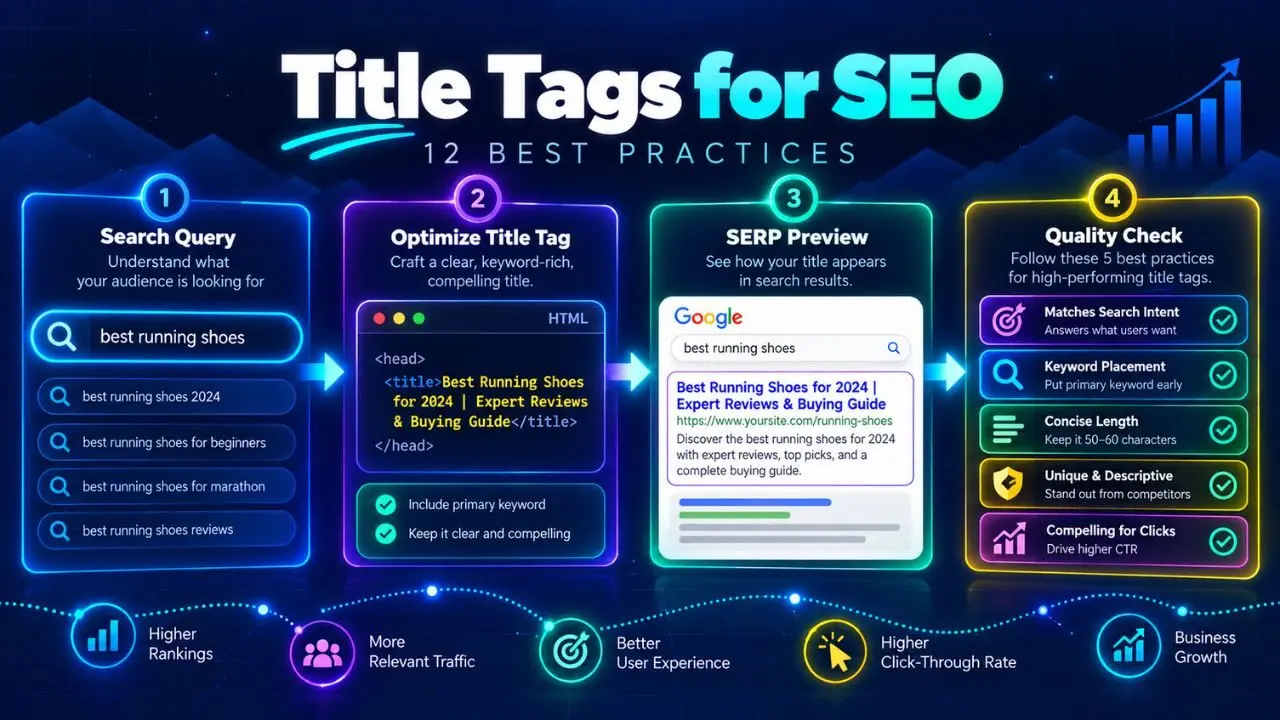
A title tag is an HTML element that defines the title of a web page.
In HTML, it looks like:
<title>Title Tags for SEO: 12 Best Practices</title>It normally appears inside the <head> section of the page.
The title tag can be used by browsers, search engines, social platforms, and other systems as a description of the page’s title.
In search results, Google may use the title tag as the basis for the visible result title, although it can choose other text when it believes another title better represents the page.
That distinction matters:
The title tag you write is an important signal, but it does not guarantee the exact text searchers will always see.
Why Title Tags Matter for SEO
Title tags matter because they help connect three things:
Page → Query → Searcher
A strong title makes the relationship clear.
For example:
Weak
SEO Guide
Better
SEO Audit: 12 Steps to Find and Fix SEO Problems
The second title gives the user much more information.
It communicates:
- the topic
- the format
- the benefit
- the scope
That clarity helps both search engines and users understand what the page is trying to satisfy.
Title Tags Can Influence Click-Through Rate
Suppose two results rank next to each other.
Result A
Keyword Research
Result B
Keyword Research Process: 12 Steps for Better SEO
Both may be relevant.
The second gives the user more context before the click.
A more descriptive title can improve click appeal when it accurately reflects the page.
However, click-through rate should never be manipulated with misleading promises.
The title must match the content.
Title Tags Help Define Page Ownership
A good title can also reinforce the unique purpose of each URL.
For example:
Keyword Clustering: How to Group Keywords by IntentKeyword Mapping: How to Match Keywords With Pages
These two topics are related.
Their titles make the distinction clear.
That supports the keyword ownership system you have been building throughout your Keyword Research workflow.
Title Tag vs H1
The title tag and H1 are related, but they are not the same thing.
Title Tag
Used primarily in:
- browser tabs
- search result presentation
- page metadata
H1
Visible on the page as the main heading.
They can be identical.
They do not have to be.
For example:
Title Tag
Title Tags for SEO: 12 Best Practices
H1
Title Tags for SEO: 12 Best Practices to Improve Rankings and Clicks
This can work well because the search title is concise while the on-page heading can provide more context.
Do not create large differences between the two unless there is a clear reason.
Both should describe the same page.
Title Tag vs Meta Description
These two elements often appear together in search results, but they have different roles.
Title Tag
Communicates the main page topic.
Meta Description
Provides a short summary or reason to click.
For example:
Title
Keyword Mapping: 12 Steps to Match Keywords With Pages
Meta Description
Learn how to assign keyword clusters to the right URLs, prevent cannibalization and build cleaner SEO architecture.
The title attracts attention.
The description provides additional context.
The next article in this series will cover meta descriptions in detail.
12 Title Tag SEO Best Practices
1. Match the Search Intent
The title should reflect what the searcher expects.
For example:
Informational Query
how to write title tags
A suitable title:
How to Write Title Tags for SEO: 12 Best Practices
Commercial Query
best SEO tools
A suitable title:
12 Best SEO Tools for Keyword Research, Audits and Tracking
The title should align with the page type.
If the SERP favors comparison pages, a basic definition title may not match the intent.
Your Search Intent guide explains how to classify these needs.
2. Put the Main Topic Early
In many cases, placing the primary topic near the beginning makes the title clearer.
For example:
Better
Title Tags for SEO: 12 Best Practices
Weaker
12 Important Things You Should Know About Writing Better Title Tags for SEO
The first is more direct.
Users can immediately understand the subject.
Do not force exact-match wording if it makes the title unnatural.
Clarity comes first.
3. Make Every Important Page Title Unique
Avoid using the same or nearly identical title tag across multiple URLs.
For example:
Page A
SEO Services | Brand
Page B
SEO Services | Brand
Page C
SEO Services | Brand
If these pages serve different purposes, their titles should show the difference.
For example:
Technical SEO Services | BrandLocal SEO Services | BrandEcommerce SEO Services | Brand
Unique titles support clearer page differentiation.
4. Describe the Page Accurately
The title should match the content.
Avoid titles such as:
Complete SEO Guide
if the page only explains one small aspect of SEO.
Likewise, do not write:
Best SEO Tools
if the page only discusses one product.
Accuracy protects:
- user trust
- search intent alignment
- editorial quality
A title is a promise.
The content should deliver it.
5. Keep the Title Concise
There is no single perfect character count that guarantees how a title will display.
Search engines can truncate titles depending on:
- device
- available display width
- characters used
- query context
A practical approach is to keep titles concise enough to communicate the main value quickly.
For many pages, somewhere around 50–60 characters can be a useful editorial target, but do not treat that as a strict search-engine rule.
A slightly longer title can still be appropriate if it is clear and useful.
6. Avoid Keyword Stuffing
A title such as:
SEO Title Tags | Title Tags SEO | Best SEO Title Tags Guide
is not better optimized.
It is repetitive and difficult to read.
A stronger version is:
Title Tags for SEO: 12 Best Practices
Use the primary phrase naturally.
Do not repeat synonyms just to increase keyword density.
7. Use Specificity Where It Helps
Specific titles are often more useful than vague ones.
For example:
Vague
Keyword Research Guide
Specific
Keyword Research Process: 12 Steps for Better SEO
Specificity can come from:
- number of steps
- audience
- outcome
- format
- use case
Do not add a number unless the content genuinely supports it.
8. Use Brand Names Strategically
Branding can be useful, especially on:
- homepages
- product pages
- company pages
- high-trust commercial pages
For example:
SEO Consulting Services | Hafiz Ahmed Zafar
But branding does not need to dominate every informational title.
For long blog titles, adding the brand at the end may create unnecessary length.
A clean approach is:
Blog Article
Keyword Difficulty: How to Judge SEO Competition
Homepage
Hafiz Ahmed Zafar | Digital Marketing & SEO
Use the brand where it adds value.
9. Avoid Boilerplate That Adds No Meaning
Large websites often append standard text to every title.
For example:
Title Tags Guide | Best Tips | Company Name | Official Site
This can become cluttered.
Boilerplate may be appropriate when it helps users identify the site.
But do not add words simply because a template requires them.
Every word should earn its place.
10. Match the Page Type
Different page types need different title approaches.
Blog Guide
Keyword Mapping: 12 Steps to Match Keywords With Pages
Product Page
Men's Waterproof Trail Running Shoes | Brand
Service Page
Technical SEO Consulting Services | Brand
Category Page
CRM Automation Guides and Tutorials
Comparison Page
Shopify vs WooCommerce: Features, Costs and Use Cases
The title should tell the user what kind of page they are about to visit.
11. Write for Humans First
A title should sound natural.
Weak:
Title Tags SEO Best Title Tag Optimization SEO Guide
Better:
Title Tags for SEO: 12 Best Practices
Search users are people.
A title that is technically optimized but difficult to understand has failed its job.
12. Test and Improve Over Time
Title tags are not permanent.
You may update them when:
- search intent changes
- the page is refreshed
- CTR is unusually weak
- the content expands
- the current title is unclear
Use Search Console to review:
- impressions
- clicks
- CTR
- average position
Your SEO Reporting guide explains how these metrics work together.
Do not change a title after a few days simply because CTR looks low.
Evaluate enough data and account for ranking position and query mix.
How Long Should a Title Tag Be?
There is no universal title tag character limit that guarantees complete display.
Search results are constrained by visual space rather than a simple SEO character rule.
Still, an editorial target can help.
A practical guideline is:
roughly 50–60 characters when possible
But this should not override clarity.
For example:
58 Characters
Keyword Mapping: 12 Steps to Match Keywords With Pages
Good.
66 Characters
International Keyword Research: 12 Steps for Global SEO Growth
Potentially still fine if the wording is useful.
Do not remove important meaning just to hit a specific number.
Title Tag Examples
SEO Article
Primary keyword: title tags SEO
Title:
Title Tags for SEO: 12 Best Practices
Local Service
Primary keyword: dentist Karachi
Title:
Dentist in Karachi: General and Cosmetic Dental Care
Ecommerce Category
Primary keyword: men’s trail running shoes
Title:
Men's Trail Running Shoes | Brand
SaaS Comparison
Primary keyword: HubSpot vs Salesforce
Title:
HubSpot vs Salesforce: Features, Pricing and Use Cases
B2B Service
Primary keyword: SaaS SEO consultant
Title:
SaaS SEO Consultant for Sustainable Organic Growth
Each title reflects a different intent and page type.
Good vs Bad Title Tags
Example 1
Bad
Best SEO SEO Guide SEO Tips SEO Strategy
Problems:
- repetition
- vague intent
- keyword stuffing
Better
SEO Strategy: 10 Steps to Build a Winning Plan
Clearer and more useful.
Example 2
Bad
Home
Problem:
The title provides almost no context.
Better
Hafiz Ahmed Zafar | Digital Marketing & SEO
The second version communicates identity and topic.
Example 3
Bad
Products
Better
CRM Automation Software for Growing Agencies | Brand
The second title defines the product category and audience.
Why Google May Rewrite a Title
You may write one title tag and see a different title in search results.
Possible reasons can include:
- the original title is excessively long
- the title is repetitive
- boilerplate dominates it
- the title does not represent the page well
- another visible heading better describes the result
- the query context makes another version more useful
Google may use information such as:
- the title element
- visible page headings
- prominent page text
- anchor text
- other signals
This means title optimization should focus on consistency.
Your:
- title tag
- H1
- page topic
- internal anchors
should all describe the page clearly.
Does Google Rewriting a Title Mean the Original Is Bad?
Not necessarily.
Title generation can vary by query.
One page may be shown differently depending on what the user searched.
However, frequent rewrites can be a reason to review whether the title is:
- vague
- overly long
- repetitive
- mismatched with the page
Do not panic after seeing one variation.
Look for patterns.
Title Tags and Search Intent
Suppose the keyword is:
keyword research process
The current SERP may favor:
- workflows
- step-by-step guides
- tutorials
A title like:
What Is Keyword Research?
may be too broad.
A stronger match is:
Keyword Research Process: 12 Steps for Better SEO
Your title should communicate the intent and format that the page actually delivers.
Title Tags and Keyword Mapping
Keyword mapping makes title optimization easier.
When every URL has:
- one primary keyword
- one clear intent
- one page type
the title can reflect that ownership.
For example:
URL
/seo/title-tags/
Primary Keyword
title tags SEO
Title
Title Tags for SEO: 12 Best Practices
Your Keyword Mapping guide explains how this ownership system prevents overlapping pages.
Title Tags and Keyword Cannibalization
Titles can reveal cannibalization problems.
Imagine three pages:
SEO Audit GuideComplete SEO Audit GuideHow to Do an SEO Audit
If all three serve the same intent, changing titles alone will not solve the underlying overlap.
You may need to:
- consolidate
- redirect
- reposition
Title differentiation should reflect real content differentiation.
Title Tags for Blog Posts
Blog titles usually work well when they combine:
Topic + Value Proposition
For example:
SERP Analysis: 12 Steps to Understand Search Results
Other useful patterns include:
How-To
How to Build a Keyword Map for SEO
Numbered
12 Title Tag Best Practices for SEO
Definition + Benefit
Keyword Clustering: How to Group Keywords by Search Intent
Do not make every article title follow exactly the same formula.
Variety can improve readability across the site.
Title Tags for Ecommerce
Ecommerce titles should prioritize useful product information.
A category title could include:
- product type
- audience
- important attribute
- brand
Example:
Women's Waterproof Hiking Boots | Brand
Product titles may use:
Product Name + Main Attribute + Brand
Avoid stuffing every product variation into the title.
Title Tags for SaaS
SaaS sites may need titles for:
- homepage
- feature pages
- integration pages
- comparison pages
- use cases
Examples:
Feature
CRM Workflow Automation Software | Brand
Integration
CRM + WhatsApp Integration | Brand
Use Case
CRM for Digital Agencies | Brand
Each title should clearly describe the page’s role.
Title Tags for Local SEO
Local pages often need:
Service + Location
Example:
SEO Consultant in Karachi | Hafiz Ahmed Zafar
But only use locations when the page genuinely serves that place.
Do not insert multiple cities into one title simply to rank everywhere.
Weak:
SEO Consultant Karachi Lahore Islamabad Dubai UAE
Better:
SEO Consultant in Karachi | Brand
A focused page is easier to understand.
Title Tags for International SEO
Title terminology should reflect the target market.
For example, an ecommerce title might use:
US
sneakers
UK
trainers
Your International Keyword Research guide explains why search language should be researched locally rather than translated mechanically.
Title Tags and Numbers
Numbers can help when they reflect the real content.
Example:
12 Title Tag Best Practices
The user immediately knows the format.
But adding:
7 Secrets
to a page with no meaningful seven-part structure is unnecessary.
Use numbers when they make the content easier to understand.
Title Tags and Dates
Dates can be useful for time-sensitive content.
For example:
SEO Statistics 2026
But dates create maintenance obligations.
If you use a year in the title, the article should actually be reviewed and updated appropriately.
Do not automatically add the current year to evergreen articles just to make them look fresh.
Title Tags and CTR
A page may have strong rankings but weak CTR.
For example:
- position: 4
- impressions: high
- CTR: lower than expected
The title may be one factor.
But do not assume it is the only cause.
CTR can also be affected by:
- SERP features
- brand familiarity
- ads
- query mix
- competing titles
Use your SERP Analysis guide to understand the full click environment.
How to Test Title Tags
Title testing should be controlled.
Step 1
Identify a page with sufficient impressions.
Step 2
Document the current:
- title
- clicks
- CTR
- rankings
Step 3
Change one meaningful variable.
For example:
Before
SEO Audit Guide
After
SEO Audit: 12 Steps to Find and Fix SEO Problems
Step 4
Allow enough time for meaningful data.
Step 5
Compare:
- CTR
- position
- clicks
- conversions
Be careful interpreting results if ranking position changes significantly during the test.
How Often Should You Rewrite Title Tags?
Do not change them routinely without evidence.
Review titles when:
- page purpose changes
- content is refreshed
- search intent shifts
- CTR is persistently weak
- titles are duplicated
- the current title is misleading
Stable, accurate titles do not need constant rewriting.
How to Audit Title Tags
A title-tag audit can classify pages into several groups.
Missing
No useful title exists.
Duplicate
Multiple URLs use the same title.
Too Generic
Examples:
- Home
- Blog
- Products
Keyword Stuffed
Unnatural repetition.
Intent Mismatch
Title does not represent what the page delivers.
Outdated
Contains old years or information.
Good
Unique, clear, relevant, accurate.
This gives you an actionable optimization list.
Programmatic Title Tags
Large websites often generate titles from templates.
For example:
[Product Name] | [Category] | [Brand]
or:
[Service] in [Location] | [Brand]
Templates can work well.
But they need quality controls.
Watch for:
- missing values
- awkward repetition
- duplicate titles
- overly long output
Programmatic generation should still create useful human-readable titles.
Title Tag Workflow for WordPress
In WordPress, the title may be generated by:
- WordPress itself
- theme templates
- SEO plugins
- custom code
In your Hafiz SEO workflow, enter the optimized SEO title in the SEO title field rather than relying only on the WordPress post title when you want them to differ.
For this article:
WordPress H1
Title Tags for SEO: 12 Best Practices to Improve Rankings and Clicks
SEO Title
Title Tags for SEO: 12 Best Practices
That gives you a concise search title and a more descriptive on-page heading.
Title Tags and Social Titles
Social titles do not always need to be identical to SEO titles.
For example:
SEO
Title Tags for SEO: 12 Best Practices
Are Your Title Tags Costing You Organic Clicks?
The SEO title serves search intent.
Social copy can emphasize curiosity or discussion.
However, both should remain accurate.
Title Tag Optimization Checklist
Before publishing, check:
Relevance
- Does the title accurately describe the page?
- Does it match search intent?
Keyword
- Is the primary topic clear?
- Is it used naturally?
Uniqueness
- Does another page have the same title?
- Does another URL target the same intent?
Clarity
- Can a user immediately understand the topic?
- Is unnecessary wording removed?
Length
- Is the important information early?
- Is the title reasonably concise?
Click Appeal
- Does the title provide a useful reason to choose the result?
- Is the promise accurate?
Branding
- Is the brand included only when useful?
Page Alignment
- Does the H1 support the same topic?
- Does the page deliver what the title promises?
Common Title Tag Mistakes
Stuffing Keywords
More repetitions do not create better optimization.
Using the Same Title Everywhere
Important pages need unique titles.
Writing for Bots Instead of Users
Titles should be understandable.
Ignoring Search Intent
A good phrase in the wrong format can still fail.
Using Vague Titles
Services tells searchers very little.
Making Unsupported Claims
Avoid words such as “best” unless the page genuinely supports that comparison.
Adding the Year Automatically
Only use dates when freshness actually matters.
Ignoring Existing Rankings
Do not casually rewrite titles on successful pages.
Treating 60 Characters as a Hard Rule
Display is not controlled by one fixed character count.
Forgetting the H1
The title tag and visible heading should support the same page purpose.
FAQ
Are title tags a ranking factor?
Title tags help search engines and users understand page content and are an important on-page SEO element. They should be optimized for relevance and clarity rather than treated as a place to stuff keywords.
Should the keyword be first in the title?
Not necessarily.
Putting the main topic early can improve clarity, but natural language and intent matter more than forcing the exact phrase into the first position.
Can the title tag and H1 be different?
Yes.
They can differ while describing the same topic.
The title tag may be shorter for search presentation, while the H1 can provide more context.
Why is Google showing a different title?
Search engines can generate alternative title links using the title element and other visible or contextual signals when they believe another version better represents the page for a query.
Should every page have a unique title?
Important indexable pages should generally have titles that clearly distinguish their purpose.
If many pages share the same title, review whether they genuinely need separate URLs.
How often should title tags be updated?
Update them when there is a strategic reason, such as:
- content changes
- search intent changes
- duplicate titles
- persistent CTR weakness
- inaccurate wording
Avoid unnecessary constant changes.
Final Thoughts
Title tags are simple in code but strategic in practice.
A strong title connects:
Keyword → Search Intent → Page → User
The most effective titles are:
- relevant
- clear
- unique
- specific
- concise
- naturally written
- aligned with the page
Do not optimize title tags by counting keywords.
Optimize them by asking:
If a searcher sees this title beside competing results, will they immediately understand what this page offers—and will the page actually deliver it?
That principle works for:
- blog articles
- service pages
- ecommerce categories
- SaaS pages
- local landing pages
Title optimization is also only one part of search-result presentation.
The next article in the On-Page and Content SEO pillar covers the supporting text that can influence how your result is understood and clicked: meta descriptions.