
A meta description may never appear visibly inside the main content of your page.
Yet it can influence one of the most important moments in organic search:
the decision to click.
When someone searches Google, they may see:
- your page title
- your URL or breadcrumb
- a descriptive snippet
The text beneath the title helps searchers understand what they may find after clicking.
Sometimes that text comes from your meta description.
Sometimes Google creates a different snippet using the page content.
This means meta-description optimization should not be approached as:
Write 155 characters, insert the keyword, and forget about it.
A better approach is:
Write a clear, accurate and persuasive description of the page while ensuring the page itself contains strong content Google can use when generating query-specific snippets.
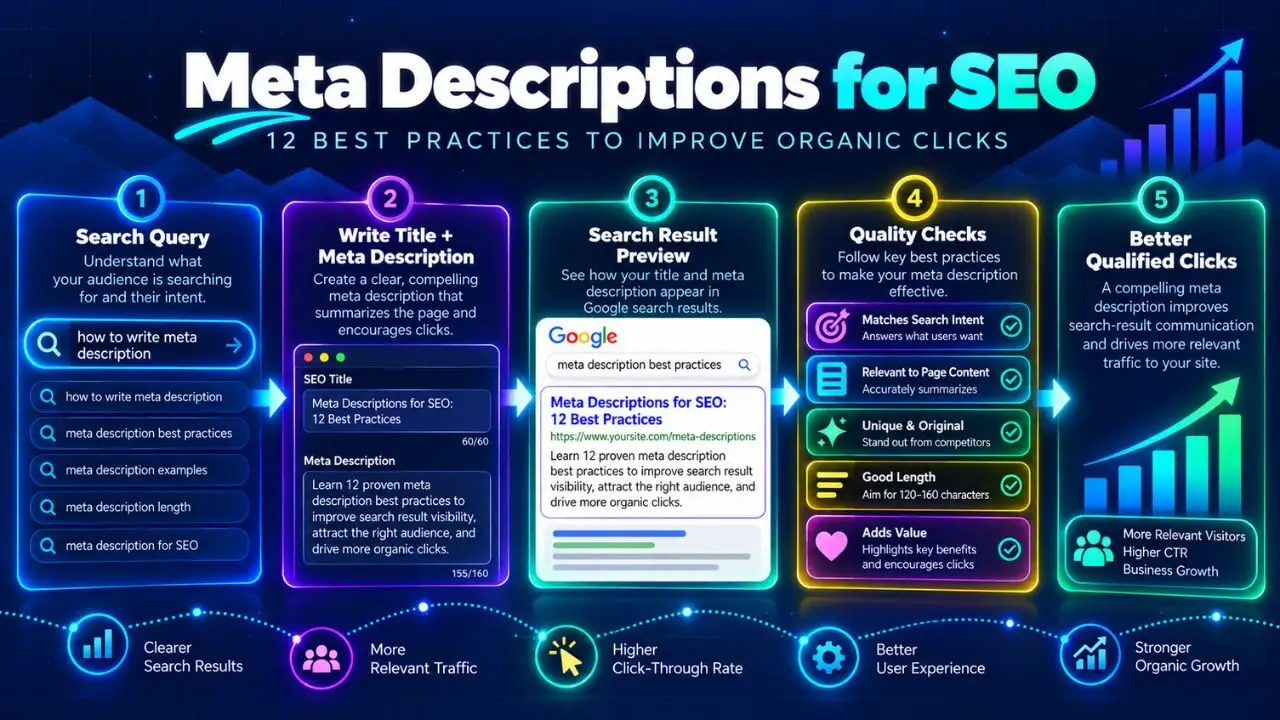
Good meta descriptions for SEO help connect:
Search Query → Search Intent → Search Result → Page
They can make a result clearer, communicate value and encourage qualified searchers to choose your page.
This guide explains what meta descriptions are, whether they affect rankings, how long they should be, why Google may rewrite them, how to write them for different page types and how to measure whether your descriptions are helping organic performance.
What Is a Meta Description?
A meta description is an HTML element that provides a short summary of a web page.
It usually appears inside the <head> section of the page.
Example:
<meta
  name="description"
  content="Learn how to write meta descriptions for SEO, improve search-result clarity, increase organic clicks and avoid common optimization mistakes."
>
The description itself is normally not displayed as visible body content.
Instead, search engines and other systems can use it to understand or present information about the page.
Google explains that search-result snippets are primarily generated from page content, but the meta description may be used when it provides a more accurate description of the page.
That distinction is essential.
You can write a meta description.
You cannot guarantee that Google will always display it exactly as written.
What Does a Meta Description Look Like in Search Results?
A traditional organic result may contain:
Title
Title Tags for SEO: 12 Best Practices
URL
hafizahmedzafar.com/seo/title-tags/
Snippet
Learn how to write and optimize SEO title tags, match search intent, improve click appeal and avoid common title-tag mistakes.
The descriptive portion is the snippet.
That snippet may come from:
- your meta description
- relevant on-page text
- other page content Google believes better matches the query
Google can therefore show different snippets for the same page depending on what the user searched.
Are Meta Descriptions a Ranking Factor?
Meta descriptions should not be treated as a place to manipulate rankings through keyword repetition.
Their practical SEO value is mainly connected with search-result communication and click appeal.
A strong description can help the searcher understand:
- what the page covers
- whether it matches their intent
- what they may gain by visiting
- whether the result is relevant enough to click
Think of the meta description as part of your search-result presentation, not as a keyword-density field.
That means this is usually a poor approach:
SEO meta descriptions, meta description SEO, best meta description SEO tips and SEO meta tags.
A better description would be:
Learn how to write useful meta descriptions for SEO, including ideal structure, keyword use, Google rewrites, CTR analysis and common mistakes.
The second version communicates value to a person.
That is the objective.
Meta Description vs Search Snippet
These terms are related but not identical.
Meta Description
The description you provide in the HTML.
Search Snippet
The descriptive text the search engine actually displays.
Sometimes they match.
Sometimes they do not.
Google says snippets are automatically created to preview the page content most relevant to a user’s search and may differ across queries.
This means a useful SEO workflow should optimize both:
Meta Description + On-Page Content
If the page itself is weak or unclear, the description alone cannot solve the problem.
Meta Description vs Title Tag
The previous guide covered title tags.
The title and description have different responsibilities.
Title Tag
Communicates the main topic quickly.
Example:
Meta Descriptions for SEO: 12 Best Practices
Meta Description
Adds context and value.
Example:
Learn how to write useful SEO meta descriptions, understand Google snippet rewrites, improve organic clicks and avoid common optimization mistakes.
A useful way to think about the relationship is:
Title = What is this?
Description = Why might this result help me?
They should support each other without simply repeating the same sentence.
12 Meta Description SEO Best Practices
1. Match the Search Intent
Start with the user’s goal.
Imagine the query:
how to write meta descriptions
The user probably wants:
- guidance
- examples
- a process
- best practices
A useful description might be:
Learn how to write effective SEO meta descriptions with practical examples, length guidance, keyword tips and common mistakes to avoid.
Now consider:
SEO audit service
That search may be commercial.
The description should reflect:
- the service
- the audience
- the outcome
Intent comes before clever copywriting.
Your Search Intent guide explains how to identify the user’s underlying goal.
2. Describe the Actual Page
Your meta description should accurately summarize the content.
Avoid promising:
The ultimate guide to everything you need to know about SEO.
if the page only covers title tags.
A better description would be:
Learn 12 title-tag SEO best practices covering search intent, keyword placement, uniqueness, Google rewrites and organic CTR testing.
A search snippet is a preview.
The page should deliver what the preview promises.
3. Make Important Pages Unique
Google recommends creating unique descriptions for individual pages where possible.
Imagine 100 service pages using:
We provide high-quality professional services. Contact us today to learn more.
That tells the user almost nothing about the individual page.
Instead:
Technical SEO
Get technical SEO support for crawling, indexing, site architecture, redirects, Core Web Vitals and other technical search issues.
Local SEO
Improve local visibility with Google Business Profile optimization, local landing pages, citation management and review strategy.
The descriptions clarify the difference between the pages.
4. Put the Main Value Early
Important information should not be buried at the end.
Weak:
There are many things to understand about this topic and in this detailed article we will look at many concepts, including meta descriptions.
Better:
Learn how to write meta descriptions for SEO, understand Google snippet rewrites and improve search-result click appeal.
The second version establishes relevance immediately.
5. Use the Primary Keyword Naturally
Including the main topic can make the description clearer.
For this page:
meta descriptions SEO
does not need to be repeated mechanically.
A natural version is:
Learn how to optimize meta descriptions for SEO using better summaries, natural keywords, search intent and CTR analysis.
Keyword presence should improve clarity.
It should never make the copy awkward.
6. Keep the Description Concise
Google says there is no fixed limit on meta-description length, but snippets may be truncated as needed to fit the device.
For editorial purposes, many SEO teams aim for roughly:
140–160 characters
because that often encourages concise writing.
However, this is not a guaranteed display limit.
Treat it as a writing target rather than a search-engine rule.
A slightly longer description can still be valid.
What matters most is that the useful information appears early.
7. Give the Searcher a Reason to Click
A description should communicate value.
Weak:
This page is about keyword mapping and contains information about keyword mapping.
Better:
Learn how to map keyword clusters to the right URLs, prevent cannibalization and organize a scalable SEO content architecture.
The second version explains the benefit.
Useful value propositions may include:
- learn a process
- compare options
- solve a problem
- access a template
- understand pricing
- evaluate a product
- complete a task
Avoid exaggerated language.
8. Use Action Language Where Appropriate
Useful verbs can help descriptions feel purposeful.
Examples:
- Learn
- Compare
- Discover
- Understand
- Build
- Improve
- Find
- Analyze
For example:
Discover 12 practical ways to identify content gaps, compare competitors and prioritize new SEO opportunities.
This is clearer than:
Information about content gap analysis can be found on this page.
Do not turn every description into aggressive marketing copy.
The tone should match the page.
9. Do Not Stuff Keywords
Google specifically warns against descriptions that are simply long strings of keywords because they do not clearly describe the page and are less likely to be useful as snippets.
Bad:
SEO services, SEO consultant, SEO expert, SEO specialist, SEO agency, search optimization services.
Better:
Get practical SEO consulting focused on technical issues, content strategy, keyword research and sustainable organic growth.
The second description is written for a person.
10. Avoid Duplicating the Title
Your description should add information.
Title
SERP Analysis: 12 Steps to Analyze Search Results
Weak Description
SERP Analysis: 12 Steps to Analyze Search Results.
Nothing new is added.
Better
Learn how to identify search intent, evaluate ranking pages, inspect SERP features and decide whether an SEO keyword is worth targeting.
Now the two elements work together.
11. Adapt Descriptions to Page Type
Different pages need different information.
Blog Article
Emphasize:
- what will be learned
- process
- examples
Ecommerce Product
Emphasize:
- product
- important attributes
- availability or relevant purchasing information where appropriate
Category
Clarify:
- product range
- audience
- important attributes
Service Page
Communicate:
- service
- audience
- outcome
SaaS Page
Focus on:
- feature
- use case
- benefit
The description should reflect the page’s actual job.
12. Measure and Improve
Do not assume every description is optimal forever.
Use Search Console to review:
- impressions
- clicks
- CTR
- average position
- queries
Your SEO Reporting guide explains how to interpret these metrics together.
A high-impression page with weak CTR may deserve closer review.
But the description is only one possible factor.
Other influences include:
- ranking position
- title
- brand recognition
- SERP features
- search intent
- query mix
Test carefully.
How Long Should a Meta Description Be?
There is no universal SEO character limit.
Google’s official guidance says meta descriptions have no fixed length limit and search snippets are truncated as needed, typically based on device width.
That means:
155 characters is not a law.
Still, a practical editorial range can help.
I generally recommend:
around 140–160 characters for standard pages
because it encourages:
- concise copy
- early relevance
- clear value
The most important rule is:
Put the main information early enough that truncation does not destroy the meaning.
Examples of Good Meta Descriptions
SEO Guide
Page: Keyword Mapping
Learn how to map keyword clusters to the right URLs, prevent cannibalization, plan internal links and build clearer SEO architecture.
Local Service
Page: SEO Consultant in Karachi
SEO consulting for businesses in Karachi focused on technical SEO, content strategy, keyword research and measurable organic growth.
SaaS
Page: CRM Automation
Automate lead follow-ups, sales tasks and customer workflows with CRM automation designed to reduce manual work and improve response times.
Ecommerce Category
Page: Men’s Waterproof Hiking Boots
Shop waterproof hiking boots for men with options designed for wet trails, outdoor travel and everyday hiking.
Comparison
Page: Shopify vs WooCommerce
Compare Shopify and WooCommerce across pricing, flexibility, hosting, ease of use and ecommerce features to decide which platform fits your business.
Each description supports a different search intent.
Good vs Bad Meta Description Examples
Example 1: Keyword Stuffing
Bad
Keyword research SEO, SEO keyword research, keyword tools, keyword research tools, SEO keywords, keyword strategy.
Better
Learn a repeatable keyword research process covering discovery, metrics, search intent, SERP analysis, clustering and keyword mapping.
Example 2: Too Generic
Bad
Learn more about our services today.
Better
Explore technical SEO consulting for crawling, indexing, site architecture, redirects, performance and other technical search issues.
Example 3: Meaningless Marketing Language
Bad
We are the best and most amazing company delivering world-class solutions for all your needs.
Better
CRM implementation and automation for agencies that need organized pipelines, lead follow-up and clearer sales workflows.
Specific information is more useful than empty superlatives.
Why Does Google Rewrite Meta Descriptions?
Google can generate a different snippet when page content better matches the user’s specific query.
Google explicitly says snippets are primarily created from page content and that different searches can trigger different snippets for the same page.
That means rewrites are normal.
Possible situations include:
- another paragraph better matches the query
- the description is too generic
- the description does not reflect the page
- Google identifies more relevant page text
- different queries require different previews
You should therefore not treat every rewrite as an SEO problem.
How to Reduce Unhelpful Meta Description Rewrites
You cannot force Google to use your description.
You can improve the chances that it remains useful.
Focus on:
Accuracy
Summarize the page honestly.
Specificity
Avoid generic copy.
Query Relevance
Reflect the page’s main search intent.
Page Alignment
Make sure the body content supports the same promise.
Quality
Avoid keyword strings or boilerplate.
Google’s own guidance emphasizes unique, descriptive and page-specific descriptions.
Should You Include the Keyword in a Meta Description?
Usually, yes—when natural.
For example:
Primary query:
meta descriptions SEO
A natural phrase would be:
Learn how to optimize meta descriptions for SEO…
That immediately signals relevance.
But there is no need to write:
Meta descriptions SEO guide for meta descriptions SEO optimization…
The goal is clarity.
Should Every Page Have a Meta Description?
For important indexable pages, creating a useful description is a strong editorial practice.
Priority pages include:
- homepage
- major service pages
- important blog articles
- key product categories
- high-traffic pages
Google also notes that large database-driven sites may use programmatically generated descriptions when hand-writing every one is impractical, provided the generated descriptions remain useful, human-readable and page-specific.
Programmatic Meta Descriptions
Large ecommerce or directory sites may have thousands or millions of URLs.
A useful template might be:
Shop [Product Type] from [Brand/Category]. Compare [Key Attributes] and find options for [Audience/Use Case].
The template should draw from page-specific data.
Bad programmatic output:
Buy product product product online. Best product online.
Better:
Shop men’s waterproof trail running shoes with options for wet terrain, long-distance running and technical trails.
Automation should create natural descriptions.
Meta Descriptions for Blog Posts
Blog descriptions should answer:
What will the reader learn?
For example:
Title
Content Gap Analysis: 12 Steps to Find SEO Opportunities
Description
Learn how to identify missing SEO topics, keyword gaps, search-intent opportunities and weak existing pages, then prioritize what to create or improve.
Useful blog descriptions often mention:
- the problem
- the process
- the outcome
Meta Descriptions for Ecommerce
Ecommerce descriptions can highlight:
- product type
- important attributes
- major buying information
For example:
Shop lightweight waterproof hiking jackets for men with breathable options designed for wet-weather trails and outdoor travel.
Avoid repeating dozens of product keywords.
Meta Descriptions for SaaS
SaaS descriptions can explain:
Feature + Outcome + Audience
Example:
Automate lead follow-ups, pipeline tasks and customer communications with CRM workflows built for growing sales teams.
This is stronger than:
Best CRM automation software online.
Meta Descriptions for Local SEO
Local service descriptions should be specific and truthful.
Example:
SEO consulting for businesses in Karachi covering technical SEO, local search, content strategy and organic performance measurement.
Avoid stuffing multiple locations:
Karachi Lahore Islamabad Dubai London SEO consultant.
If separate locations genuinely require separate pages, map them properly.
Meta Descriptions for International SEO
Descriptions should reflect:
- local vocabulary
- language
- market expectations
Do not mechanically translate the domestic description.
Your International Keyword Research guide explains why language and search behavior need local validation.
Meta Descriptions and Keyword Mapping
Keyword mapping makes description writing easier.
When each page has:
- one primary topic
- clear intent
- defined URL ownership
the description can summarize that purpose accurately.
Example:
Page
/seo/meta-descriptions/
Owner
meta descriptions
Intent
Informational
Description
Learn how to write meta descriptions for SEO, understand Google snippet rewrites, improve search-result clarity and avoid common mistakes.
Your Keyword Mapping guide explains why this one-owner system also reduces content overlap.
Meta Descriptions and Cannibalization
Descriptions can reveal overlapping pages.
Suppose you have:
Page A
Learn how to write meta descriptions for SEO…
Page B
Complete guide to writing SEO meta descriptions…
Page C
SEO meta description best practices…
If all three pages serve the same search intent, rewriting their descriptions will not fix the deeper issue.
You may need to:
- consolidate
- reposition
- redirect
Meta descriptions reflect architecture.
They do not replace it.
Meta Descriptions and Search Intent
Consider:
best keyword research tools
A useful description might be:
Compare keyword research tools across discovery, search-volume data, competitor research, clustering and pricing to find the right platform.
Now consider:
what is keyword research
The description should instead be educational.
Learn what keyword research is, how it works and how to find, evaluate and organize keywords for an SEO strategy.
Same broad topic.
Different search intent.
Different description.
Meta Descriptions and CTR
A description can influence click appeal.
But CTR analysis must include context.
Suppose:
- position: 3
- impressions: 20,000
- CTR: 2%
That might appear weak.
But perhaps the SERP contains:
- ads
- videos
- shopping
- direct answers
- strong brands
Before rewriting the description, inspect the actual results using the process in your SERP Analysis guide.
How to Test Meta Descriptions
A simple testing workflow is:
Step 1: Select a Suitable Page
Choose one with enough impressions.
Step 2: Record the Baseline
Document:
- current description
- impressions
- clicks
- CTR
- average position
Step 3: Identify the Problem
For example:
- vague wording
- weak value proposition
- intent mismatch
Step 4: Rewrite the Description
Change it meaningfully.
Before
Learn more about keyword research.
After
Learn a 12-step keyword research process covering discovery, intent, SERP analysis, clustering, URL mapping and performance measurement.
Step 5: Monitor Results
Compare over a reasonable period.
Step 6: Interpret Carefully
CTR can change because of:
- rankings
- SERP layout
- seasonality
- query mix
Do not attribute every change to the description.
How to Audit Meta Descriptions
A useful audit can classify descriptions as:
Missing
No description supplied.
Duplicate
Same description across multiple pages.
Generic
Does not explain the page.
Keyword Stuffed
Reads like a keyword list.
Misaligned
Does not match search intent.
Outdated
Contains old information.
Strong
Unique, accurate and useful.
This converts an SEO crawl into an actionable editorial workflow.
Meta Description Workflow in WordPress
In WordPress, the description may be managed through:
- an SEO plugin
- custom theme fields
- custom code
For your Hafiz SEO setup, enter the description in the dedicated Meta Description field.
For this article, use:
Learn 12 meta description SEO best practices covering length, keywords, Google snippet rewrites, unique descriptions, CTR analysis and common mistakes.
Do not paste the article introduction into the meta field automatically.
Write a dedicated search-result summary.
Meta Descriptions and Social Descriptions
Your Open Graph description does not have to be identical to your SEO meta description.
SEO
Learn 12 meta description SEO best practices covering length, keywords, Google snippet rewrites, CTR analysis and common mistakes.
Social
Your meta description may be only a short piece of text, but it can influence whether a searcher chooses your result. Learn how to write better ones.
Search and social distribution have different contexts.
Meta Description Optimization Checklist
Before publishing, confirm:
Relevance
- Does the description match the page?
- Does it match search intent?
Clarity
- Can a user quickly understand the page?
- Is important information near the beginning?
Uniqueness
- Is the description page-specific?
- Is unnecessary boilerplate avoided?
Keywords
- Is the primary topic included naturally?
- Is there no keyword stuffing?
Value
- Does the description explain why the page is useful?
Length
- Is it concise?
- Would the message survive truncation?
Alignment
- Does the title support the same promise?
- Does the page deliver what is described?
Measurement
- Can CTR and impressions be reviewed later?
Common Meta Description Mistakes
Treating 155 Characters as a Hard Rule
Google does not define a fixed character limit for descriptions.
Stuffing Keywords
Descriptions should summarize the page, not list search terms.
Duplicating Descriptions
Important pages should have page-specific descriptions.
Writing Generic Copy
“Learn more here” communicates little value.
Misrepresenting the Page
Do not promise information the page does not contain.
Repeating the Title
Use the description to add context.
Ignoring Search Intent
Different users need different page promises.
Panicking When Google Rewrites It
Query-specific snippet generation is normal.
Changing Successful Descriptions Constantly
Test when there is evidence of a problem.
Optimizing the Description but Ignoring the Page
Google primarily creates snippets from page content.
FAQ
What is a meta description in SEO?
A meta description is an HTML element that provides a short summary of a page. Search engines may use it when generating the descriptive snippet shown beneath a search result.
Do meta descriptions improve rankings?
They should primarily be optimized for accurate search-result communication and qualified clicks rather than keyword repetition.
How long should a meta description be?
Google does not specify a fixed character limit. Snippets may be shortened depending on device and context. Around 140–160 characters is a practical editorial target for many standard pages, not a ranking rule.
Why does Google change my meta description?
Google often creates snippets from page content and may show different snippets for different queries if another part of the page better represents what the searcher needs.
Should every page have a unique meta description?
Important indexable pages should generally have useful page-specific descriptions where practical. Google recommends unique descriptions for individual pages.
Should I include my primary keyword?
Use the main topic naturally when it helps accurately summarize the page. Do not force repetitions.
Can meta descriptions be generated automatically?
Yes. Google specifically notes that programmatic generation can be appropriate for large database-driven sites when descriptions remain accurate, readable and diverse.
Final Thoughts
Meta descriptions are not about fitting keywords into a tiny box.
Their real purpose is to communicate:
what the page contains + why it matters to the searcher
A useful optimization process is:
Search Intent → Page Purpose → Clear Summary → Relevant Value → Search Preview → Measurement
Write each important description so it is:
- accurate
- specific
- useful
- naturally worded
- aligned with the title
- aligned with the page
Then make sure the page itself contains clear, useful content because the search engine may generate the snippet from that content instead.
The strongest meta description cannot rescue a page that does not satisfy the search intent.
But when the page, title and description all tell the same clear story, the search result becomes easier to understand and more compelling for the right visitor.
The next article in the On-Page and Content SEO series covers how to organize the visible content after the user lands on the page: heading structure.