
Keyword research becomes difficult when every project starts from scratch.
You open a keyword tool.
Enter a few phrases.
Export thousands of rows.
Check search volume.
Look at competitors.
Add a few keywords to a spreadsheet.
Then eventually ask:
Which of these keywords should actually become pages?
That approach may work for a small project.
It becomes unreliable when you are managing:
- hundreds of content ideas
- multiple topic clusters
- existing rankings
- competitors
- different search intents
- international markets
- commercial pages
- internal links
A better approach is to build a repeatable keyword research process.
A keyword research workflow turns individual SEO activities into a structured system.
Instead of randomly discovering keywords and deciding what to publish later, you move through a defined sequence:
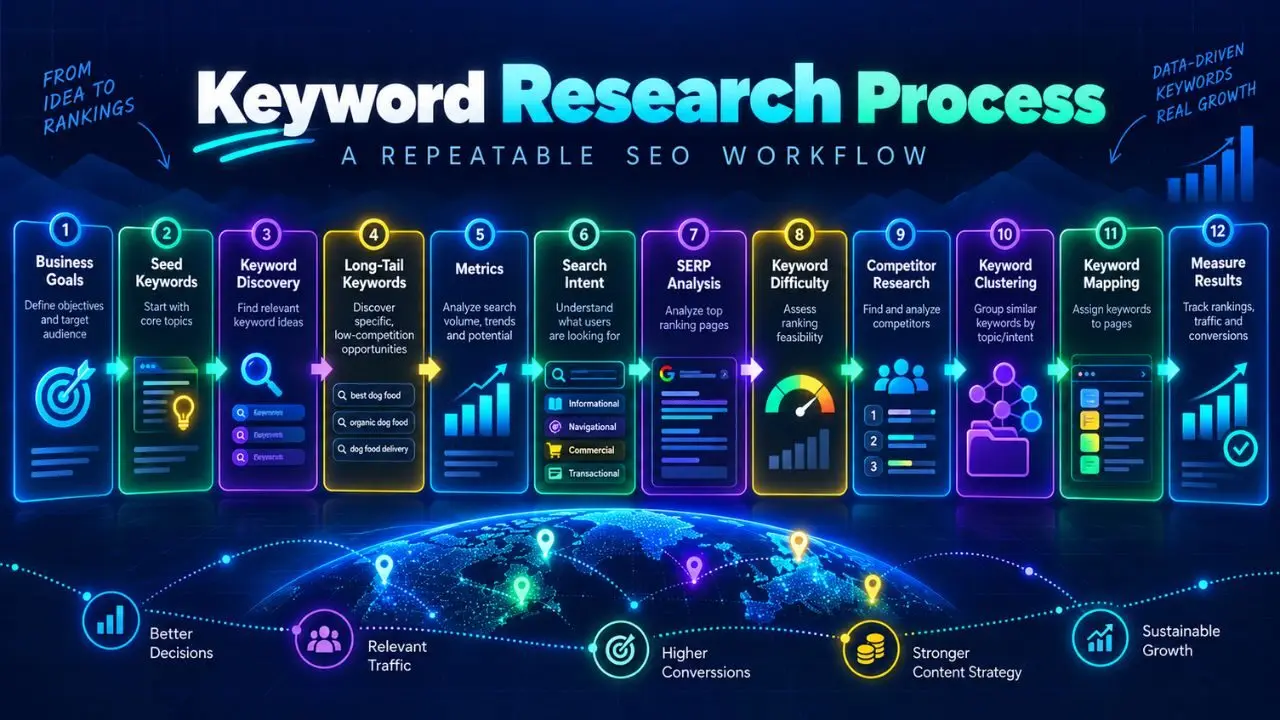
Business Goals → Seed Topics → Keyword Discovery → Metrics → Intent → SERP Analysis → Clustering → Mapping → Prioritization → Content Brief → Publishing → Measurement
Each stage answers a different question.
The goal is not to create the largest keyword list.
The goal is to build a research process that consistently identifies:
- what your audience searches for
- why they search
- which opportunities matter
- what type of page is needed
- which URL should own the intent
- what should be published first
- how results should be measured
This guide brings together the full Keyword Research pillar into one practical workflow.
What Is a Keyword Research Process?
A keyword research process is a repeatable sequence used to discover, evaluate, organize, prioritize, and map search opportunities to content or commercial pages.
It helps transform:
raw search queries
into:
clear SEO decisions
A complete process usually includes:
- defining goals
- selecting seed topics
- discovering keyword opportunities
- evaluating metrics
- identifying search intent
- analyzing SERPs
- evaluating difficulty
- clustering related queries
- studying competitors and gaps
- mapping clusters to URLs
- prioritizing opportunities
- measuring performance
The process should be documented so that another SEO professional, writer, editor, or strategist can understand how a decision was made.
Why You Need a Repeatable Keyword Research Workflow
Without a workflow, keyword research becomes inconsistent.
One article may be selected because:
it has high volume.
Another because:
a competitor published it.
Another because:
someone on the team thought it sounded useful.
Those decisions may individually be reasonable.
But they do not create a coherent strategy.
A repeatable workflow provides structure.
It Reduces Random Content Production
Every planned page should have a reason for existing.
For example:
- meaningful audience demand
- business relevance
- content gap
- cluster requirement
- commercial intent
- customer question
The workflow forces you to define that reason before publishing.
It Helps Prevent Cannibalization
If keyword discovery, clustering, and mapping are completed before content creation, you are less likely to publish several pages targeting the same intent.
It Makes Research Easier to Scale
A documented workflow can be used across:
- SEO projects
- client sites
- ecommerce stores
- SaaS businesses
- local businesses
- international campaigns
The inputs may change.
The process remains recognizable.
The Keyword Research Workflow at a Glance
A practical system can be divided into four phases.
Phase 1: Discovery
Understand the audience and collect potential search opportunities.
This includes:
- business goals
- seed keywords
- customer questions
- competitor research
- Search Console
- long-tail discovery
Phase 2: Evaluation
Determine which opportunities matter.
This includes:
- search volume
- trends
- search intent
- difficulty
- business value
- SERP analysis
Phase 3: Organization
Turn thousands of keyword rows into clear page opportunities.
This includes:
- clustering
- content gaps
- entity research
- keyword mapping
Phase 4: Execution and Measurement
Turn research into content and evaluate results.
This includes:
- prioritization
- content briefs
- internal links
- publishing
- reporting
- refreshes
This is much more useful than treating keyword research as one isolated task.
12 Steps in a Professional Keyword Research Process
Step 1: Define the Business Goal
Do not begin with the keyword tool.
Begin with the business.
Ask:
- What are we trying to achieve?
- Who is the audience?
- What products or services matter?
- Which topics should we become known for?
- What actions should organic visitors take?
Possible goals include:
- generate leads
- sell products
- build topical authority
- increase non-branded traffic
- support product adoption
- reduce dependency on paid traffic
Your SEO objective influences keyword selection.
Example
Suppose you operate a CRM business.
A generic keyword such as:
what is CRM
may generate awareness.
A query such as:
CRM for real estate agencies
may have lower volume but significantly higher commercial relevance.
Both can matter.
But they serve different goals.
Step 2: Build Your Seed Keyword List
Seed keywords define the initial research space.
They are broad terms related to:
- products
- services
- customer problems
- topics
For an SEO website, seeds might include:
- SEO
- keyword research
- technical SEO
- local SEO
- link building
For a CRM company:
- CRM
- sales automation
- lead management
- pipeline management
Your Seed Keywords guide explains how to create this starting set systematically.
Do not try to create thousands of seeds.
A focused list is enough to begin expansion.
Step 3: Expand Through Keyword Discovery
Now turn seeds into a larger opportunity set.
Use multiple sources.
Keyword Tools
Useful for:
- search volume
- related terms
- questions
- modifiers
Google Search
Look at:
- autocomplete
- related searches
- visible SERP patterns
Search Console
Useful for discovering queries where your site already receives impressions.
Customer Questions
Review:
- emails
- support tickets
- calls
- contact forms
Communities
Look at:
- industry forums
- professional groups
Competitors
Identify the queries and topics competitors already rank for.
Your Keyword Discovery guide covers these methods in more detail.
At this stage, collect broadly.
Do not over-filter too early.
Step 4: Expand Long-Tail Opportunities
Broad keywords often reveal the market.
Long-tail keywords reveal specific problems.
Suppose the seed is:
email marketing
Long-tail variations may include:
- email marketing for restaurants
- email automation for ecommerce
- email marketing for consultants
- how to write a welcome sequence
Long-tail research helps expose:
- audiences
- use cases
- pain points
- buying stages
Your Long-Tail Keywords guide explains how to expand these opportunities without assuming that every specific phrase needs its own page.
Step 5: Add Keyword Metrics
Now evaluate the dataset.
Useful metrics can include:
- search volume
- trend
- keyword difficulty
- CPC
- paid competition
- traffic potential
- current ranking
- business value
The goal is not to find one perfect number.
Metrics provide context.
Your Keyword Metrics guide explains why search volume alone is not enough.
A useful keyword may combine:
moderate demand + strong relevance + realistic competition + high business value
rather than simply having the largest volume.
Step 6: Identify Search Intent
Now determine what the user wants.
Common search intents include:
Informational
The user wants to learn.
Example:
how keyword research works
Navigational
The user wants a specific brand or destination.
Example:
Google Search Console login
Commercial Investigation
The user is evaluating options.
Example:
best keyword research tools
Transactional
The user wants to take action.
Example:
hire keyword research consultant
Search intent influences:
- page type
- content format
- conversion strategy
Your Search Intent guide provides the full framework.
Step 7: Perform SERP Analysis
Never make an important keyword decision using spreadsheet data alone.
Search the query.
Analyze:
- ranking page types
- content formats
- competitors
- SERP features
- freshness
- intent
Your SERP Analysis guide explains how to do this systematically.
Suppose the keyword is:
keyword research tools
If the results are mostly:
- tools
- comparisons
- software reviews
then a basic educational article may not satisfy the intent.
The SERP provides practical validation.
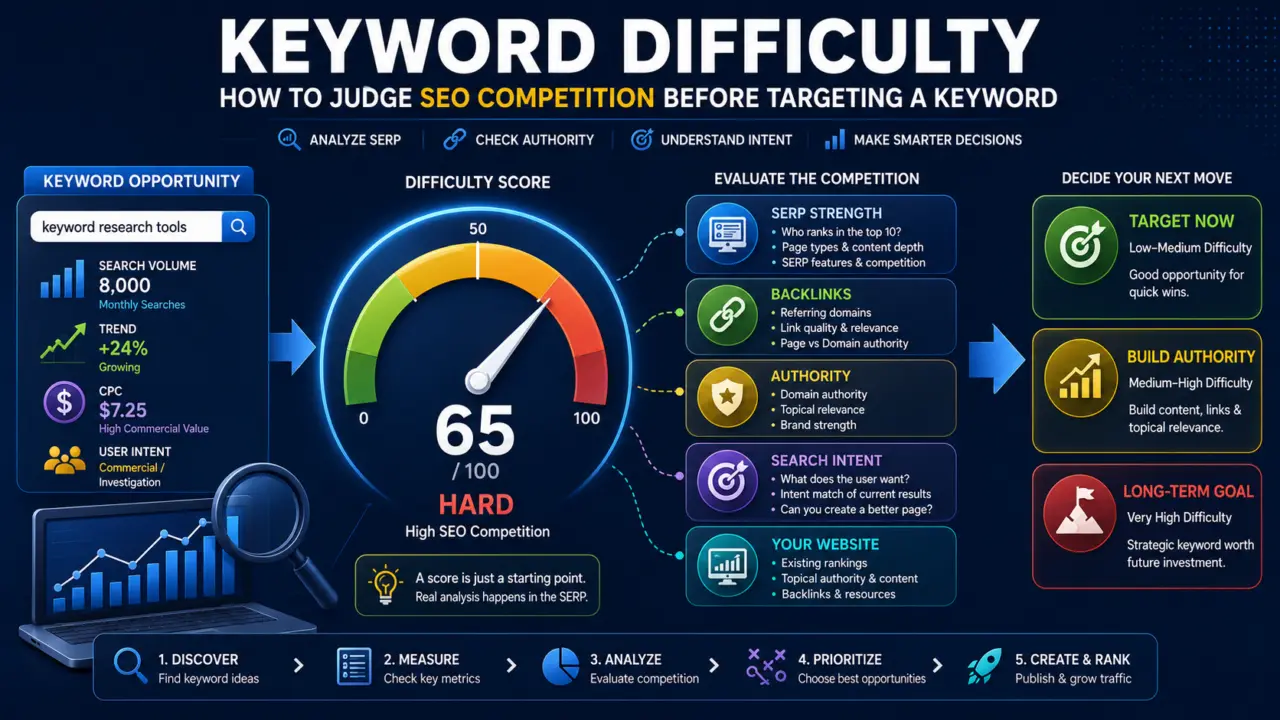
Step 8: Evaluate Keyword Difficulty
Now examine whether you can realistically compete.
Your Keyword Difficulty guide explains why a third-party difficulty score should never be the only decision criterion.
Review:
- ranking domains
- page quality
- backlinks
- topical authority
- existing rankings
- your own resources
Then classify the opportunity.
Near-Term
Realistic now.
Medium-Term
Requires more authority or supporting content.
Long-Term
Strategically valuable but highly competitive.
This is much more useful than simply filtering:
KD under 30.
Step 9: Analyze Competitors and Content Gaps
Competitors help reveal what your own research may have missed.
Your Competitor Keyword Research guide explains how to analyze:
- competing domains
- top pages
- ranking queries
- keyword gaps
Then use your Content Gap Analysis guide to classify opportunities.
Examples:
Missing
You have no relevant page.
Weak
You have a page but competitors perform much better.
Covered
The topic is already sufficiently addressed.
Irrelevant
The competitor ranks, but the topic does not support your strategy.
This prevents competitor research from turning into copying.
Step 10: Cluster Related Keywords
By now you may have thousands of phrases.
Do not create thousands of pages.
Cluster related queries according to:
- meaning
- intent
- SERP overlap
For example:
- keyword research process
- keyword research workflow
- SEO keyword research process
- keyword research steps
- how to do keyword research
These may all belong to one page.
Your Keyword Clustering guide explains how to determine when keywords belong together.
A useful rule is:
If one strong page can completely satisfy both searches, they probably belong in the same cluster.
Step 11: Map Each Cluster to a URL
Once clusters exist, assign ownership.
Your Keyword Mapping guide explains how to connect clusters with:
- existing pages
- planned pages
- page types
- internal links
For example:
Cluster
keyword research process
URL
/seo/keyword-research-workflows/
Intent
Informational
Status
Planned / Draft / Published
Each important intent should have one clear owner.
This reduces:
- duplication
- cannibalization
- publishing confusion
Step 12: Prioritize, Brief, Publish and Measure
The research is not finished when the spreadsheet is complete.
Turn the highest-value opportunities into production.
For each page, create a brief containing:
- primary keyword
- supporting terms
- search intent
- target URL
- page type
- internal links
- content requirements
- evidence requirements
Then publish.
After publishing, measure:
- impressions
- clicks
- rankings
- organic sessions
- conversions
The workflow then becomes cyclical:
Research → Publish → Measure → Learn → Refresh
Add Entity Research to the Workflow
Keywords tell you how users search.
Entities help you understand the subject itself.
For important content, use your Entity Research guide to identify:
- concepts
- technologies
- organizations
- products
- attributes
- relationships
For example:
Topic
Keyword Mapping
Relevant Entities
- keyword
- cluster
- URL
- search intent
- SERP
- internal link
- cannibalization
This helps create a stronger content brief.
Entity research should enrich the workflow—not replace keyword research.
Include Zero-Volume Opportunities
Do not automatically discard keywords reporting zero searches.
Your Zero-Volume Keywords guide explains how to validate them using:
- Search Console
- customer questions
- communities
- SERPs
- business value
Zero-volume terms should receive more validation, not automatic publication.
The workflow might classify them as:
Validated
Evidence supports the opportunity.
Supporting
Include within an existing page.
Ignore
Insufficient relevance or evidence.
Adapt the Workflow for International SEO
International research requires additional steps.
Your International Keyword Research guide explains how to incorporate:
- country
- language
- local terminology
- local SERPs
- regional competitors
A keyword workflow for international SEO may therefore become:
Market → Language → Seeds → Local Keywords → Metrics → Local Intent → Local SERP → Clustering → Localized URL
Do not simply translate a domestic keyword list.
A Realistic Keyword Research Example
Suppose you are building an SEO education website.
Business Goal
Build topical authority around Keyword Research.
Seeds
- keyword research
- SEO keywords
- search intent
Discovery
You find:
- keyword discovery
- seed keywords
- long-tail keywords
- keyword difficulty
- keyword clustering
- keyword mapping
Metrics
Some have:
- high volume
- moderate difficulty
Others have:
- low volume
- strong strategic relevance
Intent
Most are informational.
SERP Review
Each concept has distinct search results.
Clustering
You group similar query variations around each topic.
Mapping
You assign:
keyword discovery → /seo/keyword-discovery/
seed keywords → /seo/seed-keywords/
keyword clustering → /seo/keyword-clustering/
Internal Linking
You create a learning sequence.
That is exactly what transforms a keyword list into a content architecture.
A Keyword Research Spreadsheet Structure
A practical research sheet might include:
| Column | Purpose |
|---|---|
| Keyword | Search query |
| Seed Topic | Original topic |
| Country | Target market |
| Intent | Search goal |
| Search Volume | Estimated demand |
| Trend | Growing/stable/declining |
| Difficulty | Competitive estimate |
| CPC | Commercial signal |
| Current Position | Existing visibility |
| Business Value | Strategic relevance |
| Cluster | Query group |
| Primary Keyword | Cluster owner |
| Existing URL | Current page |
| Target URL | Planned owner |
| Page Type | Guide/service/product |
| Priority | Production order |
| Status | Planned/draft/published |
The purpose is not to maximize columns.
The purpose is to document decisions.
How to Prioritize Keyword Opportunities
Once everything is mapped, prioritize.
A practical framework includes:
Relevance
Does the topic matter to the audience?
Business Value
Could it contribute to meaningful outcomes?
Demand
Is there evidence of interest?
Feasibility
Can the site realistically compete?
Strategic Importance
Does it complete a critical cluster?
Existing Momentum
Do you already rank?
Production Effort
What resources are required?
Think conceptually:
Priority = Relevance × Value × Opportunity ÷ Effort
Do not treat the result as mathematical truth.
It is a decision aid.
Quick Wins vs Strategic Keywords
A mature workflow should classify keywords by timeframe.
Quick Wins
Examples:
- existing ranking positions 8–20
- content missing a useful section
- weak internal linking
- outdated content
Medium-Term Opportunities
Examples:
- new supporting article
- moderate competition
- strong cluster fit
Long-Term Strategic Keywords
Examples:
- high-volume pillar topics
- competitive commercial pages
- major categories
A good SEO roadmap contains all three.
Build Content Briefs From the Workflow
The output of keyword research should be a useful brief.
For example:
Primary Keyword
keyword research process
Search Intent
Informational
Page Type
Comprehensive guide
Supporting Topics
- seed keywords
- keyword discovery
- keyword metrics
- intent
- SERP analysis
- clustering
- mapping
URL
/seo/keyword-research-workflows/
Internal Links
- Keyword Discovery
- Seed Keywords
- Keyword Metrics
- Keyword Clustering
- Keyword Mapping
This gives the writer a clear scope.
Quality Controls for Keyword Research
Before declaring research complete, review several areas.
Relevance Check
Remove keywords that do not serve the audience.
Intent Check
Ensure one cluster does not mix incompatible search goals.
SERP Check
Validate important keywords manually.
Cannibalization Check
Ensure one primary intent has one clear page owner.
Business Check
Confirm high-volume terms actually matter.
Evidence Check
Validate low-data opportunities.
Architecture Check
Make sure the content fits the wider website.
Quality control is what separates a keyword export from a keyword strategy.
How Often Should Keyword Research Be Updated?
Keyword research is not permanent.
Markets change.
New products appear.
Search behavior evolves.
Competitors publish new content.
Your own site begins ranking for unexpected queries.
Review the research when:
- entering a new market
- launching a product
- building a new topic cluster
- rankings change significantly
- customer language changes
- Search Console reveals new opportunities
You do not need to rebuild the entire keyword universe every month.
Maintain the system continuously.
Keyword Research for a New Website
New websites have limited first-party data.
Focus more heavily on:
- customer understanding
- competitor research
- SERPs
- foundational content
Build a balanced roadmap containing:
Foundational Pages
Broad topics necessary to establish context.
Supporting Content
Specific questions and subtopics.
Commercial Pages
Products and services.
Avoid targeting only easy keywords.
A website still needs core topics even when they are competitive.
Keyword Research for an Existing Website
Established websites should begin with:
- Search Console
- current rankings
- existing pages
- content gaps
- cannibalization
Your fastest opportunity may already exist.
For example:
A page ranking:
Position 12
may deserve priority over a completely new topic.
Existing data should influence the workflow.
Keyword Research for Ecommerce
An ecommerce workflow needs to distinguish:
- categories
- products
- filters
- informational content
For example:
Keyword
running shoes
→ Category
Keyword
Nike Pegasus
→ Product
Keyword
best running shoes for beginners
→ Buying guide
The keyword workflow should connect search demand to ecommerce architecture.
Keyword Research for SaaS
SaaS workflows should consider:
Category
CRM software
Feature
CRM automation
Integration
CRM with WhatsApp
Audience
CRM for agencies
Comparison
HubSpot vs Salesforce
Alternatives
Salesforce alternatives
Educational
what is CRM
These belong to different page types and buying stages.
Do not place them all inside the blog.
Keyword Research for Local Businesses
Local research should combine:
Service + Location + Problem
But avoid automatically creating location pages.
Validate:
- actual service availability
- local intent
- SERP type
- business relevance
A useful local workflow may also include Google Business Profile and map analysis.
Keyword Research for B2B
B2B keyword volumes can look small.
Do not reject opportunities based solely on demand.
Evaluate:
- contract value
- buyer role
- industry
- company size
- product fit
A keyword with 50 searches may have greater business value than one with 50,000.
Keyword Research Workflow With AI
AI can accelerate parts of the process.
Useful applications include:
- seed expansion
- keyword categorization
- intent classification
- entity extraction
- clustering
- spreadsheet cleanup
- brief generation
But AI should not make final decisions without validation.
It can:
- invent demand
- misclassify intent
- create fake keyword metrics
- merge unrelated topics
A stronger workflow is:
AI Assistance → Search Data → SERP Validation → Human Review
Use AI to reduce repetitive work.
Keep strategic judgment human.
Keyword Research Workflow Automation
As your website grows, some processes can be automated.
Examples:
- importing Search Console data
- tracking rankings
- updating keyword metrics
- detecting duplicate targets
- generating internal-link opportunities
Automation becomes valuable when the underlying workflow is already clear.
Do not automate a broken process.
First define:
- inputs
- decision rules
- outputs
- quality controls
Then automate repetitive steps.
How to Measure the Quality of Keyword Research
Do not measure success by:
number of keywords in the spreadsheet.
A list containing 100,000 keywords can still be useless.
Better indicators include:
Clear Intent Ownership
Every important cluster has one URL owner.
Lower Cannibalization
Overlapping pages are minimized.
Organic Visibility
Mapped pages begin receiving impressions and clicks.
Business Outcomes
Organic traffic contributes to:
- leads
- sales
- subscriptions
Editorial Efficiency
Writers know exactly what each page should cover.
Topical Coverage
Important subject areas are completed systematically.
Common Keyword Research Process Mistakes
Starting With Tools Instead of Business Goals
The tool does not know your strategy.
Choosing Keywords Only by Volume
Demand is only one signal.
Ignoring Search Intent
The wrong page type can fail even with excellent content.
Trusting Difficulty Scores Blindly
Inspect the actual SERP.
Creating One Page Per Keyword
Cluster similar intent.
Copying Competitor Keywords
Their strategy may not fit your business.
Ignoring Existing Pages
Optimization may outperform new production.
Rejecting Every Zero-Volume Query
Validate the need first.
Publishing Before Mapping
Assign page ownership before writing.
Stopping After Publication
Measurement completes the workflow.
Keyword Research Process Checklist
Before finishing research, confirm:
Strategy
- business goal defined
- audience defined
- product/service priorities known
Discovery
- seed keywords collected
- long-tail opportunities researched
- customer questions reviewed
- competitors analyzed
Metrics
- volume reviewed
- trends considered
- difficulty assessed
- business value scored
Intent
- search intent defined
- page type determined
SERP
- important queries manually reviewed
- competitor strength evaluated
- SERP features considered
Organization
- similar queries clustered
- content gaps identified
- entities considered where helpful
Mapping
- every important cluster has a URL
- one primary intent owner exists
- cannibalization checked
Execution
- priorities assigned
- content briefs created
- internal links planned
Measurement
- Search Console monitored
- rankings monitored
- conversions tracked
- refresh process defined
Final Thoughts
A professional keyword research process is not:
Keyword Tool → Export → Search Volume → Article
It is:
Business Goal → Seeds → Discovery → Long-Tail Expansion → Metrics → Intent → SERP Analysis → Difficulty → Competitors → Gaps → Clustering → Mapping → Prioritization → Content → Measurement
Each step removes uncertainty.
Seed keywords define the market.
Keyword discovery expands it.
Metrics estimate demand and competition.
Search intent explains what users need.
SERP analysis validates reality.
Competitor and gap research reveal missed opportunities.
Keyword clustering turns thousands of phrases into manageable topics.
Keyword mapping establishes clear page ownership.
Measurement tells you whether the strategy worked.
The real output of keyword research is therefore not a keyword list.
It is a decision system for building the right pages for the right searches in the right order.
With this article, the Keyword Research sequence has now moved from initial discovery all the way through execution.
The next stage of your SEO framework is On-Page and Content SEO, beginning with one of the most visible page-level elements in organic search: title tags.