
SEO can produce significant long-term value, but one of the hardest questions to answer is:
What results can we realistically expect from SEO?
A business may want to know whether investing in new content, technical improvements, internal linking, or authority building could generate enough additional traffic and leads to justify the effort.
That is where SEO forecasting becomes useful.
SEO forecasting is not about predicting exactly where every keyword will rank six months from now.
Search behavior changes. Competitors improve their websites. Search results evolve. Algorithms change. New content appears. Customer demand fluctuates.
A useful forecast therefore does something more practical.
It estimates a reasonable range of potential SEO outcomes based on current data, search demand, expected visibility, click potential, conversion rates, and realistic assumptions.
A forecast can help answer questions such as:
- How much organic traffic could a topic cluster generate?
- What could happen if existing rankings improve?
- Which SEO opportunities deserve priority?
- How many leads might additional organic traffic produce?
- Which assumptions have the greatest influence on projected results?
- How much content or technical work may be needed?
- Is an SEO target realistic?
The goal is not to promise the future.
The goal is to make better decisions with the information available today.
What Is SEO Forecasting?
SEO forecasting is the process of estimating future organic-search performance using historical data, search demand, rankings, click-through assumptions, conversion data, and planned SEO improvements.
Depending on the business, a forecast might estimate:
- organic impressions
- clicks
- sessions
- keyword visibility
- leads
- sales
- revenue
- conversions
- content growth
A simple forecast might estimate traffic from a group of target keywords.
A more advanced model might combine:
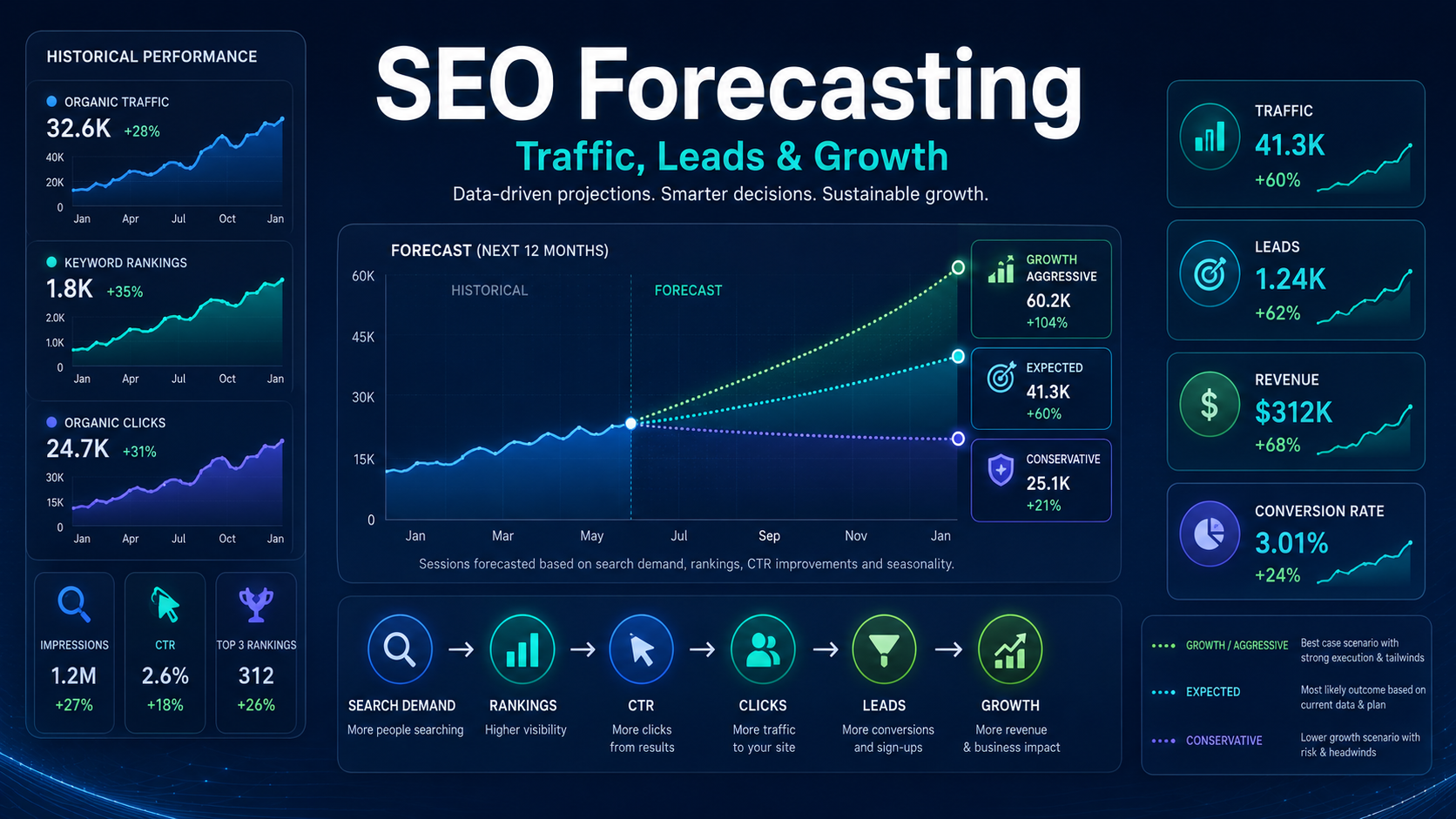
Search Demand → Expected Ranking → Estimated CTR → Organic Clicks → Conversion Rate → Leads → Revenue
For example, imagine a topic has an estimated 10,000 relevant monthly searches.
If your pages eventually capture 8% of those searches as clicks, that could represent:
10,000 × 8% = 800 estimated monthly clicks
If 3% of those visitors become leads:
800 × 3% = 24 estimated leads
If 20% of qualified leads become customers:
24 × 20% = approximately 5 customers
This does not mean five customers are guaranteed.
It means the assumptions create a scenario that can be evaluated.
Why SEO Forecasting Matters
SEO often requires investment before the full results become visible.
A business may need to invest in:
- research
- content
- development
- technical SEO
- design
- digital PR
- tools
- analytics
- ongoing optimization
Forecasting helps connect those activities with potential outcomes.
It Helps Set Realistic Expectations
A forecast can show that organic growth usually develops gradually rather than appearing immediately after publication.
This is particularly important for new websites.
Before a page can generate meaningful traffic, search engines generally need to discover, process, index, and evaluate it. If you want to understand that journey in more detail, read How Search Engines Work: Crawling, Indexing and Ranking.
It Helps Prioritize Opportunities
Suppose your team is considering two content clusters.
Cluster A
- strong search demand
- high business relevance
- realistic competitive opportunity
Cluster B
- larger search volume
- weak business relevance
- extremely strong competitors
The larger search volume does not automatically make Cluster B the better investment.
A forecast can combine traffic potential with business value.
It Helps With Resource Planning
If the forecast depends on publishing 80 high-quality articles in three months but your team can realistically produce 12, the model needs to change.
SEO forecasting should therefore connect directly to your SEO project plan.
It Helps Communicate SEO to Stakeholders
Executives and clients often understand business outcomes more easily than technical SEO terminology.
Instead of saying:
We want to improve topical authority.
you can explain:
This cluster represents a potential opportunity to attract an estimated range of qualified organic visitors. Based on our current conversion rate, that could contribute approximately X–Y additional leads if the ranking assumptions are achieved.
The forecast turns an SEO idea into a business scenario.
SEO Forecasting Is Not a Guarantee
This is one of the most important principles in this entire guide.
An SEO forecast is an estimate.
It should never be presented as a guaranteed result.
You cannot reliably promise:
- an exact Google position
- an exact traffic number
- an exact date when a page will rank
- an exact number of leads
- an exact amount of revenue
Too many variables exist outside your control.
A professional SEO forecast should therefore communicate:
- assumptions
- ranges
- scenarios
- uncertainty
- limitations
A forecast that says:
Organic traffic will be exactly 42,750 visits in six months.
creates false precision.
A more responsible forecast might say:
Based on current demand and our ranking assumptions, the modeled opportunity is approximately 30,000–45,000 monthly organic visits under the expected scenario.
The second statement acknowledges uncertainty.
How to Create an SEO Forecast
A practical SEO forecasting process can be broken into nine steps.
Step 1: Define What You Are Forecasting
Do not begin with a spreadsheet.
Begin with the business question.
What exactly are you trying to estimate?
Possible forecasting goals include:
Organic Traffic Growth
How much additional organic traffic could the website generate?
Content Cluster Potential
How much traffic could a particular group of topics attract?
SEO Lead Generation
How many additional leads could organic search produce?
Ecommerce Revenue
How much revenue could improved organic visibility contribute?
Existing Page Growth
What could happen if pages currently ranking between positions 6 and 20 improve?
Market Expansion
What might happen if the website enters a new service, product, country, or language market?
The model should match the decision you are trying to make.
Step 2: Establish Your Current Baseline
Before forecasting the future, understand the present.
Your baseline might include:
- organic clicks
- organic sessions
- impressions
- ranking queries
- conversions
- conversion rate
- organic revenue
- indexed pages
- top landing pages
Historical performance is particularly valuable because it shows what the website has already demonstrated it can achieve.
Your SEO reporting system should make much of this information easier to retrieve.
Example Baseline
Imagine a website currently receives:
- 20,000 organic visits per month
- 400 leads per month
- 2% organic conversion rate
That gives you an existing relationship between traffic and leads.
If future traffic rises while conversion behavior remains similar, the baseline provides a starting assumption.
However, do not automatically assume that every new visitor will convert at the same rate.
Different topics can attract audiences with very different intent.
Step 3: Audit the Current Opportunity
Forecasting from a weak foundation can produce misleading results.
Before projecting aggressive growth, investigate whether the website has major problems such as:
- indexation issues
- broken pages
- poor site architecture
- duplicate content
- weak internal linking
- serious technical issues
- irrelevant existing traffic
A structured SEO audit can help determine whether your forecast should focus on growth, recovery, consolidation, or technical remediation.
For example, suppose a website already has strong content but poor internal linking.
Its growth opportunity may differ significantly from a site that needs to create an entire content library from scratch.
Step 4: Estimate Relevant Search Demand
Next, estimate how much relevant search demand exists.
This can involve:
- keyword research
- existing Search Console queries
- keyword research platforms
- historical demand
- Google Trends
- competitor visibility
- customer language
- related topics
The key word here is relevant.
Do not simply add every keyword containing a phrase.
Your keyword universe should reflect the audience and topics the website can realistically serve.
Group Keywords by Topic
Instead of forecasting hundreds of isolated keywords, organize them into meaningful clusters.
For example:
SEO Forecasting Cluster
- SEO forecasting
- SEO forecast
- how to forecast SEO traffic
- organic traffic forecasting
- SEO traffic projection
- forecast SEO growth
Search engines can associate one strong page with many related queries.
Forecasting only one exact keyword may therefore underestimate the opportunity.
Step 5: Account for Search Intent
Search volume alone cannot tell you the value of a keyword.
Consider two queries:
what is SEO
and
hire SEO consultant
Both are related to SEO.
But the user behind each search is at a very different stage.
The first is primarily informational.
The second has much stronger commercial intent.
Your forecast should consider whether the expected traffic is:
- informational
- navigational
- commercial
- transactional
If you need a deeper framework, see the guide to the four types of search intent.
Why Intent Matters for Forecasting
Suppose:
Topic A
10,000 projected visits
0.5% conversion rate
That produces:
50 conversions
Now consider:
Topic B
2,000 projected visits
4% conversion rate
That produces:
80 conversions
Topic B generates one-fifth of the traffic but potentially more conversions.
This is why SEO forecasting should not stop at traffic.
Step 6: Build Ranking Scenarios
You now need to estimate what level of visibility might realistically be achieved.
Avoid assuming every keyword will reach position one.
Instead, create scenarios.
A simple model might use:
Conservative Scenario
The project produces modest ranking improvements.
Expected Scenario
The project achieves reasonable visibility based on competition, resources, and site strength.
Aggressive Scenario
The project performs exceptionally well and captures stronger rankings.
For example:
| Scenario | Estimated Share of Search Demand |
|---|---|
| Conservative | 3% |
| Expected | 7% |
| Aggressive | 12% |
These are only example assumptions.
Your actual percentages should reflect the specific market, ranking distribution, content type, website, and SERP.
Scenario Modeling Is Better Than One Number
Instead of saying:
This cluster will generate 8,500 visits.
say:
- Conservative: 4,000 visits
- Expected: 7,000 visits
- Aggressive: 11,000 visits
Now decision-makers can see the range.
Step 7: Estimate Organic Click Potential
Once search demand and visibility assumptions are established, estimate clicks.
A simplified model is:
Estimated Search Demand × Expected Organic Click Share = Estimated Organic Clicks
Example:
Relevant monthly search demand:
50,000
Expected click capture:
6%
Estimated clicks:
3,000 per month
However, real search results are more complicated.
Click behavior changes depending on:
- ranking position
- query type
- paid ads
- maps
- shopping results
- videos
- featured results
- AI-powered results
- brand recognition
- search intent
Do not assume every search produces a traditional organic click.
Your model should remain conservative enough to account for this uncertainty.
Step 8: Forecast Conversions and Revenue
Traffic is useful.
Business outcomes are more useful.
Once you have estimated organic traffic, apply realistic conversion assumptions.
Lead Forecast
Suppose the expected scenario predicts:
5,000 monthly organic visits
Historical conversion rate:
2.5%
Estimated leads:
5,000 × 2.5% = 125 leads
If approximately 20% become qualified opportunities:
125 × 20% = 25 qualified opportunities
If 20% of those become customers:
25 × 20% = 5 customers
Revenue Forecast
Suppose the average initial customer value is:
$2,000
Estimated customer acquisition:
5 customers
Potential revenue:
5 × $2,000 = $10,000
Again, this is a scenario—not a promise.
Use Different Conversion Rates Where Necessary
An informational article and a service page should not necessarily use the same conversion assumptions.
You may model:
- informational traffic
- commercial traffic
- transactional traffic
separately.
This makes the forecast more realistic.
Step 9: Add Time to the Forecast
SEO forecasts become much more useful when they include time.
Organic growth rarely moves directly from zero to full potential.
A simplified model might look like this:
Months 1–2
Research, technical preparation, and publishing.
Months 3–4
Indexation expands and early impressions appear.
Months 5–6
More queries begin gaining visibility.
Months 7–9
Stronger pages generate meaningful click growth.
Months 10–12
The content library matures and optimization becomes increasingly important.
This timeline is not universal.
Some pages can perform faster.
Others may take significantly longer.
The purpose is to avoid modeling the website at full potential from the first month.
Three Useful SEO Forecasting Models
There is no single perfect forecasting methodology.
Different situations require different models.
Model 1: Historical Growth Forecast
This is one of the simplest approaches.
Use historical organic performance to estimate future growth.
Suppose organic clicks were:
| Month | Organic Clicks |
|---|---|
| January | 10,000 |
| February | 10,500 |
| March | 11,100 |
| April | 11,800 |
| May | 12,400 |
| June | 13,200 |
You can identify the overall growth trend and create a baseline projection.
When It Works Best
Historical forecasting is most useful when:
- the website has substantial historical data
- the business is relatively stable
- no major migration is planned
- the market is not changing dramatically
Limitation
Past growth does not guarantee future growth.
A website cannot necessarily continue increasing at the same percentage forever.
Model 2: Keyword Opportunity Forecast
This approach begins with search demand.
The simplified calculation is:
Keyword Search Demand × CTR Assumption = Traffic Potential
For multiple keywords:
Sum of Estimated Keyword Clicks = Cluster Traffic Potential
You can then apply conversion assumptions.
Best For
- new content clusters
- service expansions
- new websites
- market opportunity analysis
Limitation
Keyword volume estimates are estimates.
They also do not perfectly represent the total traffic potential of a page because pages can rank for many related queries.
Model 3: Existing Ranking Improvement Forecast
This model focuses on pages that already have visibility.
For example, identify queries or pages currently ranking:
- positions 4–10
- positions 11–20
- positions 21–30
Then model what could happen if selected pages move into stronger positions.
Example
Current monthly impressions:
20,000
Current CTR:
1.5%
Current clicks:
300
Modeled improved CTR:
4%
Potential clicks:
800
Estimated opportunity:
+500 monthly clicks
This can be particularly useful because the website has already demonstrated relevance for the topic.
Forecast New SEO Content vs Existing Content Separately
New content and existing pages should not always be modeled in the same way.
Existing Content
You already have data such as:
- impressions
- clicks
- queries
- ranking history
- conversion performance
This makes forecasting somewhat more grounded.
New Content
You have more uncertainty.
You need assumptions about:
- indexation
- topic relevance
- ranking potential
- search demand
- competitive strength
- internal linking
- site authority
For a newer website, the SEO fundamentals should be established before building aggressive forecasts.
Use Topic Clusters in SEO Forecasting
A major mistake is forecasting every article independently.
Modern websites often gain visibility across entire topic areas.
For example, an SEO Foundations cluster might include:
- SEO fundamentals
- how search engines work
- search intent
- SEO terminology
- SEO strategy
- SEO project planning
- SEO audits
- SEO reporting
- SEO forecasting
These articles strengthen the site’s overall coverage of the subject.
Instead of asking:
How much traffic will this one article generate?
you may also ask:
What is the combined search opportunity of this entire cluster?
This creates a more strategic view of content investment.
Forecast by Funnel Stage
You can take the model further by grouping projected traffic by customer journey.
Awareness
Examples:
- what is SEO
- how search engines work
Consideration
Examples:
- SEO audit checklist
- SEO reporting tools
- SEO forecasting methods
Decision
Examples:
- SEO consultant
- SEO agency
- SEO audit service
This helps estimate not only traffic volume but also commercial potential.
Account for Seasonality
Some search markets change significantly throughout the year.
Examples include:
- tax services
- holiday products
- travel
- education
- fitness
- events
- seasonal ecommerce
A flat monthly forecast may therefore be misleading.
If demand historically rises during certain months, your forecast should reflect that pattern.
Compare:
Flat forecast
10,000 searches every month
with:
Seasonal forecast
January: 18,000
February: 15,000
March: 12,000
April: 8,000
May: 6,000
Both equal meaningful annual demand, but the business implications are very different.
Consider Brand Growth
SEO forecasts often focus only on non-branded search.
But successful content marketing can also contribute indirectly to increased branded demand.
Users may:
- discover your article
- remember your name
- return later
- search for your brand
- convert
This effect is difficult to predict precisely.
Treat it as potential upside rather than inventing unsupported numbers.
Build Conservative Assumptions
One of the easiest ways to create a bad SEO forecast is to make every assumption optimistic.
For example:
- every article indexes
- every keyword ranks top three
- every ranking gets industry-average CTR
- every visitor converts at the current site average
- no competitor improves
- demand never changes
Stack enough optimistic assumptions together and the final forecast becomes meaningless.
A stronger model should include friction.
Ask:
- What if only 70% of planned content performs?
- What if rankings take twice as long?
- What if CTR is lower?
- What if conversion rate falls?
- What if production is delayed?
- What if demand declines?
SEO forecasting should help you prepare for uncertainty rather than hide it.
Use Sensitivity Analysis
Sensitivity analysis shows which assumptions have the biggest impact on the forecast.
Imagine your forecast uses:
- 100,000 monthly relevant searches
- 5% traffic capture
- 2% conversion rate
- $1,000 customer value
Estimated traffic:
5,000
Estimated conversions:
100
But what happens if conversion rate changes?
At 1%
50 conversions
At 2%
100 conversions
At 3%
150 conversions
The forecast is highly sensitive to conversion rate.
Now management understands that improving conversion performance may be almost as important as increasing rankings.
Forecast SEO Costs Too
A serious business forecast should not only estimate outcomes.
Estimate the investment required to achieve them.
Potential SEO costs include:
- writers
- editors
- designers
- developers
- SEO specialists
- tools
- outreach
- digital PR
- content updates
- analytics
Suppose a project costs:
$30,000
and the expected scenario estimates:
$75,000 in attributable value
That creates a business conversation.
But keep attribution conservative.
SEO often influences customer journeys that involve multiple channels.
Forecast Production Capacity
A content forecast should reflect how much content the team can actually create.
For example:
Required content:
60 articles
Production capacity:
5 articles per month
Minimum production period:
12 months
A forecast assuming all 60 articles are live by month three would be unrealistic.
This is another reason the forecast should connect with your project planning and publishing calendar.
SEO Forecasting for a New Website
Forecasting a new website is especially challenging because historical data is limited.
Use broader ranges.
Consider:
- total addressable search demand
- competitor performance
- content production capacity
- technical quality
- niche difficulty
- internal linking
- brand recognition
- authority-building ability
Instead of:
We expect 50,000 organic visitors by month six.
use:
Conservative
5,000 monthly visits
Expected
12,000 monthly visits
Aggressive
25,000 monthly visits
Then explain the conditions required for each scenario.
The wider range reflects greater uncertainty.
SEO Forecasting for an Established Website
Established sites have an advantage:
data.
You can use:
- historical clicks
- existing rankings
- page-level conversions
- seasonal patterns
- content performance
- topic-cluster growth
Established websites can often build more precise forecasts because assumptions are based partly on their own performance.
For example, instead of using a generic conversion benchmark, use the historical conversion rate of comparable organic landing pages.
SEO Forecasting for Ecommerce
Ecommerce forecasts should ideally move beyond traffic.
Model:
Search Demand → Clicks → Product/Category Visits → Conversion Rate → Orders → Average Order Value → Revenue
You may forecast separately for:
- category pages
- product pages
- informational content
- branded searches
- non-branded commercial searches
A category page targeting a purchase-focused search should not be modeled like an informational blog article.
SEO Forecasting for Lead Generation
Lead-generation websites can model:
Organic Traffic → Lead Conversion Rate → Qualified Lead Rate → Close Rate → Customer Value
Example:
Projected organic visitors:
10,000
Website lead rate:
3%
Leads:
300
Qualified rate:
40%
Qualified leads:
120
Close rate:
20%
Customers:
24
Average customer value:
$3,000
Potential value:
$72,000
Every stage is an assumption.
That is why the model should allow those values to be changed easily.
Common SEO Forecasting Mistakes
Treating Search Volume as Traffic
Search volume represents estimated demand, not guaranteed website visits.
Your site must still earn visibility and clicks.
Assuming Position One Everywhere
Even excellent SEO campaigns do not rank first for every target query.
Using One CTR for Every Keyword
Click behavior differs substantially across search results.
Ignoring Search Intent
High traffic does not necessarily mean high business value.
Using One Conversion Rate Across Everything
Informational and commercial traffic often behave differently.
Ignoring Seasonality
Annual demand may not be distributed evenly.
Ignoring Production Constraints
Content that has not been published cannot generate traffic.
Ignoring Technical Problems
A forecast built on a site with major indexing problems may require technical work before content growth can occur.
Promising the Forecast
Forecasts should guide decisions.
They should never be converted into guarantees.
Never Updating the Model
A forecast should evolve as real performance data becomes available.
Compare Forecast vs Actual Results
Forecasting becomes more valuable when you regularly compare estimates with real performance.
For example:
| Metric | Forecast | Actual | Difference |
|---|---|---|---|
| Organic Clicks | 10,000 | 8,500 | -15% |
| Leads | 250 | 280 | +12% |
| Conversion Rate | 2.5% | 3.3% | +32% |
This reveals something important.
Traffic underperformed the forecast.
But leads exceeded expectations because conversion performance was stronger.
That insight can improve the next forecast.
Your forecasting model should become more accurate as your SEO reporting system collects additional real-world data.
How Often Should You Update an SEO Forecast?
For an active SEO program, review assumptions regularly.
A practical rhythm might be:
Monthly
Compare actual results with forecasted results.
Quarterly
Update:
- ranking assumptions
- conversion rates
- production timelines
- search demand
- opportunity estimates
Annually
Rebuild the strategic model based on:
- market changes
- business priorities
- historical performance
- new products
- new services
- competitor movement
Do not change the forecast every time rankings fluctuate for a few days.
Look for meaningful patterns.
What Should an SEO Forecast Include?
A professional forecast should document:
Objective
What are we trying to predict?
Baseline
What is current organic performance?
Search Opportunity
How much relevant demand exists?
Assumptions
What rankings, CTRs, and conversion rates are being modeled?
Scenarios
What are the conservative, expected, and aggressive outcomes?
Timeline
How quickly could the results develop?
Resources
What work is required?
Business Outcomes
What could the traffic mean for leads, sales, or revenue?
Risks
What could cause the forecast to underperform?
Review Process
When will forecasted results be compared with actual performance?
Without documented assumptions, a forecast becomes difficult to evaluate later.
Simple SEO Forecasting Formula
For a basic model, start with:
Search Demand × Estimated Click Capture = Organic Traffic
Then:
Organic Traffic × Conversion Rate = Conversions
Then, where appropriate:
Conversions × Customer Value = Estimated Business Value
For example:
Search demand:
40,000
Expected click capture:
7%
Forecasted organic clicks:
2,800
Conversion rate:
3%
Forecasted conversions:
84
Average conversion value:
$500
Potential value:
$42,000
Then create conservative and aggressive variations around those assumptions.
The formulas are simple.
The quality of the forecast depends on the quality of the assumptions.
SEO Forecasting Checklist
Before presenting an SEO forecast, confirm:
Objective
- The business question is clear.
- The forecast covers a defined period.
- Success metrics are documented.
Baseline
- Current organic traffic is documented.
- Current conversions are documented.
- Existing rankings are considered.
- Historical performance has been reviewed.
Search Demand
- Relevant keywords are included.
- Keywords are grouped by topic.
- Search intent has been considered.
- Seasonality has been reviewed.
Assumptions
- Ranking assumptions are realistic.
- CTR assumptions are documented.
- Conversion assumptions are documented.
- Production capacity is realistic.
Scenarios
- Conservative scenario included.
- Expected scenario included.
- Aggressive scenario included.
Business Value
- Leads or sales are estimated where appropriate.
- Customer value assumptions are documented.
- Costs are considered where possible.
Risk
- Forecast limitations are explained.
- External variables are acknowledged.
- No outcomes are presented as guarantees.
Measurement
- Actual performance will be tracked.
- Forecast vs actual results will be reviewed.
- Assumptions will be updated over time.
Final Thoughts
SEO forecasting is not about predicting Google with perfect accuracy.
It is about turning uncertainty into a structured decision-making process.
A useful forecast follows this sequence:
Baseline → Search Demand → Intent → Ranking Assumptions → Click Potential → Conversions → Business Value → Timeline → Review
The strongest forecasts do not pretend that every variable is known.
They make uncertainty visible.
They show what assumptions are being made, what would need to happen for the model to succeed, and how different outcomes could affect the business.
Use SEO forecasting to answer questions such as:
- Is this opportunity worth pursuing?
- What results would justify the investment?
- Which topics deserve priority?
- How much content can we realistically produce?
- What conversion rate would make the project worthwhile?
- What happens if rankings are weaker than expected?
Then use real performance data to improve the model.
Your first SEO forecast will rarely be perfect.
That is fine.
Forecast, execute, measure, compare, learn, and update.
Over time, the forecast becomes less about guessing what SEO might do and more about understanding how your own website actually grows.