
SEO can increase visibility, traffic, leads, and revenue.
But how you achieve those results matters.
There is a major difference between improving a website so that search engines and users can understand it more easily and manipulating systems purely to manufacture rankings.
That difference is the foundation of SEO ethics.
Ethical SEO focuses on creating genuine value, communicating honestly, protecting users, following search-engine policies, and building sustainable visibility instead of relying on deceptive shortcuts.
This matters because SEO decisions affect more than rankings.
They can affect:
- users
- clients
- businesses
- publishers
- competitors
- search quality
- privacy
- brand reputation
A tactic may produce a temporary ranking improvement and still be a poor business decision if it misleads users, violates platform policies, damages trust, or creates long-term risk.
Google describes spam as techniques intended to deceive users or manipulate its search systems, and policy violations can result in lower visibility or removal from Search.
This guide explains the principles behind ethical SEO, the practices to avoid, how AI changes the conversation, and how to build an optimization process that supports both users and sustainable organic growth.
What Is Ethical SEO?
Ethical SEO is the practice of improving organic search performance through transparent, user-focused, policy-compliant methods that create genuine value.
Ethical SEO generally means:
- creating useful content
- representing information accurately
- improving technical accessibility
- using keywords naturally
- earning or attracting legitimate links
- avoiding deception
- respecting intellectual property
- protecting user privacy
- disclosing commercial relationships
- using automation responsibly
- following search-engine policies
- measuring performance honestly
The objective is still to improve SEO performance.
Ethical SEO does not mean ignoring rankings.
It means pursuing rankings in ways that do not depend on deception or manipulation.
If you are still building your foundation, the broader principles covered in SEO Fundamentals provide useful context for how content, technical optimization, search intent, and authority work together.
Why SEO Ethics Matters
SEO creates incentives.
A website that ranks higher may receive significantly more:
- traffic
- leads
- revenue
- exposure
- customers
- influence
Those incentives can encourage shortcuts.
For example:
If links help rankings, why not buy hundreds?
Or:
If keywords matter, why not repeat them everywhere?
Or:
If publishing content helps, why not generate 10,000 pages automatically?
The problem is that optimization taken to an extreme can become manipulation.
Ethical SEO introduces a more useful question:
Would this tactic still make sense if search engines did not reward it?
If the answer is no, you should examine the tactic carefully.
For example, writing a genuinely useful guide still helps users even without rankings.
Improving website navigation still helps visitors.
Making a site faster still improves experience.
Creating accurate product comparisons still helps buyers make decisions.
Those are strong foundations for sustainable SEO.
SEO Ethics vs Search Engine Guidelines
SEO ethics and search-engine guidelines overlap, but they are not exactly the same thing.
Search Engine Guidelines
These are rules and policies established by search platforms.
They define practices that may result in:
- ranking adjustments
- manual actions
- reduced visibility
- removal from search results
SEO Ethics
Ethics goes further.
A practice might technically avoid violating a specific documented rule while still being:
- misleading
- exploitative
- deceptive
- harmful
- irresponsible
For example, publishing an article that intentionally exaggerates a product’s benefits may not always fall neatly under an SEO spam category.
But it can still be unethical because readers are being misled.
A responsible SEO program should therefore consider both:
platform compliance + user trust
White Hat, Gray Hat and Black Hat SEO
SEO practices are often described using three broad labels.
White Hat SEO
Generally refers to practices aligned with search-engine guidelines and user value.
Examples include:
- improving site architecture
- creating useful content
- fixing crawl problems
- improving internal links
- earning legitimate backlinks
- matching search intent
- improving page experience
Black Hat SEO
Usually refers to tactics designed primarily to manipulate ranking systems.
Examples may include:
- cloaking
- hidden text
- link schemes
- doorway pages
- keyword stuffing
- deceptive redirects
Google explicitly identifies practices such as cloaking, doorway abuse, keyword stuffing, link spam, hidden text, scaled content abuse, scraping, and sneaky redirects within its spam policies.
Gray Hat SEO
Gray hat is an industry term rather than an official Google classification.
It usually describes tactics that sit in uncertain territory or aggressively test the boundaries of guidelines.
The problem is that relying on gray areas creates business risk.
Policies change.
Enforcement improves.
And a tactic that works temporarily may become a liability later.
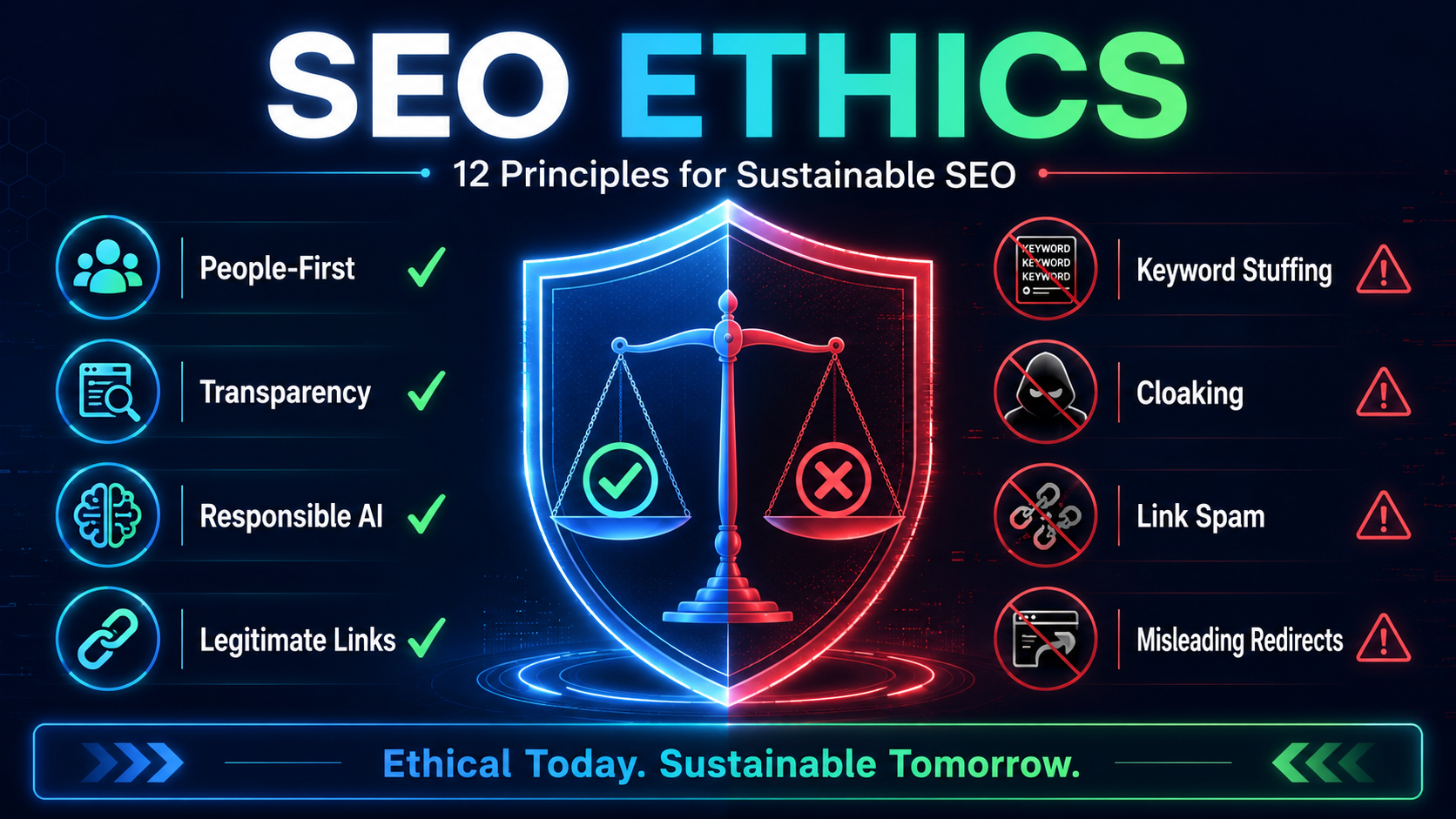
12 Principles of Ethical SEO
A sustainable SEO program can be built around twelve practical principles.
1. Optimize for People and Search Engines
You do not have to choose between users and search engines.
Good SEO helps both.
For example, a clear heading structure helps readers scan an article while also helping systems understand its organization.
Descriptive internal links help visitors discover related information while also establishing relationships between pages.
The problem starts when optimization becomes invisible or unnatural to the user.
Examples include:
- keyword stuffing
- hidden text
- meaningless location lists
- repetitive anchor text
- content created only to capture variants of the same query
Google considers keyword stuffing to include unnatural repetition of words or phrases intended to manipulate rankings.
Use keywords to clarify meaning.
Do not write for keyword density.
2. Match Search Intent Honestly
A ranking is not useful if the page misleads the searcher.
Suppose someone searches:
free SEO audit template
and your page promises a free template but only contains a sales form requiring payment.
That creates a mismatch between expectation and reality.
Your content should accurately represent what the page offers.
The framework in the Search Intent guide can help determine whether a page should be informational, commercial, transactional, or navigational.
Ethical intent optimization means satisfying the reason behind the search rather than exploiting the wording of the query.
3. Never Use Cloaking to Manipulate Rankings
Cloaking means intentionally showing search engines one thing while showing users something substantially different in order to manipulate search results.
Google explicitly treats this as spam.
For example:
Search engine sees:
A detailed guide about home insurance.
Visitor sees:
A gambling promotion.
That is deceptive.
There are legitimate reasons content can appear differently based on device, authentication, localization, personalization, or accessibility.
The key issue is intent.
If the purpose is to deceive search systems, the practice becomes problematic.
4. Do Not Create Doorway Pages
Doorway pages are pages created primarily to capture multiple similar queries and funnel visitors toward the same destination.
Examples could include:
- SEO consultant Dubai
- SEO consultant Sharjah
- SEO consultant Ajman
- SEO consultant Abu Dhabi
when every page contains nearly identical text and simply sends users to the same service.
Google describes doorway abuse as creating sites or pages to rank for similar queries when those pages function as intermediate steps rather than genuinely useful destinations.
Location pages can be legitimate.
The question is whether each page provides meaningful value specific to that location.
5. Build Links Responsibly
Links remain one of the most misunderstood areas of SEO.
Not every paid link is automatically problematic.
Advertising, sponsorships, affiliate relationships, and commercial partnerships are normal parts of the web.
The important issue is whether links are being used primarily to manipulate ranking signals.
Google’s spam policies identify practices such as buying or selling links for ranking purposes, excessive link exchanges, automated link creation, and low-quality directory or comment links as examples of link spam. Paid or sponsored links can be appropriately qualified with attributes such as rel="sponsored" or rel="nofollow".
A better approach is to earn links through:
- original research
- useful tools
- expert commentary
- strong resources
- digital PR
- legitimate partnerships
- genuine citations
Authority should be a result of usefulness and reputation, not manufactured link volume.
6. Use AI Responsibly
AI has made content production dramatically faster.
That does not mean publishing as much AI-generated content as possible is a good SEO strategy.
Google’s current spam policies define scaled content abuse as generating many pages primarily to manipulate rankings rather than help users, regardless of whether the pages are created with AI, humans, or other methods. The policy specifically includes generating large amounts of low-value content with generative AI as one possible example.
The ethical question is therefore not:
Was AI used?
A more useful question is:
Did the final content provide genuine value?
AI can responsibly support:
- research organization
- outlines
- brainstorming
- editing
- summarization
- data analysis
- workflow automation
But important content should still receive appropriate:
- fact-checking
- editorial review
- expert judgment
- original examples
- source verification
- experience-based input
Do not publish information simply because an AI system produced it confidently.
7. Do Not Steal or Lightly Rewrite Other People’s Content
SEO research often involves reviewing competitors.
Research is legitimate.
Copying is not.
Google’s spam policies include scraping practices such as republishing other sites’ content without meaningful original value or making only superficial automated modifications before republishing it.
Beyond search policies, copying creates:
- copyright risk
- trust problems
- poor differentiation
- weak brand identity
Use competitor research to understand:
- search intent
- common questions
- content formats
- gaps
- SERP expectations
Then create something original.
A strong article should contribute its own:
- explanation
- examples
- perspective
- visuals
- evidence
- process
- experience
8. Be Transparent About Affiliate Relationships
Affiliate marketing can support a high-quality website.
The ethical problem arises when commercial incentives are hidden or when recommendations are presented as independent despite being influenced by compensation.
Affiliate content should clearly disclose material relationships.
Recommendations should not automatically favor the product with the highest commission.
Strong affiliate content may include:
- original testing
- real screenshots
- clear pros and cons
- suitable alternatives
- limitations
- comparison criteria
- disclosure of affiliate relationships
Google also distinguishes useful affiliate sites from thin affiliate content that largely copies merchant descriptions without meaningful added value.
If you have not personally tested a product, do not imply that you have.
9. Protect User Privacy
SEO increasingly overlaps with analytics, tracking, conversion measurement, personalization, and marketing automation.
That creates privacy responsibilities.
Only collect data you genuinely need.
Be transparent about tracking.
Use appropriate consent mechanisms where required.
Protect sensitive information.
Avoid deceptive tracking.
SEO performance is not worth compromising visitor privacy.
When implementing:
- analytics
- pixels
- session recording
- conversion tracking
- remarketing
- forms
make sure your implementation follows the applicable privacy and consent requirements for your audience and jurisdiction.
SEO is part of the broader digital customer experience.
Trust matters.
10. Report SEO Performance Honestly
SEO reporting can be manipulated just as easily as rankings.
For example, an agency might highlight:
Organic visibility increased 200%.
while avoiding mentioning:
- conversions fell
- branded searches created most of the increase
- the baseline was extremely small
- traffic came from irrelevant keywords
Ethical reporting requires context.
The SEO Reporting guide explains why clicks, impressions, rankings, conversions, and business outcomes should be interpreted together.
Do not:
- cherry-pick metrics
- hide declines
- present estimates as actual traffic
- claim causation without evidence
- promise guaranteed rankings
- exaggerate results
A professional report should explain both successes and problems.
11. Test Responsibly
SEO experimentation is valuable.
But testing should not expose users to deceptive or harmful experiences.
The SEO Testing guide explains how structured experiments can help validate optimization decisions.
Responsible testing means:
- defining a hypothesis
- documenting the change
- protecting user experience
- avoiding cloaking
- measuring accurately
- ending temporary experiments appropriately
- reporting inconclusive results honestly
A failed experiment is not unethical.
Hiding the result can be.
12. Think Long Term
Many questionable SEO tactics become attractive because they produce short-term gains.
For example:
Month 1: automated links create ranking growth.
Month 3: traffic increases.
Month 6: spam detection catches the pattern.
Month 8: visibility collapses.
A sustainable SEO strategy should consider what happens after the initial ranking gain.
Ask:
Would I still be comfortable with this tactic if Google manually reviewed the website?
And:
Would I be comfortable explaining this tactic publicly to customers?
Those two questions can eliminate many bad SEO decisions.
Important SEO Practices to Avoid
Several practices deserve particular attention.
Keyword Stuffing
Repeating a target phrase unnaturally does not create better content.
Instead of:
Our Dubai SEO company provides Dubai SEO services for companies looking for Dubai SEO experts…
write naturally.
Keywords should help clarify context, not dominate the writing.
Hidden Text
Do not hide keyword-filled text by:
- making text the same color as the background
- positioning it off-screen
- using zero font sizes
- making it invisible solely to manipulate rankings
Google explicitly distinguishes manipulative hidden text from legitimate interface patterns such as tabs, accordions, slideshows, tooltips, and accessibility text.
Sneaky Redirects
Redirects are normal and necessary.
You may need them for:
- migrations
- deleted pages
- URL consolidation
- site restructuring
The problem is using redirects deceptively.
Google considers redirects designed to show users something substantially different from what they expected a spam practice.
Automated Link Schemes
Do not use software to create thousands of:
- forum links
- profile links
- blog comments
- directory entries
- artificial backlinks
Link quantity is not the same thing as authority.
Scaled Low-Value Content
Publishing 50 useful pages can be better than publishing 50,000 pages that exist only because keywords were available.
Before creating a page, ask:
Does this deserve to exist independently?
If several pages answer essentially the same question, consolidation may be more useful.
Expired Domain Abuse
Buying an expired domain is not inherently unethical.
The problem arises when an expired domain’s historical reputation is exploited primarily to rank unrelated, low-value content.
Google specifically addresses expired domain abuse in its current spam policies.
Site Reputation Abuse
Another area requiring careful attention is third-party content placed on established websites primarily to benefit from the host site’s existing ranking signals.
Google’s site reputation policy targets this behavior. Its enforcement approach was updated in August 2026, including changes to how affected pages are handled for users in the European Economic Area.
This does not mean third-party writers, freelancers, affiliate content, advertorials, or user-generated content are automatically problematic.
The issue is publishing third-party content primarily to exploit the host site’s reputation for rankings.
Ethical SEO and Client Work
SEO professionals also have ethical responsibilities toward clients.
Do Not Guarantee #1 Rankings
No SEO consultant controls Google’s ranking systems.
Guaranteeing:
Position #1 within 30 days
is generally not a responsible promise.
You can guarantee:
- work quality
- deliverables
- communication
- reporting
- processes
You cannot legitimately guarantee a ranking controlled by an external search engine.
Explain Risks
If a client requests an aggressive tactic, explain:
- potential upside
- policy risk
- sustainability
- alternatives
Do not implement dangerous tactics without informed discussion simply because the client requested them.
Do Not Hide Your Methods
A client should understand the general nature of the work being performed.
For example:
- content creation
- outreach
- link acquisition
- technical changes
- AI usage
Secretive methods create unnecessary risk.
Protect Client Assets
Take care with access to:
- websites
- analytics
- Search Console
- hosting
- domains
- advertising accounts
Do not retain control of client properties as leverage.
Report Problems Clearly
If performance declines, report it.
SEO professionals build more trust by explaining problems accurately than by hiding them.
Ethical SEO and Content Accuracy
SEO articles frequently influence decisions.
Some topics are particularly sensitive:
- health
- finance
- legal matters
- safety
- major purchases
Accuracy becomes even more important in these areas.
Before publishing:
- verify factual claims
- cite reliable sources
- disclose uncertainty
- distinguish opinion from fact
- avoid invented statistics
- update outdated information
Do not create false authority.
If you are not qualified to give specialized medical or legal advice, do not present yourself as though you are.
Ethical Use of Search Competitor Data
Competitor research is a normal part of SEO.
You can study:
- rankings
- titles
- content structures
- backlinks
- page types
- search intent
- public SERPs
But research should inform your strategy—not become plagiarism.
Your process might be:
Analyze → Identify Expectations → Find Gaps → Add Original Value
not:
Analyze → Copy → Rewrite Slightly → Publish
That distinction is essential for building a recognizable brand.
SEO Ethics and Forecasting
Forecasts can also become misleading.
A forecast is a model, not a guarantee.
The SEO Forecasting guide explains why responsible projections should use conservative assumptions, ranges, and scenarios.
Instead of:
SEO will generate $500,000 next year.
say:
Under the expected scenario, the model estimates this range based on the documented traffic, CTR, and conversion assumptions.
Make the assumptions visible.
That allows stakeholders to evaluate the forecast intelligently.
SEO Ethics and Website Audits
An SEO audit may uncover hundreds of potential issues.
Ethical consulting means distinguishing between:
- serious problems
- useful opportunities
- minor warnings
- tool-generated noise
Do not exaggerate harmless warnings to frighten clients into buying unnecessary services.
For example:
Your website has 583 SEO errors and is at serious risk.
sounds alarming.
But if 550 of those “errors” are minor metadata recommendations, the presentation is misleading.
Prioritize by actual impact.
Create an Ethical SEO Decision Framework
Before using a questionable tactic, ask six questions:
- Does this genuinely help the user?
- Would I do this if rankings were not involved?
- Does it accurately represent the page or business?
- Does it comply with search-engine policies?
- Would I be comfortable explaining it publicly?
- Is the potential short-term benefit worth the long-term risk?
If several answers make you uncomfortable, reconsider the tactic.
Sustainable SEO Is Usually Less Dramatic
Ethical SEO is sometimes less exciting than tactics promising instant rankings.
It involves:
- research
- publishing
- technical improvements
- internal linking
- measurement
- testing
- updating
- building authority
- waiting for evidence
- continuously improving
That process can feel slower.
But it creates assets that compound.
A useful article can generate traffic for years.
A strong site architecture can support hundreds of pages.
A trustworthy brand can earn links naturally.
A well-maintained website can survive changes that destroy sites built around loopholes.
SEO Ethics Checklist
Before publishing or implementing SEO work, verify:
Content
- Content provides original value.
- Important claims are accurate.
- Sources are credited where appropriate.
- Search intent is genuinely satisfied.
- Keywords are used naturally.
- AI-generated material has been reviewed.
Links
- Links were not created through deceptive schemes.
- Paid or sponsored relationships are appropriately handled.
- Affiliate relationships are disclosed.
- Anchor text is natural.
Technical SEO
- Users and search engines receive equivalent meaningful content.
- Redirects are legitimate.
- Structured data accurately represents visible content.
- Hidden elements are used for legitimate UX or accessibility reasons.
Users
- The page delivers what it promises.
- Privacy is respected.
- Forms and CTAs are not intentionally deceptive.
- Accessibility and usability are considered.
Business
- Results are reported accurately.
- Forecasts are presented as estimates.
- Risks are explained.
- Commercial relationships are transparent.
Sustainability
- The tactic can survive long-term scrutiny.
- It supports the site’s broader reputation.
- It is not dependent on exploiting a temporary loophole.
Final Thoughts
SEO ethics is not about avoiding optimization.
It is about deciding what kind of optimization you are willing to build your business on.
A sustainable framework is:
Help users → Communicate honestly → Follow guidelines → Build real value → Measure accurately → Improve responsibly
Search engines will continue evolving.
New technologies will appear.
AI will change workflows.
New ranking systems will emerge.
Spam detection will improve.
Specific tactics will come and go.
But the principles behind sustainable SEO remain remarkably stable.
Create something useful.
Make it accessible.
Describe it accurately.
Avoid deception.
Respect users.
Earn trust rather than manufacture it.
And when you are unsure about a tactic, ask whether the website would still be better because of the change even if search engines gave you no additional ranking benefit.
If the answer is yes, you are usually moving in the right direction.