
Some of the most valuable SEO opportunities are not the broadest keywords.
They are the specific searches that reveal exactly what someone wants.
Consider the difference between:
Broad keyword:
SEO
and:
More specific search:
how to do SEO for a new local business website
The second query may attract fewer searches, but it tells you much more about the person searching.
You know:
- they want to learn
- they have a new website
- they operate a local business
- they need practical SEO guidance
That specificity is what makes long-tail keywords so useful.
Long-tail keywords can help you discover narrower customer problems, create more focused content, understand search intent, and reach people whose needs may not be satisfied by broad generic pages.
But there is an important misconception to clear up immediately:
Long-tail does not automatically mean low competition.
Some highly specific queries can be commercially valuable and extremely competitive.
The real advantage of long-tail keyword research is not that every query is easy to rank for.
It is that specific queries often reveal clearer intent and more precise content opportunities.
This guide explains what long-tail keywords are, why they matter, how to find them, how to evaluate them, and how to use them without creating hundreds of unnecessary pages.
What Are Long-Tail Keywords?
Long-tail keywords are relatively specific search queries that represent narrower needs within a larger search market.
They often contain more words than broad keywords, although word count alone does not define whether a keyword is long-tail.
For example:
Broad:
running shoes
More specific:
running shoes for flat feet
Even more specific:
best running shoes for flat feet and long-distance running
The search becomes progressively more detailed.
The same pattern exists in SEO.
Broad:
keyword research
More specific:
keyword research for beginners
More specific:
how to do keyword research for a new website
Long-tail searches often sit deeper within a topic.
They represent the many specific searches surrounding a smaller number of high-volume head terms.
Why Are They Called Long-Tail Keywords?
The concept comes from the shape of a search-demand distribution.
Imagine a graph where:
- the horizontal axis represents keywords
- the vertical axis represents search volume
A relatively small number of broad keywords receive very high search volumes.
Then there is a much larger number of lower-volume queries.
The graph stretches into a long tail.
A simplified example looks like this:
Head terms
SEO
Keyword research
Technical SEO
↓
More specific terms
SEO keyword research tools
Technical SEO for ecommerce
Keyword research for local businesses
↓
Long-tail searches
How to find keywords for a new plumbing website
Technical SEO checklist for a Shopify store
How to research local keywords without paid tools
Individually, many of these searches may have modest demand.
Collectively, they can represent a substantial portion of the search market.
Long-Tail Keywords vs Seed Keywords
Long-tail research usually begins with broader starting topics.
Those starting points are your seed keywords.
For example:
Seed keyword:
email marketing
Potential long-tail searches:
- email marketing for small restaurants
- how to create an email welcome sequence
- email marketing automation for ecommerce
- best email marketing platform for a small nonprofit
The seed gives you the broad topic.
Long-tail research reveals narrower variations.
If you have not built your starting topic list yet, read the Seed Keywords guide first.
The typical process is:
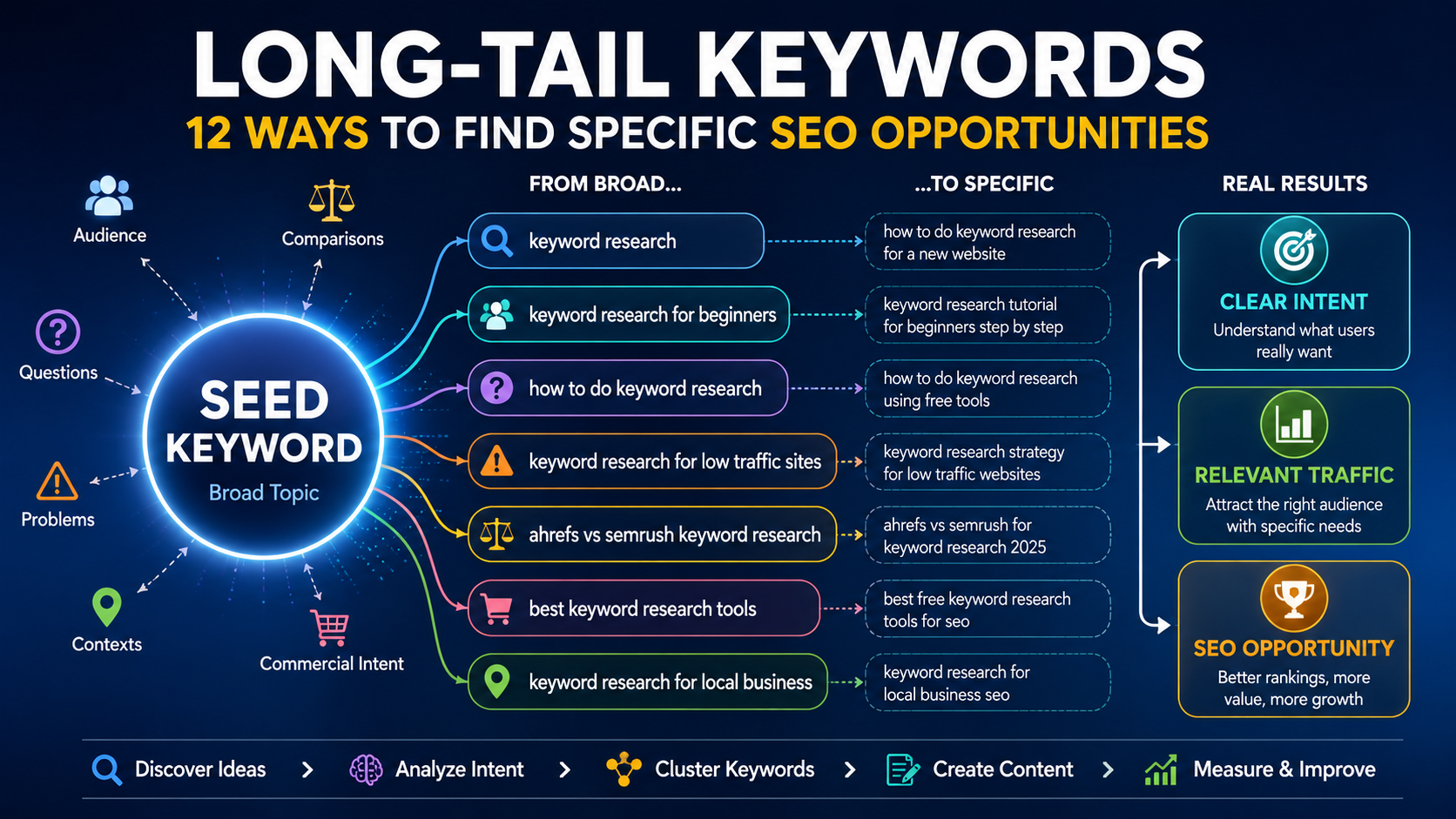
Seed Keyword → Keyword Expansion → Long-Tail Queries → Search Intent → Keyword Cluster → Page
Why Long-Tail Keywords Matter for SEO
Long-tail searches can provide several strategic advantages.
They Reveal Clearer Search Intent
Consider:
CRM
What does the user want?
Possibilities include:
- a definition
- software
- pricing
- tutorials
- comparisons
- login access
Now compare:
best CRM for small real estate agencies
The intent is much clearer.
The user is:
- evaluating CRM software
- running or working with a small real estate agency
- likely comparing solutions
Clear intent makes it easier to create the right page.
Our Search Intent guide explains why understanding the user’s goal should come before choosing a page format.
They Help You Understand Customer Problems
Specific searches often describe problems more naturally than broad industry terminology.
A user may not search:
technical SEO
They may search:
why are some pages not showing in Google
or:
Google indexed wrong version of my page
Those searches reveal practical problems.
That makes long-tail research useful not only for SEO, but also for:
- product development
- sales
- customer support
- content strategy
They Can Produce Highly Relevant Traffic
A broad query may generate more visits.
But a specific query can attract a more relevant visitor.
Consider:
Keyword A
marketing
versus:
Keyword B
email marketing automation for dental clinics
The second audience is much narrower.
If you sell marketing automation specifically to dental businesses, that smaller query could have far greater business value.
They Help Build Topic Depth
Long-tail opportunities can reveal the smaller questions surrounding a core topic.
For example:
Pillar: Keyword Research
Supporting topics could include:
- how to find seed keywords
- how to discover competitor keywords
- long-tail keywords
- keyword difficulty
- search volume
- keyword clustering
- keyword mapping
These supporting topics deepen the site’s coverage of the broader subject.
Long-Tail Does Not Automatically Mean Easy
This misconception causes many poor keyword decisions.
A query can be:
- long
- specific
- low volume
and still be highly competitive.
For example:
best business credit card for travel rewards
is relatively specific.
But it can be commercially valuable enough to attract major financial publishers and strong competitors.
Similarly:
enterprise technical SEO consultant
may receive relatively modest search volume but still be competitive because one lead could be valuable.
Do not use:
Long-tail = easy
as your strategy.
Use:
Long-tail = more specific
Then evaluate difficulty separately.
12 Ways to Find Long-Tail Keywords
1. Expand Your Seed Keywords
Start with the broad seeds you already identified.
Suppose your seed is:
SEO audit
Now expand it by audience.
Audience Variations
- SEO audit for beginners
- SEO audit for small business
- SEO audit for ecommerce
- SEO audit for SaaS
- SEO audit for local businesses
Then expand by problem.
Problem Variations
- SEO audit for traffic decline
- SEO audit for indexing issues
- SEO audit after website migration
Then by format.
Format Variations
- SEO audit checklist
- SEO audit template
- SEO audit spreadsheet
One seed can reveal dozens of more specific opportunities.
2. Use Google Autocomplete
Start entering a seed phrase into Google and study the suggested completions.
For example:
long tail keywords…
could lead to variations around:
- SEO
- examples
- tools
- ecommerce
- beginners
Try different modifiers:
- how
- why
- best
- for
- without
- vs
- examples
- tools
For example:
keyword research for…
may reveal:
- keyword research for YouTube
- keyword research for ecommerce
- keyword research for local SEO
- keyword research for bloggers
Autocomplete is useful for discovering how broad ideas turn into specific searches.
Do not automatically create pages for every suggestion.
Discovery comes before evaluation.
3. Explore Related Searches
Search one of your main topics and inspect related searches.
Suppose your topic is:
local SEO
Related searches could lead toward:
- local SEO for small businesses
- local SEO checklist
- local SEO ranking factors
- local SEO tools
- local SEO for multiple locations
These can reveal subtopics worth investigating.
Pay attention to patterns.
If several searches repeatedly include:
for small business
that suggests an audience-specific need.
4. Study People Also Ask Questions
Questions naturally generate long-tail opportunities.
For example:
- How do long-tail keywords work?
- Are long-tail keywords easier to rank for?
- How many long-tail keywords should I target?
- Where can I find long-tail keywords?
- Do long-tail keywords still matter?
Some questions may belong inside one article.
Others may represent genuinely different topics.
Your job is to determine whether the intent is different enough to deserve a separate page.
5. Use Google Search Console
One of the best sources of long-tail keyword ideas is your own search data.
Search Console can show queries where your site already receives impressions.
Look for:
- unexpected queries
- detailed questions
- low-click queries
- queries ranking outside the top positions
- variations you did not intentionally optimize for
For example, your Seed Keywords article might begin appearing for:
how many seed keywords should I start with
Even if that phrase was not your primary target, it tells you something about user demand.
You could respond by:
- expanding the existing article
- adding a clearer section
- creating a supporting article if the intent is sufficiently distinct
Your SEO Reporting guide explains how query-level Search Console data can be turned into useful decisions.
6. Look at Customer Questions
Real customer language is one of the richest sources of long-tail ideas.
Review:
- sales emails
- support tickets
- calls
- contact forms
- chat conversations
- reviews
Suppose customers frequently ask:
How do I know which keywords my competitors rank for but I don’t?
That could reveal searches such as:
- find competitor keyword gaps
- keywords competitors rank for
- competitor keyword analysis
- how to find missing SEO keywords
These are often better content ideas than generic tool-generated suggestions because they come from real problems.
7. Research Forums and Communities
People often describe problems more naturally in communities than they do in formal keyword tools.
Useful sources can include:
- niche forums
- Facebook groups
- LinkedIn communities
- Q&A websites
- YouTube comments
Look for phrases such as:
How do I…
Why does…
Is there a way to…
What should I use for…
Has anyone tried…
For example:
How do you find keywords for a site that has no Search Console data yet?
That could become a useful search opportunity around:
- keyword research for new websites
- find keywords without Search Console
- keyword research without historical data
Community research can reveal emerging or highly specific topics before they appear clearly in keyword databases.
8. Analyze Competitor Pages
Competitor articles can expose long-tail query groups.
Do not just look at the keyword they appear to target.
Look at:
- subheadings
- questions
- supporting sections
- ranking queries
- comments
- FAQs
Suppose a competitor has a page about:
keyword research
and also ranks for:
- how many keywords should a page target
- how to choose a primary keyword
- can one page rank for multiple keywords
Those secondary queries can help you understand the wider topic.
The goal is not to copy the competitor.
Use the information to find:
- gaps
- missing explanations
- better examples
- alternative angles
9. Add Audience Modifiers
One of the easiest ways to turn broad keywords into long-tail opportunities is to add a specific audience.
For example:
Seed: SEO
becomes:
- SEO for beginners
- SEO for photographers
- SEO for SaaS companies
- SEO for dentists
- SEO for real estate agents
Seed: email marketing
becomes:
- email marketing for restaurants
- email marketing for Shopify stores
- email marketing for consultants
- email marketing for nonprofits
Audience modifiers can reveal highly relevant market segments.
But do not create dozens of audience pages unless each can genuinely provide unique value.
10. Add Problem Modifiers
Users often search around pain points.
Common modifiers include:
- not working
- declining
- slow
- missing
- broken
- low
- no traffic
- not ranking
For example:
Google Search Console
could expand into:
- Search Console impressions dropping
- Search Console pages not indexed
- Search Console clicks declining
- Search Console data not updating
Problem modifiers can be particularly useful because they reveal urgent needs.
11. Add Commercial Modifiers
Long-tail queries can also signal that the user is closer to making a decision.
Common modifiers include:
- best
- reviews
- pricing
- cost
- vs
- alternatives
- affordable
- service
- consultant
For example:
CRM
could become:
- best CRM for digital agencies
- HubSpot alternatives for small teams
- CRM pricing for 10 users
- affordable CRM for consultants
These searches may have more commercial value than broad informational queries.
12. Mine Your Existing Content
Your current articles can generate long-tail ideas.
Take one page and examine every major section.
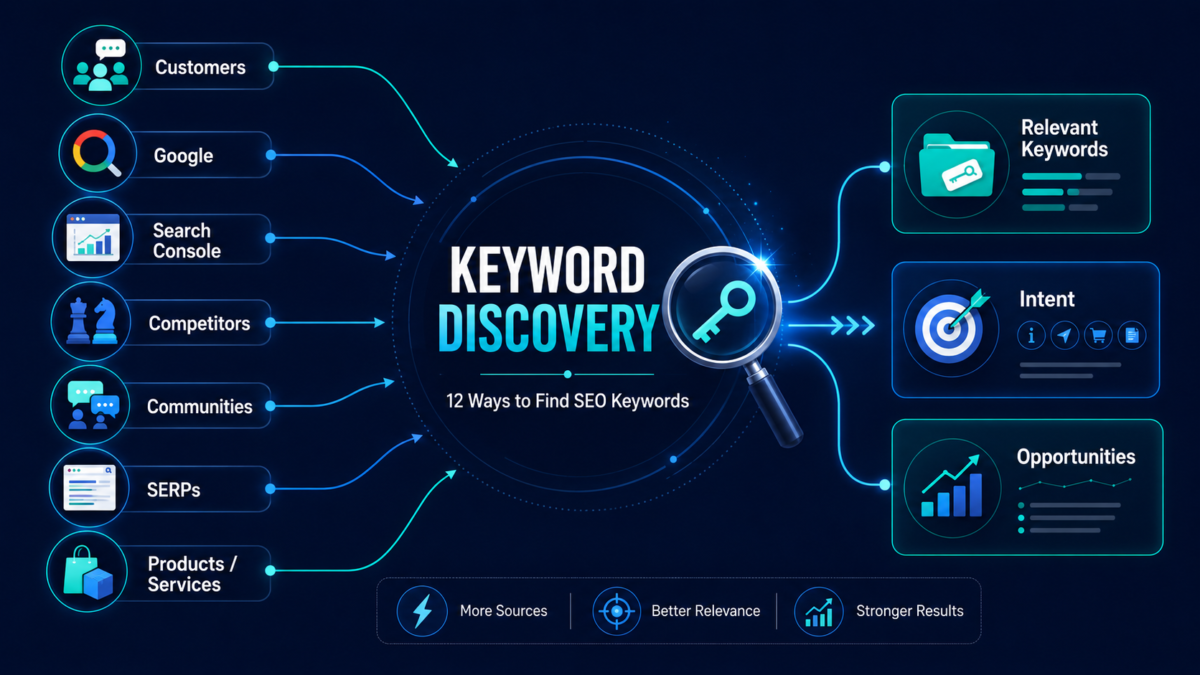
For example, your Keyword Discovery guide covers:
- customers
- Google suggestions
- Search Console
- competitors
- communities
- internal search
Each could lead to more specific queries such as:
- how to find keywords from customer questions
- how to use Search Console for keyword research
- how to find keywords on Reddit
- how to find competitor keyword gaps
Some belong inside the existing guide.
Some may become separate supporting content later.
Your existing site should continuously feed your future keyword research.
Use a Modifier Matrix
A modifier matrix is a simple way to expand long-tail opportunities systematically.
Suppose your seed keyword is:
keyword research
Now combine it with modifiers.
| Type | Modifier | Example |
|---|---|---|
| Audience | beginners | keyword research for beginners |
| Audience | ecommerce | keyword research for ecommerce |
| Problem | low competition | how to find low competition keywords |
| Tool | free | free keyword research tools |
| Format | checklist | keyword research checklist |
| Comparison | vs | Ahrefs vs Semrush keyword research |
| Intent | service | keyword research service |
| Stage | new website | keyword research for a new website |
This method is useful because it forces you to explore several dimensions of search demand.
Discover Question Keywords
Questions make excellent long-tail research inputs.
Use:
- who
- what
- when
- where
- why
- how
- can
- should
- does
- is
For example:
Seed: backlinks
Questions might include:
- what are backlinks
- why are backlinks important
- how do backlinks work
- how many backlinks do I need
- should I buy backlinks
- can backlinks hurt SEO
Question research can help you understand the educational journey around a topic.
Long-Tail Keywords and Search Intent
One long-tail phrase often gives you more information about intent than a broad query.
Consider:
WordPress
It is difficult to know exactly what the user wants.
Now compare:
how to speed up WordPress without changing hosting
This clearly suggests:
Intent: informational
Problem: website speed
Platform: WordPress
Constraint: existing hosting must remain
That level of specificity helps you create a much better answer.
This is why long-tail research and search intent analysis should work together.
Group Long-Tail Keywords by Intent
Suppose you discover:
- how to find long-tail keywords
- find long-tail keywords for SEO
- long-tail keyword research methods
- ways to discover long-tail keywords
These likely belong to one intent group.
You probably do not need four pages.
Now consider:
- long-tail keyword research tool
- best long-tail keyword tools
- free long-tail keyword tool
These may represent a more commercial tool-selection intent.
Potentially, that deserves a separate page.
Do Not Create One Page Per Long-Tail Keyword
This is one of the biggest risks of long-tail SEO.
You may discover:
- SEO for dentists
- SEO for dental practices
- dentist SEO
- dental SEO services
- SEO marketing for dentists
Does that mean five pages?
Probably not.
If the user need is essentially the same, those terms should usually be grouped.
The process should be:
Discover → Understand Intent → Cluster → Map to Page
not:
Discover → Publish
Creating pages for every variation can lead to:
- duplication
- cannibalization
- thin content
- confusing architecture
One strong page can often rank for many related long-tail queries.
Primary Keyword vs Supporting Long-Tail Keywords
A page can have one main focus and many supporting search opportunities.
For example:
Primary Keyword
long-tail keywords
Supporting Queries
- what are long-tail keywords
- long-tail keyword examples
- how to find long-tail keywords
- are long-tail keywords easier to rank for
- long-tail keyword research
- long-tail SEO keywords
You do not need separate pages for each variation.
A well-structured article can naturally cover them together.
How to Evaluate Long-Tail Keywords
After discovery, evaluate each opportunity.
1. Relevance
Does it matter to your audience?
A very specific keyword can still be irrelevant.
2. Search Intent
What is the user trying to accomplish?
3. Business Value
Could the search contribute to:
- leads
- sales
- subscriptions
- affiliate revenue
- product adoption
4. Search Demand
Is there evidence people search for it?
Remember that keyword-tool volumes are estimates.
5. Competition
What pages currently rank?
Could you create something genuinely useful enough to compete?
6. Existing Content
Does your site already have a page satisfying the intent?
If yes, improve the existing page rather than creating another one.
7. Strategic Fit
Does the topic strengthen an important pillar?
This final question is particularly important.
A keyword may be relevant but still not deserve priority today.
Do Zero-Volume Long-Tail Keywords Matter?
Sometimes.
A keyword tool showing:
0 searches
does not prove nobody searches for the phrase.
Keyword databases are estimates.
They may underrepresent:
- new queries
- niche B2B searches
- highly specific searches
- local searches
- low-frequency questions
However, this does not mean you should create pages for every zero-volume phrase.
Ask:
- Is the problem real?
- Do customers ask it?
- Does Search Console show related demand?
- Does it fit a broader page?
- Would answering it improve the content?
Sometimes the best solution is to include a zero-volume question as a section inside a larger page.
Long-Tail Keywords for New Websites
New websites can benefit from specific search opportunities, but avoid the simplistic advice:
Only target low-volume long-tail keywords because they are easy.
Instead, build a balanced content system.
Start with:
Foundational Pages
Broad topics necessary to establish context.
Supporting Pages
More specific questions around the foundation.
For example:
Pillar: Keyword Research
Supporting pages:
- Keyword Discovery
- Seed Keywords
- Long-Tail Keywords
- Keyword Difficulty
- Search Volume
- Keyword Clustering
This creates depth.
A new site needs both structural foundation and specific opportunities.
Long-Tail Keywords for Existing Websites
Established websites have a major advantage:
actual performance data.
Use Search Console to identify:
Position 8–20 Queries
These may represent optimization opportunities.
High-Impression, Low-Click Queries
These may reveal CTR or intent issues.
Unexpected Queries
These may reveal content gaps.
Queries Growing Over Time
These could indicate emerging demand.
You can then use SEO Testing to evaluate improvements such as:
- title changes
- additional sections
- internal links
- better intent alignment
Long-Tail Keywords for Ecommerce
Ecommerce offers many natural long-tail combinations.
For example:
Product:
running shoes
Audience
running shoes for women
Problem
running shoes for flat feet
Use Case
running shoes for marathon training
Feature
waterproof running shoes
Combination
women’s waterproof trail running shoes
Specific product searches can indicate strong purchase intent.
However, do not automatically create indexable pages for every filter combination.
Ecommerce sites need careful control over:
- faceted navigation
- duplicate URLs
- crawlability
- indexation
Long-Tail Keywords for Local SEO
Local searches naturally become more specific.
Examples:
- emergency plumber in Austin
- dentist open Saturday in Manchester
- wedding photographer in downtown Chicago
But local SEO does not mean generating hundreds of nearly identical pages.
A local landing page should provide genuine location-specific value.
Useful information could include:
- services available
- real local examples
- service areas
- directions
- reviews
- local proof
- contact information
The page should deserve to exist independently.
Long-Tail Keywords for SaaS
SaaS businesses can find specific opportunities through:
Audience
CRM for real estate teams
Feature
CRM with WhatsApp integration
Problem
automate sales follow-up
Comparison
HubSpot vs Pipedrive for agencies
Alternative
Salesforce alternatives for small businesses
Integration
CRM that integrates with Shopify
These queries can reveal users closer to product evaluation.
Long-Tail Keywords for B2B
Long-tail research is especially valuable in B2B.
Broad keywords can be enormous and vague.
For example:
ERP
versus:
ERP software for small manufacturing companies
The second query is narrower but much more commercially meaningful.
B2B modifiers can include:
- industry
- company size
- role
- integration
- feature
- use case
Examples:
- CRM for manufacturing sales teams
- accounting software for marketing agencies
- project management software for architecture firms
Traffic may be smaller.
Potential customer value may be much higher.
Long-Tail Keywords and Content Clusters
Long-tail research is one of the best ways to develop supporting content.
Suppose your topic is:
Keyword Research
Long-tail opportunities might reveal:
- how to find seed keywords
- how to identify keyword intent
- how to find competitor keywords
- how to group similar keywords
- how to map keywords to URLs
These questions can gradually become a useful topic cluster.
The key is to avoid overfragmentation.
Some questions deserve their own article.
Others belong as sections inside broader guides.
Long-Tail Keywords and Internal Linking
Specific supporting articles should connect back to broader resources.
For example:
Keyword Discovery
↓
Seed Keywords
↓
Long-Tail Keywords
↓
Keyword Clustering
↓
Keyword Mapping
This creates a logical progression for readers.
The previous article on Seed Keywords explains where the starting topics come from.
This guide explains how those seeds become more specific search opportunities.
Future articles on clustering and mapping can explain what happens next.
That relationship is much stronger than publishing unrelated articles with no internal structure.
Long-Tail Keywords and SEO Forecasting
Specific keywords can be useful inputs for forecasting, but avoid forecasting every query separately.
Instead, group similar long-tail searches.
Example:
Cluster
local SEO for small business
Supporting queries:
- local SEO for small companies
- local SEO tips for small business
- how small businesses do local SEO
- local SEO guide for small businesses
Then estimate demand at the cluster level.
Your SEO Forecasting guide explains how to convert keyword demand into conservative, expected, and higher-growth scenarios.
Long-Tail Keywords and SEO Ethics
Specific keyword discovery can tempt websites to generate enormous numbers of pages.
For example:
We found 30,000 keyword combinations, so let’s publish 30,000 AI pages.
That is not a sound strategy by itself.
Your scheduled SEO Ethics guide explains why scalable publishing should still be grounded in genuine usefulness.
Before creating a long-tail page, ask:
Does this search represent a sufficiently distinct user need to deserve a separate resource?
If the answer is no, consolidate it into a stronger page.
A Practical Long-Tail Keyword Workflow
Use this process.
Step 1: Start With Seed Keywords
Build your broad topic list.
Step 2: Expand the Seeds
Use:
- autocomplete
- related searches
- customer questions
- Search Console
- competitors
- communities
Step 3: Add Modifiers
Explore:
- audiences
- problems
- locations
- use cases
- comparisons
- questions
Step 4: Identify Search Intent
Determine what each query really wants.
Step 5: Cluster Similar Queries
Group variations that belong on the same page.
Step 6: Review Existing URLs
Avoid duplicating content you already have.
Step 7: Evaluate Opportunities
Assess:
- relevance
- demand
- competition
- business value
Step 8: Map the Cluster to a Page
Decide whether to:
- optimize an existing page
- create a new article
- expand a pillar page
Step 9: Add Internal Links
Connect supporting content to related pages.
Step 10: Measure Performance
Use Search Console and analytics to understand what happens.
That transforms long-tail research from a keyword list into a content system.
Long-Tail Keyword Checklist
Before selecting a long-tail opportunity, ask:
Relevance
- Does the query matter to our audience?
- Does it fit our business?
Intent
- What does the user actually want?
- Which page type should satisfy it?
Demand
- Is there evidence of real search interest?
- Do customers ask this question?
Competition
- What currently ranks?
- Can we create something genuinely useful?
Architecture
- Does this belong on an existing page?
- Does it deserve a new page?
- Which pillar does it support?
Value
- Could it contribute to leads, sales, or authority?
Execution
- Can we create the page properly?
- Do we have evidence, examples, or useful experience?
If the query passes these checks, it may deserve a place in your SEO roadmap.
Final Thoughts
Long-tail keywords help transform broad keyword research into specific understanding.
They reveal:
- who is searching
- what problem they have
- what they want to accomplish
- how close they may be to taking action
But successful long-tail SEO is not about finding thousands of low-volume phrases and publishing thousands of pages.
A stronger process is:
Seed Keyword → Specific Searches → Search Intent → Keyword Cluster → Useful Page → Internal Links → Measurement
Start broad enough to understand the market.
Then go deeper.
Study customer language.
Explore questions.
Review Search Console.
Analyze competitors.
Use modifiers.
Group related queries.
And create pages only when a distinct user need genuinely deserves one.
The objective is not to rank for the longest keyword.
The objective is to understand the most specific problems your audience is searching for—and create content that solves them better.