
SEO involves a lot of recommendations.
Change the title.
Add internal links.
Expand the content.
Improve page speed.
Update the introduction.
Change the page structure.
Add original images.
Refresh outdated information.
But there is an important question that often gets skipped:
Did the change actually improve performance?
That is where SEO testing becomes valuable.
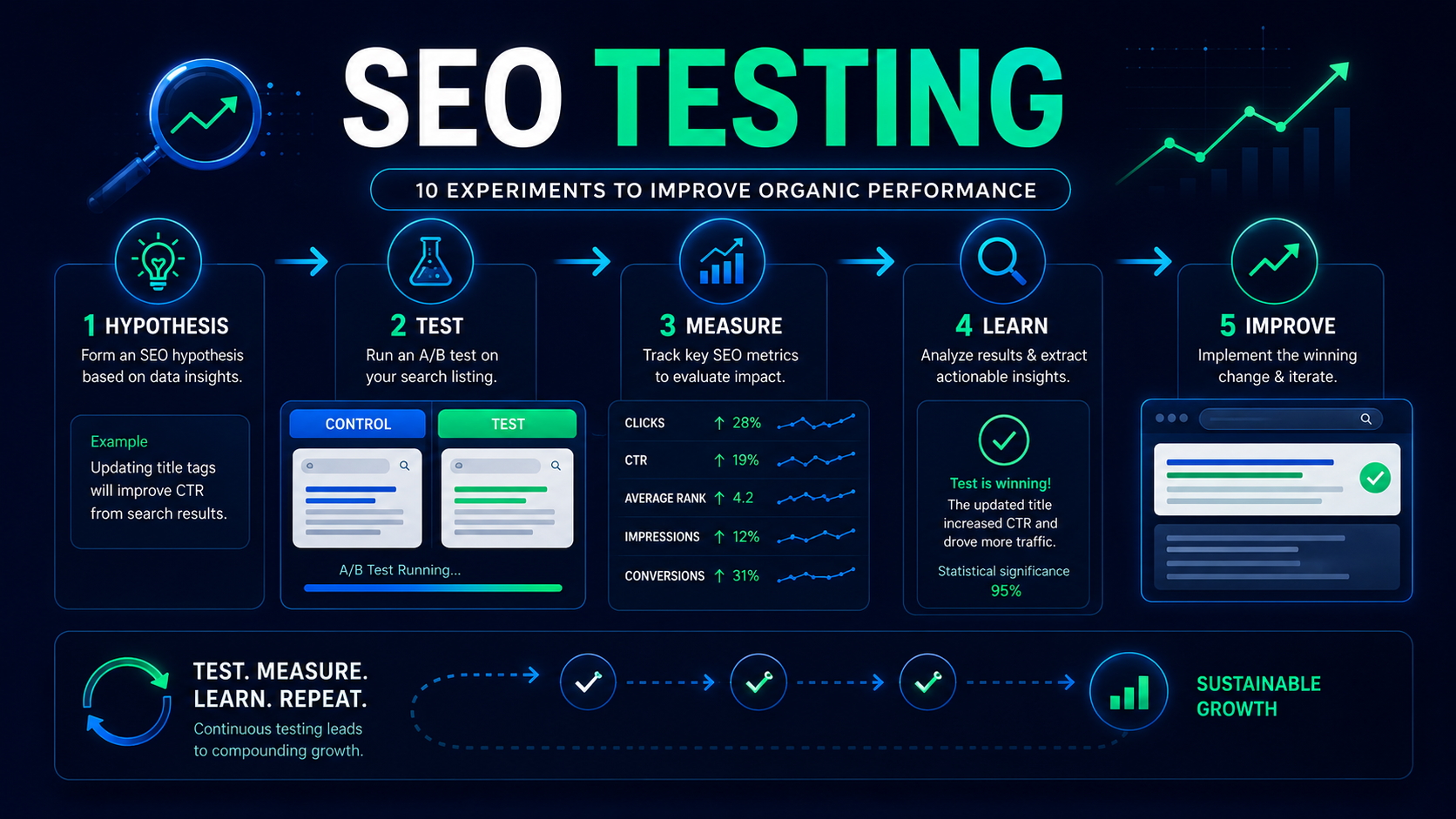
SEO testing is the process of making a controlled change, measuring what happens, and using the result to make better optimization decisions.
Instead of assuming that a tactic works because it is considered a “best practice,” testing allows you to ask:
- What exactly are we trying to improve?
- What change are we making?
- Which pages should be affected?
- What metric should move?
- How long should we collect data?
- What else could have caused the result?
- Should we keep, reverse, or expand the change?
SEO testing does not remove uncertainty from search optimization.
It helps you manage uncertainty more intelligently.
This guide explains how SEO testing works, how it differs from traditional A/B testing, which experiments you can run, how to measure results, and how to avoid common testing mistakes.
What Is SEO Testing?
SEO testing is a structured process for evaluating whether a specific website change contributes to improved organic search performance.
A basic SEO test follows this sequence:
Hypothesis → Baseline → Change → Measurement → Analysis → Decision
For example:
We believe adding relevant contextual internal links from high-authority articles to underlinked SEO guides will increase their organic impressions and clicks.
You could then:
- identify the pages being tested
- document their current performance
- implement the internal links
- monitor Search Console data
- compare performance
- account for other changes
- decide whether to expand the approach
The objective is not merely to change the website.
The objective is to learn something useful from the change.
Why SEO Testing Matters
Many SEO decisions are based on general best practices.
Those best practices can provide a strong starting point.
But websites differ.
A tactic that produces excellent results for one site may have little impact on another.
Differences can include:
- audience
- website authority
- technical setup
- search intent
- competition
- content quality
- site architecture
- brand recognition
- market demand
Testing helps you discover which improvements actually matter for your website.
SEO Testing Helps Reduce Guesswork
Without testing, optimization often follows this pattern:
Change something → Wait → See traffic increase → Assume the change caused it
The problem is that many other things may have happened simultaneously.
For example:
- search demand increased
- competitors lost rankings
- Google changed the SERP
- another article linked to the page
- the page gained backlinks
- seasonality changed
- multiple SEO changes were deployed together
A structured experiment makes the relationship easier to evaluate.
SEO Testing vs SEO Strategy
SEO testing should support your broader strategy.
Your SEO strategy determines the direction of the SEO program.
Testing helps improve specific decisions within that strategy.
For example:
Strategy
Build stronger visibility around SEO education topics.
Possible Tests
- improve article introductions
- add contextual internal links
- refresh outdated pages
- change title positioning
- improve content formatting
- add original visual explanations
Testing should not become random experimentation.
Every meaningful test should connect to a larger objective.
SEO Testing vs Traditional A/B Testing
Traditional A/B testing normally divides users between two versions.
For example:
Version A: Green button
Version B: Blue button
Then user behavior is compared.
SEO testing can be more complicated because search engines also crawl, render, index, and rank pages.
Showing Googlebot one version while deliberately showing human users another version can become cloaking, which violates Google’s spam policies.
Google’s guidance for website experiments specifically recommends avoiding cloaking. When tests use multiple URLs, Google recommends canonicalizing alternate versions to the original URL and using temporary 302 redirects rather than permanent 301 redirects where redirects are required. Google also recommends ending experiments once sufficient data has been collected rather than leaving test variations running unnecessarily.
That means SEO tests need to be designed with search-engine behavior in mind.
How Search Engines Affect SEO Testing
To test SEO properly, it helps to understand that changes may not be reflected immediately.
Search engines may need to:
- discover the changed URL
- crawl it again
- render the page where necessary
- process the new information
- update indexing systems
- reevaluate the page against relevant searches
Our guide to how search engines work explains this process in more detail.
This delay is one reason why SEO tests often need longer observation periods than conversion-rate experiments.
A button-color test may generate useful data quickly on a high-traffic site.
An SEO content change may require significantly more time before search performance stabilizes.
How to Run an SEO Test
A useful SEO experiment can be organized into nine stages.
Step 1: Identify the Problem
Do not start with:
What can we test?
Start with:
What problem are we trying to solve?
Examples include:
- high impressions but low clicks
- pages ranking between positions 8 and 20
- weak internal linking
- declining organic traffic
- low conversion rate from SEO traffic
- overlapping content
- slow templates
- poor mobile experience
Your SEO audit can be a valuable source of test ideas because it identifies problems that deserve investigation.
Step 2: Create a Clear Hypothesis
A good hypothesis predicts both the change and expected outcome.
Weak hypothesis:
Internal linking might help.
Better hypothesis:
Adding contextual internal links from closely related, established SEO articles to underlinked pages will increase organic impressions and clicks to the destination pages.
Another example:
Rewriting title tags to better align with search intent will improve organic CTR for pages already receiving substantial impressions.
A test needs a clear hypothesis so you know what result you are evaluating.
Step 3: Choose the Pages
Decide which pages will participate.
Depending on the experiment, you might use:
One Page
Useful for individual content tests.
A Group of Similar Pages
For example:
- blog articles
- product pages
- category pages
- location pages
Test and Control Groups
For larger sites, similar pages may be divided into:
Test group: receives the change.
Control group: remains unchanged.
This can make it easier to separate the effect of the experiment from wider changes in search demand or rankings.
Step 4: Establish the Baseline
Record performance before making the change.
Useful metrics can include:
- clicks
- impressions
- CTR
- average position
- organic sessions
- conversions
- revenue
- engagement
Google Search Console’s Performance reporting provides clicks, impressions, CTR, and average position, with breakdowns such as queries and pages.
Your existing SEO reporting process should make baseline collection much easier.
Step 5: Make One Meaningful Change
Whenever possible, avoid changing ten things at once.
Suppose you simultaneously:
- rewrite the title
- add 1,000 words
- redesign the page
- change the URL
- add 20 internal links
and organic traffic improves.
Which change caused the improvement?
You may never know.
Testing becomes more useful when the variable is reasonably isolated.
Real-world SEO does not always allow perfect isolation, but you should reduce unnecessary variables whenever possible.
Step 6: Allow Time for the Change to Be Processed
Do not measure the result the next morning and declare success.
SEO changes may require crawling and processing.
The appropriate duration depends on:
- site crawl frequency
- traffic
- ranking volatility
- number of tested pages
- type of change
- seasonality
Low-traffic sites usually need longer test periods than high-traffic sites.
Step 7: Measure the Right Metrics
Choose metrics that correspond to your hypothesis.
For a title test:
- impressions
- CTR
- clicks
- average position
For internal linking:
- impressions
- clicks
- ranking visibility
- discovery/indexing where relevant
For content optimization:
- queries
- impressions
- clicks
- conversions
For UX changes:
- conversions
- engagement
- organic landing-page performance
Search Console should generally be treated as the source of truth for Google Search performance, while Google Analytics is more useful for understanding what visitors do after arriving on the website. Google explicitly recommends using the two together because they measure different parts of the journey.
Step 8: Analyze Confounding Factors
Before declaring the test successful, ask what else changed.
Potential confounding factors include:
- seasonality
- algorithm updates
- competitor changes
- backlinks
- sitewide technical changes
- new internal links
- increased brand demand
- paid campaigns
- SERP changes
This does not mean you must prove causation with scientific certainty.
It means you should avoid claiming more than the evidence supports.
Step 9: Decide What Happens Next
Every test should end with a decision.
Keep
The result appears positive.
Expand
Apply the successful change to more relevant pages.
Modify
The idea may work, but the implementation needs refinement.
Reverse
Performance deteriorated or the change created problems.
Inconclusive
There was not enough evidence to make a decision.
An inconclusive test is not necessarily wasted effort.
It may tell you that the variable has less impact than expected.
10 Practical SEO Tests You Can Run
Now let’s look at SEO experiments that can produce useful insights.
1. Test SEO Titles
Title optimization is one of the most practical experiments for pages already receiving search impressions.
You might test:
Keyword Position
Before:
Complete Guide to Building an SEO Strategy
After:
SEO Strategy: Complete Guide to Building a Winning Plan
Benefit Language
Before:
SEO Reporting Guide
After:
SEO Reporting: 10 Metrics That Show What Is Working
Specificity
Before:
SEO Audit Guide
After:
SEO Audit: 12 Steps to Find and Fix SEO Problems
The goal is not to create clickbait.
The title should accurately represent the content.
What to Measure
Monitor:
- CTR
- clicks
- impressions
- ranking changes
Do not evaluate CTR without considering position.
Moving from position nine to position three can increase CTR even if the title itself had little effect.
2. Test Search Intent Alignment
One of the strongest SEO experiments is improving how closely a page matches the reason behind the search.
Imagine someone searches:
SEO audit checklist
but lands on a page containing mostly theoretical explanations.
You could test adding:
- a step-by-step checklist
- prioritization framework
- examples
- downloadable template
Our search intent guide explains how informational, navigational, commercial, and transactional searches require different content approaches.
What to Measure
- query growth
- impressions
- clicks
- average position
- engagement
- conversions
3. Test Content Refreshes
Older content can lose effectiveness because:
- examples become outdated
- screenshots change
- statistics become obsolete
- competing pages improve
- user expectations change
Choose a group of declining articles and update:
- inaccurate sections
- examples
- screenshots
- explanations
- internal links
- recommendations
Avoid adding words simply to make the article longer.
The goal should be to make the page more useful.
What to Measure
Compare:
- impressions
- clicks
- rankings
- query coverage
before and after the refresh.
4. Test Internal Linking
Internal linking is particularly suitable for structured testing.
Suppose several strong articles cover SEO Foundations.
You might add contextual links from those pages to a newer article about SEO testing.
For example, a discussion about using performance data inside the SEO forecasting guide could naturally point readers toward testing when explaining how forecasts should be validated with actual results.
You could then monitor whether the destination page gains:
- crawl frequency
- impressions
- clicks
- query visibility
Test Different Link Sources
You might compare links from:
- highly relevant articles
- category pages
- pillar pages
- high-traffic pages
Relevance should come before raw link quantity.
5. Test Content Structure
Two articles may contain similar information but provide very different reading experiences.
You can test improvements such as:
- shorter introductions
- clearer H2 headings
- summary tables
- step-by-step sections
- checklists
- examples
- comparison tables
- visual frameworks
The goal is not merely to make the page prettier.
Better structure can help users reach the information they need faster.
What to Measure
Consider:
- organic clicks
- conversions
- engagement
- scroll behavior
- supporting query growth
6. Test Page Depth and Completeness
Some pages may underperform because they do not answer enough of the searcher’s important questions.
Suppose an SEO forecasting guide explains traffic projections but says little about:
- scenarios
- conversion rates
- seasonality
- costs
- forecasting errors
Expanding those missing areas may improve the page’s usefulness.
However, more words do not automatically mean better SEO.
The test should focus on information gain, not word count.
What to Measure
- new queries
- impressions
- rankings
- clicks
- assisted conversions
7. Test Original Visual Content
Many SEO articles rely heavily on text.
Original visual explanations can improve understanding.
Possible experiments include:
- diagrams
- flowcharts
- screenshots
- original charts
- process maps
- comparison graphics
- calculators
- templates
For example, an SEO testing article could include a visual showing:
Hypothesis → Baseline → Test → Measure → Analyze → Decide
Compare pages with meaningful original visuals against similar content without them.
Do not add decorative graphics that provide no additional value.
8. Test Calls to Action
SEO performance should eventually connect with business objectives.
Imagine an informational article receives substantial traffic but almost no conversions.
Test a more relevant CTA.
Instead of:
Contact us today.
try:
Download the SEO Audit Checklist
or:
Continue with the SEO Project Planning Guide
Different stages of search intent require different next actions.
What to Measure
- CTA clicks
- newsletter signups
- downloads
- leads
- assisted conversions
Remember that this is primarily a conversion test, but it helps determine whether organic traffic is creating useful business outcomes.
9. Test Page Performance Improvements
Technical improvements can also be tested.
For example, identify templates with poor performance and improve:
- image loading
- JavaScript
- CSS delivery
- server response
- layout stability
- mobile usability
Then compare performance and organic outcomes.
Avoid making changes purely to achieve a perfect testing-tool score.
The real goal is a faster, more stable, more usable website.
Technical SEO changes should also be evaluated for crawlability and rendering. Google’s developer guidance recommends making content accessible, secure, fast, and usable across devices, and provides tools such as URL Inspection to see how Google processes pages.
10. Test Content Consolidation
Sometimes the best SEO experiment is removing duplication.
Suppose you have:
- SEO reporting guide
- SEO reports explained
- how to create SEO reports
- monthly SEO reporting
and all four pages target almost the same search intent.
You might consolidate the strongest information into one comprehensive page and redirect outdated duplicates where appropriate.
Then monitor:
- combined impressions
- clicks
- ranking stability
- backlinks
- conversions
Content consolidation should be planned carefully.
Do not merge pages simply because they contain similar keywords.
They may serve genuinely different user needs.
SEO Split Testing
Large websites can conduct more advanced SEO split tests.
Instead of changing individual pages one at a time, similar pages are divided into groups.
For example, an ecommerce website may have hundreds of category pages.
Control Group
50 category pages remain unchanged.
Test Group
50 comparable category pages receive a new content module.
The performance of the groups can then be compared.
This approach can help control for broader trends affecting the entire website.
It is particularly useful for:
- ecommerce
- marketplaces
- directories
- large publishers
- programmatic websites
However, good group selection and statistical analysis are important.
Poorly matched groups can produce misleading conclusions.
A/B Testing With Multiple URLs
Sometimes experiments use separate URLs for variations.
When doing this, search-specific technical considerations matter.
Google currently recommends:
- do not cloak testing pages
- use
rel="canonical"on alternate test URLs pointing toward the preferred original URL - use
302temporary redirects rather than301permanent redirects when users are temporarily redirected during an experiment - remove test variations once the experiment is complete
These practices help communicate that the variations are temporary rather than independent permanent pages.
Build an SEO Testing Backlog
Not every idea should be implemented immediately.
Create a backlog of potential experiments.
For example:
| Test | Hypothesis | Priority |
|---|---|---|
| Rewrite titles | Higher relevance will improve CTR | High |
| Add internal links | More relevant links will improve visibility | High |
| Update older articles | Fresh information will recover traffic | High |
| Add diagrams | Better explanations will improve engagement | Medium |
| Change CTA | More relevant CTA will improve conversions | Medium |
Then prioritize tests based on:
- potential impact
- effort
- traffic available
- business importance
- confidence in the hypothesis
Your SEO project planning guide provides a useful framework for turning ideas like these into an organized execution process.
SEO Testing Metrics
The right metric depends on the experiment.
Search Visibility Metrics
Use:
- impressions
- query coverage
- average position
Traffic Metrics
Use:
- clicks
- organic sessions
- landing-page visits
SERP Engagement Metrics
Use:
- CTR
Business Metrics
Use:
- leads
- sales
- revenue
- newsletter subscriptions
- downloads
Technical Metrics
Use:
- crawlability
- indexation
- page performance
- Core Web Vitals
Do not choose ten primary metrics for one experiment.
Choose the metric that most directly answers the hypothesis.
Use Search Console and Analytics Together
SEO experiments often cross two different environments.
Before the Click
Search Console helps explain:
- impressions
- clicks
- CTR
- search queries
- average positions
After the Click
Analytics helps explain:
- sessions
- engagement
- events
- conversions
- revenue
Google notes that Search Console and Google Analytics measure different systems, so comparable metrics such as clicks and sessions will not always match exactly. What matters more is understanding the role of each dataset and analyzing trends appropriately.
This is why SEO testing should not rely on one dashboard alone.
How Long Should an SEO Test Run?
There is no universal answer.
A reasonable test duration depends on:
- organic traffic volume
- number of pages
- crawl frequency
- ranking volatility
- seasonality
- type of experiment
- size of expected effect
A high-traffic ecommerce website may gather useful data relatively quickly.
A new blog may require substantially longer.
Avoid ending a test because the first few days look positive.
Likewise, do not keep experiments running indefinitely.
Google specifically recommends running website experiments only as long as necessary to obtain reliable data.
Compare Forecasts With Experiments
Testing becomes particularly useful after forecasting.
Your SEO forecasting guide may predict:
Improving internal linking across this cluster should increase organic visibility.
SEO testing allows you to validate that assumption.
The relationship becomes:
Forecast → Experiment → Actual Result → New Assumption
Over time, your forecasts become better because they incorporate evidence from your own website.
Document Every SEO Test
Keep a simple testing log.
Record:
Test Name
Internal Linking Test — SEO Foundations
Hypothesis
Adding contextual links from established SEO articles will increase search visibility for newer supporting pages.
Start Date
When was the change implemented?
Test Pages
Which URLs changed?
Control Pages
Which comparable pages remained unchanged?
Primary Metric
Organic clicks.
Secondary Metrics
Impressions and average position.
Changes Made
Document exactly what was changed.
Result
Positive, negative, neutral, or inconclusive.
Decision
Roll out, modify, reverse, or test again.
Without documentation, teams often repeat the same experiments months later.
Common SEO Testing Mistakes
Testing Without a Hypothesis
Random changes produce random lessons.
Know what you expect before starting.
Changing Too Many Variables
If everything changes, attribution becomes difficult.
Measuring Too Early
Search engines need time to process changes.
Ignoring Seasonality
Comparing December with January may produce misleading conclusions in some industries.
Testing Pages With Almost No Traffic
Low data volume can make results difficult to interpret.
Declaring Correlation as Causation
Traffic rising after an update does not prove the update caused the increase.
Ignoring Conversions
A change that increases traffic but decreases qualified leads may not be an improvement.
Testing for Plugin Scores
Do not design experiments around increasing an arbitrary SEO-plugin percentage.
Test outcomes that matter to users and the business.
Ignoring Search Intent
A technically optimized page can still fail if it answers the wrong question.
Never Recording Results
Testing only becomes an organizational advantage when the lessons are preserved.
SEO Testing for New Websites
New websites have a challenge:
limited data.
Instead of trying to run sophisticated split tests immediately, focus first on establishing strong SEO fundamentals.
Early experiments might include:
- title improvements
- internal linking
- content structure
- CTAs
- updating pages receiving early impressions
As traffic grows, more controlled testing becomes possible.
Do not delay important foundational SEO simply because you cannot run a perfect experiment.
Some practices should be implemented because they are necessary for crawling, indexing, accessibility, security, or usability.
SEO Testing for Established Websites
Established websites generally have better testing opportunities because they have:
- more traffic
- more pages
- historical data
- established rankings
- conversion data
They can test:
- templates
- content modules
- internal-link structures
- titles
- structured page elements
- content refreshes
- consolidation
- performance improvements
Large sites may also have enough comparable pages for test and control groups.
SEO Testing for Ecommerce
Ecommerce sites have many repeatable templates.
Potential experiments include:
- category-page copy
- internal product links
- filter handling
- product-description structure
- category headings
- image optimization
- related-product modules
- structured content blocks
Test carefully because template changes can affect thousands of URLs.
A small mistake can become a very large SEO problem when deployed sitewide.
SEO Testing for Local Businesses
Local websites can experiment with:
- service-page titles
- location-page structure
- testimonials
- local proof
- service-area explanations
- calls to action
- FAQs
- internal links between services and locations
Measure both SEO performance and business outcomes such as:
- calls
- bookings
- forms
- direction requests
The highest-ranking variation is not necessarily the best variation if it generates weaker leads.
Create a Continuous SEO Improvement Cycle
SEO testing should not be treated as a one-time project.
A mature workflow looks like:
Audit → Identify Opportunity → Hypothesis → Test → Measure → Learn → Roll Out → Test Again
Your audit identifies problems.
Your strategy determines priorities.
Your project plan organizes implementation.
Your reporting system measures performance.
Your forecasting estimates potential outcomes.
SEO testing closes the loop by validating assumptions.
This is why testing is such an important part of a mature SEO process.
SEO Testing Checklist
Before launching an SEO test, confirm the following.
Objective
- The problem is clearly defined.
- The desired outcome is clear.
- The test supports a strategic goal.
Hypothesis
- The proposed change is specific.
- The expected result is documented.
- The primary metric is defined.
Baseline
- Pre-test performance is recorded.
- Seasonality has been considered.
- Major external changes are documented.
Implementation
- Test pages are defined.
- Control pages are used where appropriate.
- Changes are documented.
- Search-engine accessibility is protected.
Measurement
- Search Console data is available.
- Analytics data is available where needed.
- Conversions are tracked where relevant.
Analysis
- Enough time has passed.
- External factors are considered.
- Results are compared with the hypothesis.
Decision
- Keep, expand, modify, reverse, or classify as inconclusive.
- The result is documented.
- The lesson is added to future planning.
Final Thoughts
SEO testing turns optimization from a collection of assumptions into a process of continuous learning.
The basic framework is:
Observe → Hypothesize → Change → Measure → Analyze → Decide
You will not be able to test everything perfectly.
Search engines are dynamic systems, and many factors change simultaneously.
That does not make testing useless.
It means you should be disciplined about what you claim.
Instead of saying:
This SEO tactic always works.
a stronger conclusion is:
We tested this change across these pages, during this period, and observed this result.
That is much more valuable.
The most successful SEO programs do not simply follow best practices forever.
They establish strong fundamentals, measure performance, test meaningful improvements, document what they learn, and use those lessons to make the next decision better.