
Keyword research becomes useful only when keywords are assigned to the right pages.
You can discover thousands of search queries, analyze their volume, evaluate difficulty, group them into clusters, and study the search results.
But one important question still remains:
Which page should target each keyword cluster?
That is the purpose of keyword mapping.
Keyword mapping is the process of assigning a keyword or keyword cluster to a specific existing or planned URL based on search intent, page type, business purpose, and site architecture.
A good keyword map helps prevent several common SEO problems:
- multiple pages targeting the same search intent
- important keywords having no suitable page
- blog posts competing with service pages
- unnecessary duplicate content
- weak internal linking
- unclear site architecture
- content teams publishing overlapping articles
Instead of treating keyword research as a spreadsheet full of phrases, keyword mapping turns it into a structured website plan.
A practical workflow looks like:
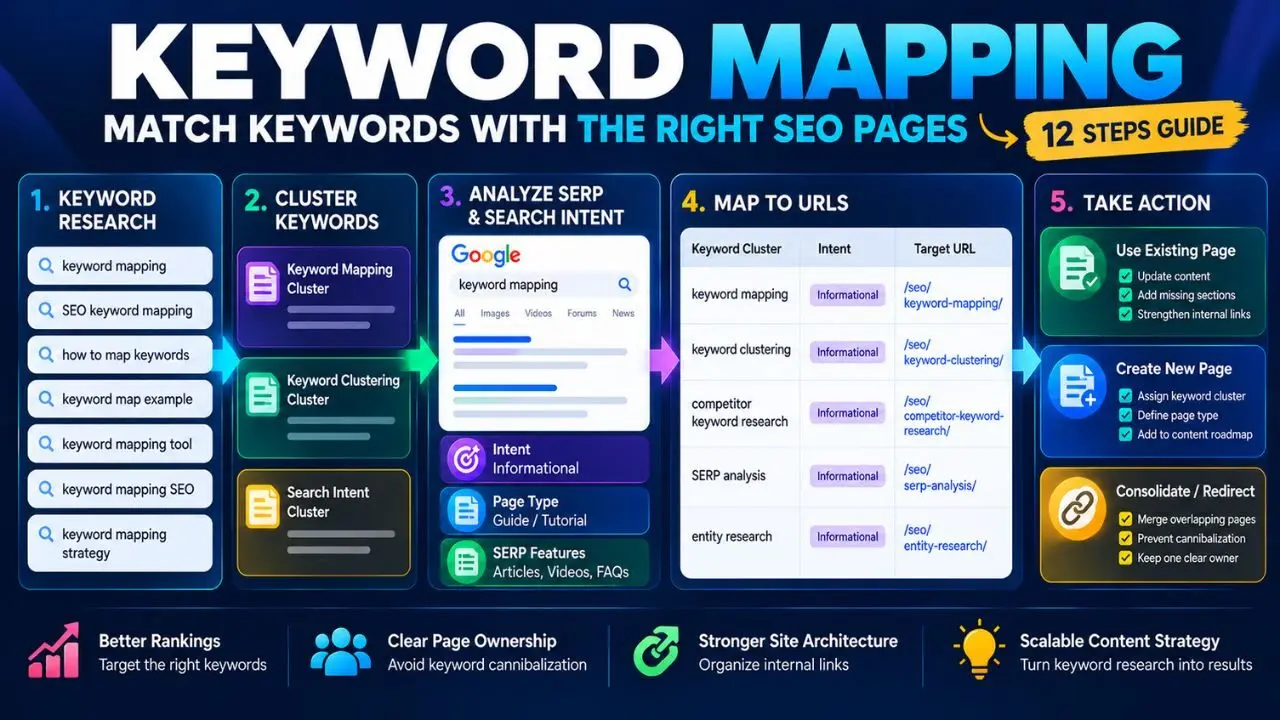
Keyword Discovery → Keyword Evaluation → Keyword Clustering → SERP Analysis → Keyword Mapping → Content Creation → Internal Linking
The goal is simple:
one primary intent → one clear page owner
This guide explains how keyword mapping works, how to assign keywords to URLs, how to handle existing pages, how to prevent cannibalization, and how to build a keyword map that can guide content production for years.
What Is Keyword Mapping?
Keyword mapping is the process of assigning target keywords and keyword clusters to specific URLs on a website.
A keyword map typically connects:
- primary keyword
- secondary keywords
- long-tail variations
- search intent
- page type
- target URL
- content status
- internal links
For example:
| Keyword Cluster | Search Intent | Target URL |
|---|---|---|
| keyword discovery | Informational | /seo/keyword-discovery/ |
| seed keywords | Informational | /seo/seed-keywords/ |
| keyword difficulty | Informational | /seo/keyword-difficulty/ |
| keyword clustering | Informational | /seo/keyword-clustering/ |
| keyword mapping | Informational | /seo/keyword-mapping/ |
The map establishes ownership.
Once keyword mapping belongs to /seo/keyword-mapping/, another article should not be created later targeting essentially the same intent.
That simple discipline can prevent major content problems as a site grows.
Why Keyword Mapping Matters
Without keyword mapping, content planning often becomes reactive.
A writer may create:
How to Map Keywords to Pages
Then several months later another writer publishes:
Keyword Mapping Guide for SEO
Later someone creates:
How to Build an SEO Keyword Map
All three pages may target the same intent.
The result can be:
- duplicated effort
- overlapping rankings
- inconsistent internal links
- diluted backlinks
- unclear page ownership
A keyword map prevents this by documenting what each page is supposed to own.
Keyword Mapping Turns Research Into Architecture
Research finds opportunities.
Mapping decides where those opportunities belong.
Your Keyword Clustering guide explains how related queries are grouped into clusters.
Keyword mapping takes the next step:
Cluster → URL
For example:
Cluster
- keyword mapping
- SEO keyword mapping
- how to map keywords
- keyword map for SEO
- keyword mapping example
Target URL
/seo/keyword-mapping/
One page can satisfy the cluster.
You do not need five URLs.
Keyword Mapping vs Keyword Clustering
These concepts are closely connected.
Keyword Clustering
Answers:
Which keywords belong together?
Keyword Mapping
Answers:
Which page should own that group?
Suppose you have:
- how to find seed keywords
- seed keyword examples
- SEO seed keywords
- what are seed keywords
Clustering determines that these belong together.
Mapping assigns them to:
/seo/seed-keywords/
The two steps should happen in sequence.
Keyword Mapping vs Content Mapping
Keyword mapping focuses primarily on search queries and page ownership.
Content mapping can be broader.
It may include:
- audience stage
- funnel stage
- content format
- customer journey
- business objective
A strong SEO system can combine both.
For example:
| Keyword | Intent | Funnel Stage | Page |
|---|---|---|---|
| what is SEO | Informational | Awareness | SEO Fundamentals |
| SEO audit checklist | Informational | Consideration | SEO Audit |
| SEO audit service | Transactional | Decision | SEO Audit Service |
This helps SEO support the entire customer journey rather than only informational traffic.
12 Steps to Build a Keyword Map
Step 1: Collect Your Keyword Research
Start with the keyword universe you have already built.
Potential sources include:
- seed keywords
- long-tail research
- competitor research
- Search Console
- customer questions
- content gap analysis
At this stage, the goal is not to map every keyword individually.
You first need a clean, relevant research set.
If the list is still messy, go back to your Keyword Discovery guide before mapping.
Step 2: Remove Irrelevant Keywords
Eliminate queries that do not fit:
- your audience
- services
- products
- market
- content strategy
For example, if your website teaches professional digital marketing, a keyword with large volume but no meaningful connection to your audience should not receive a page simply because it is popular.
Keyword maps should represent strategy.
They should not become storage for every phrase a tool can export.
Step 3: Group Keywords Into Clusters
Before assigning URLs, group keywords that represent the same or very similar intent.
For example:
- keyword mapping
- SEO keyword mapping
- how to map keywords
- keyword map SEO
These likely belong together.
Your Keyword Clustering guide explains how to use:
- semantic similarity
- search intent
- SERP overlap
to make these decisions.
Do not map every keyword variation to a different page.
Map the cluster.
Step 4: Identify Search Intent
Now define what the searcher wants.
Common categories include:
- informational
- navigational
- commercial investigation
- transactional
- local
This step matters because similar keywords can require completely different pages.
Consider:
keyword research
and:
keyword research service
The first is primarily educational.
The second is commercial.
Mapping them both to one informational article may weaken the experience.
Your Search Intent guide provides the framework for deciding what each query needs.
Step 5: Analyze the SERP
Before assigning the cluster to a URL, inspect the actual search results.
Ask:
- What page types rank?
- What formats appear?
- Is the intent clear?
- Do the same URLs rank for related terms?
Your SERP Analysis guide explains this process in detail.
SERP analysis helps prevent mapping a keyword to the wrong page type.
For example:
Query
keyword mapping tool
If the SERP is dominated by software tools, mapping that query to a long educational article may be weak.
Query
how to do keyword mapping
If guides dominate, an instructional article makes sense.
Step 6: Inventory Existing Pages
Before creating new URLs, review what already exists.
Document:
- URL
- title
- topic
- primary keyword
- search intent
- ranking queries
Then ask:
Do we already have a suitable page for this cluster?
This is critical.
A surprising number of “new content ideas” should actually become updates to existing pages.
Step 7: Match Clusters to Existing URLs
If a suitable page exists, assign the keyword cluster to it.
For example:
Cluster
keyword difficulty
Existing URL
/seo/keyword-difficulty/
Action:
Map to existing page
Do not create another article.
Then review whether the current page fully satisfies the cluster.
You may need to:
- expand sections
- improve headings
- add examples
- strengthen internal links
Mapping is not only for new content.
It also guides optimization.
Step 8: Create Planned URLs for Missing Clusters
If no appropriate page exists, create a planned URL.
Example:
Cluster
entity research SEO
Planned URL
/seo/entity-research/
Record the page as:
Planned
rather than publishing immediately.
This helps keep your content roadmap organized.
It also prevents someone else from later creating a duplicate page.
Step 9: Select One Primary Keyword
Each mapped page should have a clear primary keyword.
The primary keyword should usually represent:
- the dominant intent
- the clearest topic
- natural language
- strategic relevance
For this article:
Primary keyword: keyword mapping
Supporting terms can include:
- SEO keyword mapping
- keyword map
- keyword mapping strategy
- how to map keywords
The primary keyword defines the ownership.
Supporting keywords expand the coverage.
Step 10: Add Secondary and Long-Tail Keywords
Now document the related phrases that belong to the page.
Example:
Primary
keyword mapping
Secondary
- SEO keyword mapping
- keyword mapping strategy
- keyword map
- keyword-to-URL mapping
Long-Tail
- how to map keywords to pages
- how to create an SEO keyword map
- keyword mapping example
- keyword mapping spreadsheet
This gives the writer a clear content brief.
It also reduces the temptation to create separate articles for every minor variation.
Step 11: Define Internal Linking
A keyword map becomes much more useful when it also identifies relationships between pages.
For example:
Keyword Clustering
→ Keyword Mapping
SERP Analysis
→ Keyword Mapping
Keyword Mapping
→ Entity Research
These relationships can become internal links.
Internal linking should reflect the knowledge structure rather than simply maximizing link quantity.
Use descriptive anchors such as:
map keyword clusters to URLsanalyze search results before mappingorganize keywords by intent
This helps users understand the next logical step.
Step 12: Assign Ownership and Status
Every row in the keyword map should have a clear status.
Examples:
- Owned
- Planned
- Draft
- Published
- Refresh
- Consolidate
- Redirect
- Ignore
Also define one URL as the owner of each primary intent.
This is one of the most valuable controls in a large content system.
For example:
Primary query: keyword mapping
Intent: informational
Owner: /seo/keyword-mapping/
No other page should target the same combination.
A Practical Keyword Mapping Example
Suppose you research these terms:
- keyword mapping
- SEO keyword mapping
- how to map keywords
- keyword map example
- keyword mapping spreadsheet
- keyword clustering
- keyword grouping
- keyword clustering examples
- competitor keywords
- competitor keyword analysis
After clustering and mapping, the structure might become:
| Primary Cluster | Supporting Terms | URL |
|---|---|---|
| Keyword Mapping | SEO keyword mapping, keyword map example | /seo/keyword-mapping/ |
| Keyword Clustering | keyword grouping, clustering examples | /seo/keyword-clustering/ |
| Competitor Keyword Research | competitor keywords, competitor analysis | /seo/competitor-keyword-research/ |
Ten phrases became three page owners.
This is much cleaner than publishing ten articles.
Map Keywords to Search Intent, Not Just Words
Word similarity can be misleading.
Consider:
SEO audit
and:
SEO audit service
The words are nearly identical.
The intent is different.
SEO Audit
Likely informational or mixed.
SEO Audit Service
Commercial or transactional.
Those may need separate URLs.
Now consider:
SEO audit guide
and:
how to do an SEO audit
Different wording.
Same underlying intent.
Those may belong on one page.
A keyword map should reflect what users want, not merely which words overlap.
Map Keywords to the Correct Page Type
Each keyword cluster should match an appropriate page type.
Common page types include:
- blog guide
- pillar page
- service page
- category page
- product page
- comparison
- tool
- template
- landing page
Consider:
Keyword
best keyword research tools
Likely page type:
Comparison/list.
Keyword
keyword research service
Likely page type:
Service page.
Keyword
what is keyword research
Likely page type:
Educational guide.
The wrong page type can make ranking much harder even if the content is excellent.
Keyword Mapping for Existing Websites
Existing sites often have messy history.
You may discover:
- duplicate pages
- overlapping articles
- outdated URLs
- pages targeting no clear keyword
- several pages ranking for the same cluster
Keyword mapping can help clean this up.
For every cluster, ask:
Which current URL should own this intent?
Then choose.
Possible actions include:
Keep
One page already clearly owns the intent.
Merge
Two or more pages overlap heavily.
Redirect
An outdated page should point to the stronger owner.
Reposition
A page can target a different intent.
Refresh
The correct owner exists but needs improvement.
This process can be more valuable than constantly publishing new pages.
Keyword Mapping for New Websites
New websites have a major advantage.
You can establish ownership before publishing.
A simple plan might look like:
| Cluster | URL | Status |
|---|---|---|
| Keyword Discovery | /seo/keyword-discovery/ | Published |
| Seed Keywords | /seo/seed-keywords/ | Published |
| Keyword Metrics | /seo/keyword-metrics/ | Published |
| Keyword Difficulty | /seo/keyword-difficulty/ | Published |
| Keyword Mapping | /seo/keyword-mapping/ | Planned |
This structure reduces future duplication.
It also makes content sequencing easier.
Keyword Mapping and Cannibalization
Keyword cannibalization occurs when multiple pages compete unnecessarily for the same or highly similar search intent.
For example:
/seo/keyword-mapping-guide//seo/how-to-map-keywords//seo/seo-keyword-map/
If all three pages target the same intent, your site may have created unnecessary competition.
Keyword mapping prevents this by establishing:
one intent owner
However, do not assume every overlapping keyword is cannibalization.
Two pages may legitimately rank for similar vocabulary if they serve different intents.
Example:
Educational
keyword mapping
Commercial
keyword mapping tool
Related words.
Potentially different pages.
Intent determines ownership.
Keyword Mapping and Content Gap Analysis
Your Content Gap Analysis guide helps identify missing topics or intents.
Keyword mapping determines what happens next.
Suppose gap analysis reveals:
- entity research
- zero-volume keywords
- international keyword research
The map turns them into planned pages:
/seo/entity-research//seo/zero-volume-keywords//seo/international-keyword-research/
This transforms gaps into a controlled publishing roadmap.
Keyword Mapping and Competitor Research
Competitor research can produce thousands of keyword opportunities.
Do not map those keywords immediately.
First:
filter → cluster → validate → map
Your Competitor Keyword Research guide explains how to identify useful competitor opportunities without copying their content plan.
The keyword map should contain only opportunities that fit your own strategy.
Keyword Mapping and Keyword Difficulty
Difficulty can influence prioritization.
Suppose two clusters are mapped:
Cluster A
Difficulty: Low
Business value: Medium
Cluster B
Difficulty: High
Business value: Very High
Both may belong in your map.
They simply have different priorities.
The keyword map defines ownership.
Your publishing roadmap defines timing.
That distinction is important.
Do not remove strategically important clusters just because they are difficult.
Keyword Mapping and Search Volume
Search volume can help prioritize pages.
But it should not determine ownership.
A cluster with:
100 searches per month
may still need its own page if:
- intent is distinct
- business value is high
- user need is clear
Likewise, a keyword with:
50,000 searches
does not deserve a page if it is irrelevant.
Use volume as one signal.
Not the architecture.
Keyword Mapping and Business Value
Every mapped page should support a reason for existing.
Possible reasons include:
- traffic acquisition
- lead generation
- product discovery
- topical authority
- customer education
- conversion support
For example:
Informational page
Keyword Mapping Guide
Purpose:
Build expertise and support the Keyword Research pillar.
Commercial page
SEO Keyword Research Service
Purpose:
Generate qualified leads.
Two pages can be related but play completely different business roles.
Keyword Mapping and the Buyer Journey
A strong keyword map can include funnel stage.
For example:
| Keyword | Stage | Page Type |
|---|---|---|
| what is CRM | Awareness | Guide |
| best CRM software | Consideration | Comparison |
| HubSpot vs Salesforce | Evaluation | Comparison |
| CRM pricing | Decision | Commercial |
This helps ensure your site does not build only top-of-funnel content.
A website needs pathways from learning to action.
Keyword Mapping for Ecommerce
Ecommerce keyword mapping can become complex.
Queries may map to:
- category pages
- product pages
- filters
- buying guides
For example:
Keyword
running shoes
→ Category page
Keyword
best running shoes for beginners
→ Buying guide
Keyword
Nike Pegasus 43
→ Product page
Keyword
running shoes for flat feet
→ Category, filter, or guide depending on the SERP and catalog
Do not automatically create indexable pages for every filter combination.
The map should reflect genuine user needs and crawl strategy.
Keyword Mapping for SaaS
SaaS sites often need several page types.
For example:
Informational
what is CRM
→ Educational guide
Feature
CRM automation
→ Feature page
Use Case
CRM for agencies
→ Industry/use-case page
Comparison
HubSpot vs Salesforce
→ Comparison page
Commercial
CRM pricing
→ Pricing page
A good map prevents blog content from competing with commercial pages.
Keyword Mapping for Local SEO
Local keyword mapping often combines:
Service + Location
Example:
SEO consultant Karachi
Possible URL:
/seo-consultant-karachi/
But only create location pages when they represent a genuine service area and can provide unique value.
Do not create:
- hundreds of near-identical city pages
- pages for places you do not serve
- pages that simply swap city names
The map should reflect the actual business.
Keyword Mapping for B2B
B2B keywords often have lower search volumes but high value.
For example:
CRM for manufacturing companies
may map to:
/crm/manufacturing/
Even if volume is modest, the page can be strategically important.
B2B maps should consider:
- industry
- role
- use case
- company size
- buying stage
Business value frequently matters more than search volume.
Build a Keyword Mapping Spreadsheet
A practical keyword map can include:
| Column | Purpose |
|---|---|
| Article ID | Unique content identifier |
| Primary Keyword | Main query owner |
| Secondary Keywords | Supporting terms |
| Search Intent | User goal |
| Cluster | Topic grouping |
| Page Type | Guide, service, category, etc. |
| URL | Page owner |
| Status | Planned, draft, published |
| Priority | Publishing order |
| Internal Links In | Pages that should link here |
| Internal Links Out | Related destinations |
| Cannibalization Check | Overlap review |
| Notes | Strategic context |
This becomes a useful source of truth.
In fact, your own content system already follows this principle by giving each planned article a unique ID, cluster, primary query, and intent owner. The workbook explicitly assigns keyword mapping to A-0022 and states that no other page should target the same primary query and intent.
How to Prioritize a Keyword Map
Once mapping is complete, pages still need to be prioritized.
Consider:
Business Value
Does the page support meaningful goals?
Search Opportunity
Is demand worthwhile?
Difficulty
Can the site realistically compete?
Strategic Dependency
Does another page need this content first?
Existing Momentum
Does an existing page already rank?
Production Effort
How difficult is the page to create?
For example, a page with medium traffic potential may be prioritized because it completes an important content cluster.
SEO planning is not simply:
highest search volume first.
Keyword Mapping and Internal Links
Keyword maps can become internal-link maps.
If two pages are closely related, record the relationship.
For example:
SERP Analysis
links to:
Keyword Mapping
because mapping comes after evaluating the search results.
Keyword Mapping
links to:
Keyword Clustering
because clustering explains how keyword groups are formed.
This creates intentional navigation.
It also makes internal linking much easier during publishing.
Keyword Mapping and Anchor Text
Use descriptive anchors.
Weak:
read more
Better:
learn how keyword clustering works
Weak:
click here
Better:
map keyword clusters to the correct URL
Anchor text should explain the destination.
Avoid forcing the exact primary keyword into every internal link.
Natural variation is better for readers.
Keyword Mapping and Content Briefs
Once a cluster is mapped, it can become a content brief.
A useful brief might include:
Primary Keyword
keyword mapping
Secondary Terms
SEO keyword mapping, keyword map, keyword-to-URL mapping
Intent
Informational
Page Type
Comprehensive guide
Target URL
/seo/keyword-mapping/
Internal Links
SERP Analysis, Keyword Clustering, Content Gap Analysis
Next Page
Entity Research
This gives writers clear boundaries.
It also prevents overlap with neighboring articles.
Updating the Keyword Map After Publishing
A keyword map should not remain static forever.
Update it when:
- pages are published
- URLs change
- articles are consolidated
- new keywords emerge
- search intent shifts
- content is refreshed
For example:
Before
Status: Planned
After Publishing
Status: Published
Add:
- live URL
- publication date
- internal links
- ranking data
The map then becomes part of ongoing SEO operations.
Measuring Whether Keyword Mapping Works
Mapping itself is not a ranking factor you can measure directly.
Instead, evaluate whether the system improves:
- content ownership
- cannibalization control
- internal linking
- rankings
- content production efficiency
- topic coverage
Useful indicators include:
Fewer Overlapping Pages
Teams stop publishing duplicate intent.
Clearer Rankings
One primary URL consistently ranks for the cluster.
Better Internal Links
Related pages connect logically.
Faster Content Planning
Writers know what each page should target.
Stronger Topic Coverage
Important clusters have clear owners.
That is the practical value of keyword mapping.
Common Keyword Mapping Mistakes
Mapping One Keyword to Every Page
Each page needs a distinct primary intent.
Creating One Page Per Keyword
Map clusters, not minor variations.
Ignoring Search Intent
Similar words can require different pages.
Mapping Before Clustering
Organize related terms first.
Ignoring Existing URLs
You may already have the correct page.
Mapping Only Blog Content
Include commercial, product, category, and service pages.
Using Search Volume as the Only Priority
Business value matters.
Ignoring Cannibalization
Check ownership before creating new pages.
Never Updating the Map
SEO architecture evolves.
Mapping Without Internal Links
Page relationships are part of the structure.
A Practical Keyword Mapping Workflow
Use this sequence:
1. Discover keywords
Collect relevant search opportunities.
2. Evaluate metrics
Review demand, difficulty, trend, and business value.
3. Identify intent
Understand what the searcher wants.
4. Cluster related queries
Group searches that belong together.
5. Analyze the SERP
Confirm page type and intent.
6. Inventory existing pages
Find possible owners.
7. Match clusters to existing URLs
Avoid unnecessary new content.
8. Create planned URLs for gaps
Establish ownership before publishing.
9. Select the primary keyword
Define the main intent owner.
10. Add secondary and long-tail terms
Document supporting coverage.
11. Define internal links
Connect related pages.
12. Record status and ownership
Maintain one source of truth.
That process turns keyword research into a scalable content system.
Keyword Mapping Checklist
Before finalizing a keyword map, confirm:
Keyword Research
- irrelevant terms removed
- related queries clustered
- primary keyword selected
- supporting terms documented
Search Intent
- dominant intent identified
- mixed intents separated
- correct page type chosen
SERP
- ranking results reviewed
- page format validated
- SERP overlap considered
Existing Content
- current URLs inventoried
- suitable pages reused
- duplicate opportunities removed
Ownership
- one URL owns each primary intent
- cannibalization checked
- planned URLs documented
Architecture
- pillar assigned
- cluster assigned
- internal links planned
Business
- strategic purpose defined
- business value considered
- priority assigned
Operations
- content status recorded
- publishing sequence documented
- future updates tracked
Final Thoughts
Keyword mapping is the bridge between keyword research and website architecture.
The process can be summarized as:
Keywords → Clusters → Intent → SERP → Page Type → URL Ownership
The most important principle is:
Do not ask which keyword should go into the article. Ask which page should own the search intent.
A strong keyword map helps you:
- reduce cannibalization
- avoid duplicate content
- create clearer site architecture
- plan internal links
- prioritize production
- give every page a distinct purpose
As your website grows from dozens of pages to hundreds or thousands, this becomes increasingly valuable.
Without mapping, complexity grows.
With mapping, every new page has a defined place.
Once keywords and pages have clear ownership, the next stage of the Keyword Research pillar moves beyond query strings and begins examining the concepts and entities search engines associate with a topic through entity research.