
Keyword research tools are useful.
But they are not perfect representations of real search behaviour.
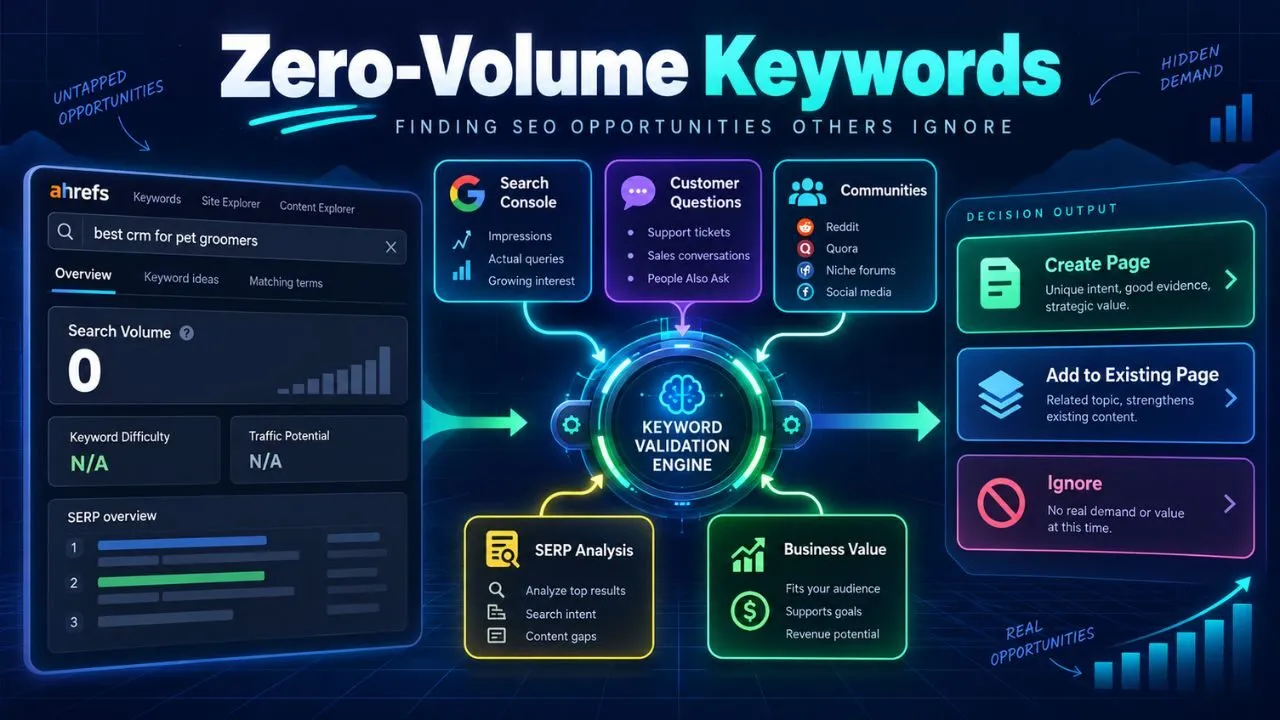
You may enter a highly relevant query into a keyword tool and see:
Search volume: 0
At first glance, the decision seems obvious.
Why create content for something nobody searches for?
The problem is that zero-volume keywords do not always mean zero searches.
Keyword databases depend on:
- available data
- historical demand
- query grouping
- sampling
- geographic coverage
- update frequency
- minimum reporting thresholds
That means some highly specific, emerging, local, or niche searches can appear to have little or no measurable volume even when real people occasionally search for them.
This makes zero-volume keywords an interesting SEO opportunity.
Not because every zero-volume phrase deserves a page.
And not because low-volume keywords are automatically easy.
But because some of the most specific customer problems may be poorly represented in standard keyword databases.
Examples could include:
- a niche B2B software problem
- an emerging AI workflow
- a highly specific local service query
- a product compatibility question
- a detailed troubleshooting search
- a new industry term
- a long-tail customer question
The right approach is not:
“The tool says zero, so ignore it.”
It is also not:
“Every zero-volume keyword is a hidden opportunity.”
The better question is:
Is there independent evidence that this search represents a real user need worth satisfying?
This guide explains what zero-volume keywords are, why tools may underreport them, how to find useful opportunities, when they deserve dedicated content, and how to avoid creating pages for search demand that does not actually matter.
What Are Zero-Volume Keywords?
Zero-volume keywords are search queries that keyword research tools report as having no measurable monthly search volume or extremely low estimated demand.
For example:
| Keyword | Reported Volume |
|---|---|
| keyword research | 20,000 |
| keyword research for SaaS | 500 |
| keyword research for a new B2B cybersecurity startup | 0 |
The third query appears to have no demand according to the tool.
But that does not necessarily mean nobody searches for it.
It means the platform does not currently report meaningful measurable volume for that exact query.
That distinction matters.
Zero Search Volume Does Not Always Mean Zero Searches
Keyword tools estimate demand.
They do not have perfect visibility into every query searched by every user.
A reported zero may represent:
- genuinely no demand
- extremely low demand
- insufficient historical data
- a new query
- a query grouped with another term
- a highly specific variation
- a small geographic market
- a niche B2B search
You should therefore interpret zero as:
No meaningful measurable volume reported by this dataset
rather than:
Nobody searches this phrase.
This is similar to the broader principle discussed in the Keyword Metrics guide: keyword metrics are useful estimates, not absolute truth.
Why Zero-Volume Keywords Can Matter
Zero-volume searches can be useful because specificity often reveals intent.
Compare:
Broad Keyword
CRM
versus:
Specific Query
CRM with WhatsApp automation for small property agencies
The second query may show almost no reported volume.
But the person searching it has revealed:
- the product category
- desired integration
- use case
- business type
If your product solves exactly that problem, the search could be commercially valuable.
A keyword does not need huge traffic to matter.
It needs the right audience and a worthwhile need.
Why Keyword Tools May Show Zero Volume
Understanding the limitations of keyword data helps prevent bad decisions.
1. The Query Is Too Specific
Long-tail searches can have demand spread across many similar variations.
For example:
- how to cluster keywords for SEO
- how to group SEO keywords
- how to organize keywords by intent
- how do I cluster search terms
Each phrase may look small individually.
Together they may represent meaningful demand.
This is why your Long-Tail Keywords guide emphasizes evaluating intent groups rather than isolated strings.
2. The Query Is New
Emerging topics may not yet have enough historical data.
This frequently occurs around:
- new software
- new AI features
- new regulations
- new products
- new industry terminology
By the time keyword databases show substantial volume, earlier publishers may already have built useful resources.
3. Search Demand Is Highly Fragmented
Users may express the same problem in hundreds of different ways.
For example:
Google is showing the wrong page
could appear as:
- Google ranking wrong URL
- wrong page showing in Google
- Google ranks another page instead
- multiple pages competing in search
Individually, these phrases may look small.
Conceptually, they belong to one broader problem.
4. The Market Is Very Small
Some B2B or specialist topics genuinely have low search demand.
Examples:
- enterprise software integrations
- industrial equipment problems
- specialist legal workflows
- technical APIs
Yet a single qualified visitor can have substantial commercial value.
5. The Query Is Local
Local demand can be difficult to estimate accurately at very narrow levels.
For example:
emergency air conditioner repair in Clifton Karachi
may have limited tool data.
That does not mean nobody needs the service.
Local business value may still be high.
6. Tools Group Similar Queries
Keyword platforms may consolidate close variants.
A tool might show meaningful demand for:
keyword mapping
while reporting:
how to map keyword clusters to URLs
as zero.
The second query may simply belong within the broader first cluster.
This is why Keyword Clustering should usually happen before page creation.
12 Ways to Find Valuable Zero-Volume Keywords
1. Start With Customer Questions
One of the best sources is real customer language.
Review:
- sales calls
- support tickets
- consultation notes
- contact forms
- live chat
- emails
Look for questions that appear repeatedly.
For example:
Can I use the same SEO page for two different cities?
A keyword tool may show little demand for the exact wording.
But repeated customer questions are evidence of a real need.
Customer data can sometimes be more useful than estimated search volume.
2. Use Google Search Console
Search Console can reveal queries that third-party tools report as zero.
Look for:
- low-impression queries
- long questions
- unusual modifiers
- emerging queries
- highly specific problems
Suppose Search Console shows impressions for:
keyword mapping spreadsheet for agencies
while your keyword tool shows zero.
That is direct evidence that real searches are occurring.
Your SEO Reporting guide explains how query-level impressions can expose these opportunities.
3. Look at Google Autocomplete
Autocomplete can reveal specific searches related to your seed topic.
Start typing:
keyword mapping for…
or:
why is my website…
Pay attention to detailed suggestions.
Autocomplete is not a substitute for keyword metrics.
But it can be an additional discovery signal.
4. Explore People Also Ask and Related Questions
Questions can reveal niche needs that individual keyword databases underreport.
For example:
- Can two pages target the same keyword?
- Should one page have multiple primary keywords?
- How do I map keywords to product pages?
These questions may belong:
- inside an existing guide
- within an FAQ
- as separate content if the intent is sufficiently distinct
The question itself does not automatically justify a new URL.
5. Study Forums and Communities
Community discussions often surface specific problems before they become visible in conventional keyword tools.
Useful sources may include:
- specialist forums
- professional communities
- product communities
- YouTube comments
Look for repeated language such as:
Has anyone figured out…
Why does…
How do you handle…
Is there a way to…
These can reveal emerging or niche searches.
6. Analyze Internal Site Search
Visitors may tell you exactly what they cannot find.
Suppose your site search shows repeated queries for:
keyword research template
but you do not offer one.
That is strong evidence of unmet demand within your own audience.
Internal search can uncover zero-volume opportunities with unusually high relevance.
7. Analyze Sales Objections
Sales questions often reveal commercial long-tail opportunities.
Examples:
- how much does technical SEO cost
- do I need SEO after migration
- can SEO work without backlinks
- should I hire an SEO consultant or agency
Some variations may show almost no volume.
But if those questions repeatedly influence buying decisions, answering them can support conversions even without large traffic.
8. Look for Emerging Topics
New developments create queries before reliable keyword volume exists.
For example:
- new marketing platforms
- AI features
- software updates
- newly released integrations
If the topic clearly matters to your audience, early content can be useful.
The important condition is real relevance, not simply novelty.
9. Expand Known Keywords With Specific Modifiers
Start with a proven keyword.
For example:
keyword research
Then add modifiers:
Audience
- for agencies
- for B2B SaaS
- for local plumbers
Problem
- without Search Console data
- for a brand-new website
- with no competitors
Format
- spreadsheet
- template
- checklist
Some combinations may show zero volume.
That does not automatically make them useless.
Evaluate the underlying need.
10. Look at Competitor Ranking Queries
Competitor pages may rank for highly specific search variations.
Your Competitor Keyword Research guide explains how to identify competitor queries and pages.
When you find zero-volume terms, ask:
- Does the competitor page receive traffic from the larger cluster?
- Is this query part of a broader intent?
- Does it reveal a missing question?
Do not create a separate page merely because a competitor ranks for the phrase.
11. Use Entity and Topic Research
Entity research can reveal concepts users may search for even when tool volume is unavailable.
For example, your Entity Research guide helps identify:
- products
- concepts
- attributes
- relationships
Those relationships can reveal specific queries.
Example:
Entity: CRM
Integration: WhatsApp
Audience: Real estate agency
Potential query:
CRM with WhatsApp integration for real estate agents
Even if reported volume is zero, the combination may represent a real commercial use case.
12. Study Search Results Directly
If you suspect a zero-volume keyword matters, search it.
Analyze the SERP.
Ask:
- Are relevant pages appearing?
- Are companies actively targeting the query?
- Is Google interpreting a recognizable intent?
- Are related questions present?
- Does the SERP redirect toward a broader topic?
Your SERP Analysis guide gives you the framework.
The SERP can reveal whether the keyword represents a distinct need or merely a variation of another cluster.
Zero-Volume Keywords vs Long-Tail Keywords
These concepts overlap but are not identical.
Long-Tail Keyword
A specific search query.
It may have:
- zero volume
- low volume
- meaningful volume
Zero-Volume Keyword
A query a tool reports as having no measurable volume.
It may be:
- long-tail
- new
- niche
- local
- commercially specific
Therefore:
Not every long-tail keyword has zero volume.
And:
Not every zero-volume keyword deserves targeting.
When a Zero-Volume Keyword Deserves Its Own Page
This is the most important decision.
A zero-volume keyword may deserve a dedicated page when several conditions are true.
The Intent Is Distinct
The search represents a need not already satisfied by another page.
The Business Value Is High
Even small traffic could matter.
The Problem Is Real
You have evidence from:
- customers
- Search Console
- communities
- product usage
The Topic Supports Your Authority
It strengthens an important cluster.
The Page Can Provide Unique Value
You have:
- experience
- data
- examples
- tools
- templates
When those signals align, low reported demand may be acceptable.
When a Zero-Volume Keyword Should Not Get Its Own Page
Many zero-volume searches belong inside broader content.
Suppose you discover:
- keyword mapping for startups
- keyword mapping for agencies
- keyword mapping for bloggers
Do these require three separate articles?
Probably not unless search intent differs substantially.
A stronger solution may be one comprehensive Keyword Mapping guide with audience-specific examples.
Creating separate pages for every modifier can produce:
- thin content
- duplication
- cannibalization
- poor site architecture
Cluster Zero-Volume Keywords Before Publishing
This is essential.
Suppose you find:
- zero search volume keywords
- zero-volume keywords SEO
- keywords with no search volume
- should I target zero-volume keywords
- are zero-volume keywords worth it
Those likely belong to the same intent group.
One page can cover the cluster.
The process should be:
Discover → Validate → Cluster → Map → Create
not:
Find phrase → Publish page
Zero-Volume Keywords and Keyword Mapping
Once the cluster is validated, assign one owner.
For this article:
Primary Intent
Understanding and evaluating zero-volume keywords.
Owner
/seo/zero-volume-keywords/
Related variations should point here.
Your Keyword Mapping guide explains why one clear intent owner is useful for preventing unnecessary overlap.
Zero-Volume Keywords and Search Intent
Search intent becomes particularly important when volume data is weak.
If a keyword has zero volume, you have less quantitative information.
So qualitative signals matter more.
Ask:
- What does the user want?
- Is the intent obvious?
- Does it overlap with another query?
- What page type would satisfy it?
For example:
CRM with WhatsApp integration for dentists
likely has commercial intent.
Meanwhile:
how does CRM WhatsApp integration work
is informational.
Related topic.
Different need.
Zero-Volume Keywords and Business Value
This is where zero-volume opportunities can be especially interesting.
Suppose:
Keyword A
marketing
Volume: enormous
Business fit: weak
Keyword B
SEO consultant for B2B SaaS migration
Volume: reported zero
Business fit: extremely strong
If one qualified visitor from Keyword B becomes a valuable client, the page may justify itself.
Traffic should not be the only success metric.
Zero-Volume Keywords for B2B SEO
B2B search often produces highly specific queries.
Examples:
- CRM for industrial distributors
- SEO consultant for enterprise migration
- marketing automation for logistics companies
Individual demand may appear very small.
But potential contract value may be large.
B2B teams should therefore evaluate:
- account value
- buyer role
- search intent
- product fit
before rejecting a query because of zero volume.
Zero-Volume Keywords for Local SEO
Local queries often combine:
Service + Problem + Location
Example:
emergency WordPress malware cleanup Karachi
A tool may have limited data for the exact phrase.
But a person searching it may have urgent commercial intent.
Evaluate:
- whether you actually offer the service
- location relevance
- customer value
- local SERP
Do not generate hundreds of thin local pages around zero-volume combinations.
Zero-Volume Keywords for SaaS
SaaS provides many specific use-case opportunities.
Examples:
- CRM for agencies with WhatsApp
- inventory software with Shopify integration
- email automation for recruiting firms
These searches can reflect high-intent requirements.
A use-case page may be useful if the product genuinely solves the problem.
Avoid creating pages for integrations or features the product does not support.
Zero-Volume Keywords for Ecommerce
Ecommerce searches can become extremely specific.
Example:
waterproof trail running shoes for wide feet
Reported volume may be tiny.
But the query expresses strong product requirements.
The right response may be:
- product filtering
- category optimization
- buying-guide content
rather than a standalone article.
Match the content format to the intent.
Should You Target Zero-Volume Keywords on a New Website?
Yes—but selectively.
A new website should not build its entire strategy around zero-volume terms.
You still need:
- foundational topics
- proven demand
- commercial pages
Zero-volume opportunities can complement the strategy.
A balanced approach might include:
Foundational Content
Broad topics necessary for authority.
Proven Long-Tail Content
Specific searches with measurable demand.
Evidence-Based Zero-Volume Content
Highly relevant queries supported by real customer or search data.
This creates a more resilient content portfolio.
Should Established Websites Target Them?
Established sites have an advantage:
data.
Search Console can show whether real long-tail queries exist.
Customer support teams can reveal repeated questions.
Analytics and internal search can expose missing needs.
This reduces guesswork.
An established website should prioritize its own first-party evidence over generic keyword estimates when the signals conflict.
How to Validate a Zero-Volume Keyword
Before creating content, look for multiple signals.
A strong validation checklist could include:
Search Console
Does the query or a close variation receive impressions?
Customer Evidence
Do real prospects ask this?
SERP Evidence
Does a recognizable search intent exist?
Competitor Evidence
Are relevant competitors covering the problem?
Community Evidence
Are people discussing it?
Business Relevance
Does solving the problem matter commercially?
Cluster Fit
Does the topic belong within an important pillar?
The more signals you have, the stronger the case.
Use a Zero-Volume Opportunity Score
You can create a simple internal scoring model.
Rate each factor 1–5.
| Factor | Score |
|---|---|
| Audience Relevance | 5 |
| Business Value | 5 |
| Customer Evidence | 4 |
| Search Evidence | 2 |
| SERP Clarity | 4 |
| Strategic Fit | 5 |
A low search-volume score can be offset by strong relevance and business value.
Do not treat the total as scientific precision.
The score simply makes the reasoning explicit.
Zero-Volume Keywords and Forecasting
Forecasting zero-volume terms is difficult.
If a tool reports zero, you cannot responsibly claim:
This page will generate 500 visits per month.
Instead, forecast at the broader cluster level.
For example:
Primary Cluster
CRM for real estate agencies
Supporting Zero-Volume Searches
- CRM with WhatsApp for real estate agents
- CRM follow-up automation for brokers
- property lead CRM with messaging
Forecast the cluster, not each tiny variation.
Zero-Volume Keywords and Content Refreshes
You do not always need a new page.
Suppose Search Console shows your article receiving impressions for:
how to cluster keywords manually without software
but your Keyword Clustering article does not explain manual clustering.
That may be an excellent section to add to the existing page.
This improves the article without creating duplicate URLs.
How to Measure Zero-Volume Keyword Performance
After publishing or updating, track:
- impressions
- clicks
- related queries
- rankings
- conversions
- leads
- assisted conversions
Do not judge the page only by traffic.
A page generating:
20 visits + 3 qualified leads
may be more valuable than one generating:
5,000 visits + 0 leads
Business outcome matters.
How Long Should You Wait Before Evaluating?
There is no universal fixed period.
It depends on:
- crawl frequency
- site authority
- competition
- topic
- internal links
Avoid making conclusions after a few days.
Monitor the page through your normal SEO review cycle.
Look for:
- indexing
- emerging impressions
- query expansion
- conversions
Then decide whether to:
- improve
- consolidate
- keep
- remove
Are Zero-Volume Keywords Easier to Rank For?
Not necessarily.
A keyword can have low volume and still be competitive.
Why?
Because:
- the visitor is valuable
- strong brands target it
- the SERP favors specialized pages
- competition is concentrated
Remember the principle from Keyword Difficulty:
Specific does not automatically mean easy.
Inspect the actual search results.
Can Zero-Volume Keywords Generate Traffic?
Yes, potentially.
A page targeted around one zero-volume query can also rank for:
- variations
- related questions
- broader phrases
- long-tail searches
This is why page-level traffic opportunity may be more meaningful than exact-match search volume.
One strong page can capture many related searches.
Zero-Volume Keywords and AI Search
Emerging search behavior may make ultra-specific queries increasingly important.
Users can express detailed questions conversationally.
That means content should focus on genuinely answering complex needs rather than merely targeting short keyword phrases.
This does not mean every conversational phrase deserves a page.
It reinforces the importance of:
- topic clusters
- intent
- complete answers
- original value
Do Not Manufacture Zero-Volume Pages at Scale
This is a major risk.
An SEO team might generate combinations such as:
CRM for [industry]
CRM for [city]
CRM for [company size]
and publish thousands of pages automatically.
Some may offer no unique value.
That can create:
- thin content
- duplicate content
- poor UX
- crawl waste
A zero-volume keyword strategy should be more selective, not less selective.
Low data means you need stronger evidence.
Common Zero-Volume Keyword Mistakes
Assuming Zero Means No Searches
It means the dataset reports no meaningful volume.
Assuming Every Zero Is an Opportunity
Many are genuinely irrelevant.
Creating One Page Per Query
Cluster related intent.
Ignoring Business Value
Commercial relevance can matter more than volume.
Ignoring Customer Evidence
Real questions are valuable signals.
Ignoring Search Intent
The query may belong to an existing page.
Publishing Thin Programmatic Pages
Specificity alone does not create value.
Assuming Zero-Volume Means Easy
Competition can still be strong.
Ignoring Search Console
First-party search data can contradict third-party estimates.
Measuring Only Traffic
Conversions may matter more.
A Practical Zero-Volume Keyword Workflow
Use this process:
1. Discover the Query
Find it through:
- customers
- Search Console
- communities
- autocomplete
- competitors
2. Verify Relevance
Does it fit the audience?
3. Identify Search Intent
What does the user actually need?
4. Check the SERP
Does a distinct result pattern exist?
5. Look for Supporting Evidence
Customer questions, impressions, community activity.
6. Cluster Related Queries
Avoid treating variations separately.
7. Review Existing Pages
Could an existing article satisfy the need?
8. Evaluate Business Value
Would the right visitor matter?
9. Map the Intent to One URL
Establish ownership.
10. Create Unique Value
Add:
- examples
- experience
- tools
- templates
where appropriate.
11. Publish and Internally Link
Connect the page to its parent topic.
12. Measure Real Performance
Use first-party data to validate your hypothesis.
Zero-Volume Keyword Checklist
Before targeting a zero-volume query, ask:
Relevance
- Is it relevant to the intended audience?
- Does it fit the business?
Evidence
- Do customers ask it?
- Does Search Console show related impressions?
- Do communities discuss the problem?
Intent
- Is the search need distinct?
- Can one page satisfy it?
SERP
- Does a recognizable result set exist?
- Is the expected page type clear?
Existing Content
- Could an existing page be expanded?
- Would a new page create cannibalization?
Business Value
- Could the visitor become valuable?
- Does the topic support an important cluster?
Execution
- Can we provide unique value?
- Do we have evidence or examples?
Measurement
- Are impressions and conversions being tracked?
- Will the page be reviewed later?
If the opportunity passes these checks, zero reported volume should not automatically stop you.
Final Thoughts
Zero-volume keywords challenge a simple assumption:
More search volume always means a better SEO opportunity.
It does not.
A more useful framework is:
Relevance → Evidence → Intent → SERP → Business Value → Cluster Fit → Content Decision
Keyword tools are valuable.
But they are estimates.
They cannot perfectly capture every:
- emerging search
- niche B2B need
- local query
- specific customer problem
- long-tail variation
The right strategy is not to ignore search-volume data.
It is to understand its limitations.
When a query has zero reported volume, look for additional evidence.
Listen to customers.
Review Search Console.
Study communities.
Inspect the SERP.
Check whether the problem fits an existing page.
Then ask whether solving it would create genuine value.
The most valuable zero-volume keyword is not the most unusual phrase you can discover.
It is the specific search need that matters to your audience even when keyword tools struggle to measure it.
The next article in the Keyword Research series expands the research process across countries, languages, and markets through international keyword research.