
Keyword research does not begin with search volume.
It begins with discovery.
Before you can decide which keywords deserve pages, which topics belong in a content cluster, or which queries could generate business results, you first need to understand how your audience searches.
That process is called keyword discovery.
Keyword discovery is the process of uncovering the words, phrases, questions, problems, products, comparisons, and topics people use when searching for information related to your business.
It helps you move beyond the handful of obvious keywords you already know.
For example, an SEO consultant might begin with:
- SEO
- SEO services
- SEO consultant
- keyword research
But deeper keyword discovery could reveal searches such as:
- why is my website not ranking
- how to find keywords competitors rank for
- how to improve Google impressions
- SEO audit for small business
- should I update old blog posts
- how long does SEO take
- how to choose keywords for a service page
These queries reveal much more than vocabulary.
They reveal problems, intent, awareness levels, buying stages, and content opportunities.
A strong keyword discovery process helps you identify those opportunities before deciding what to create.
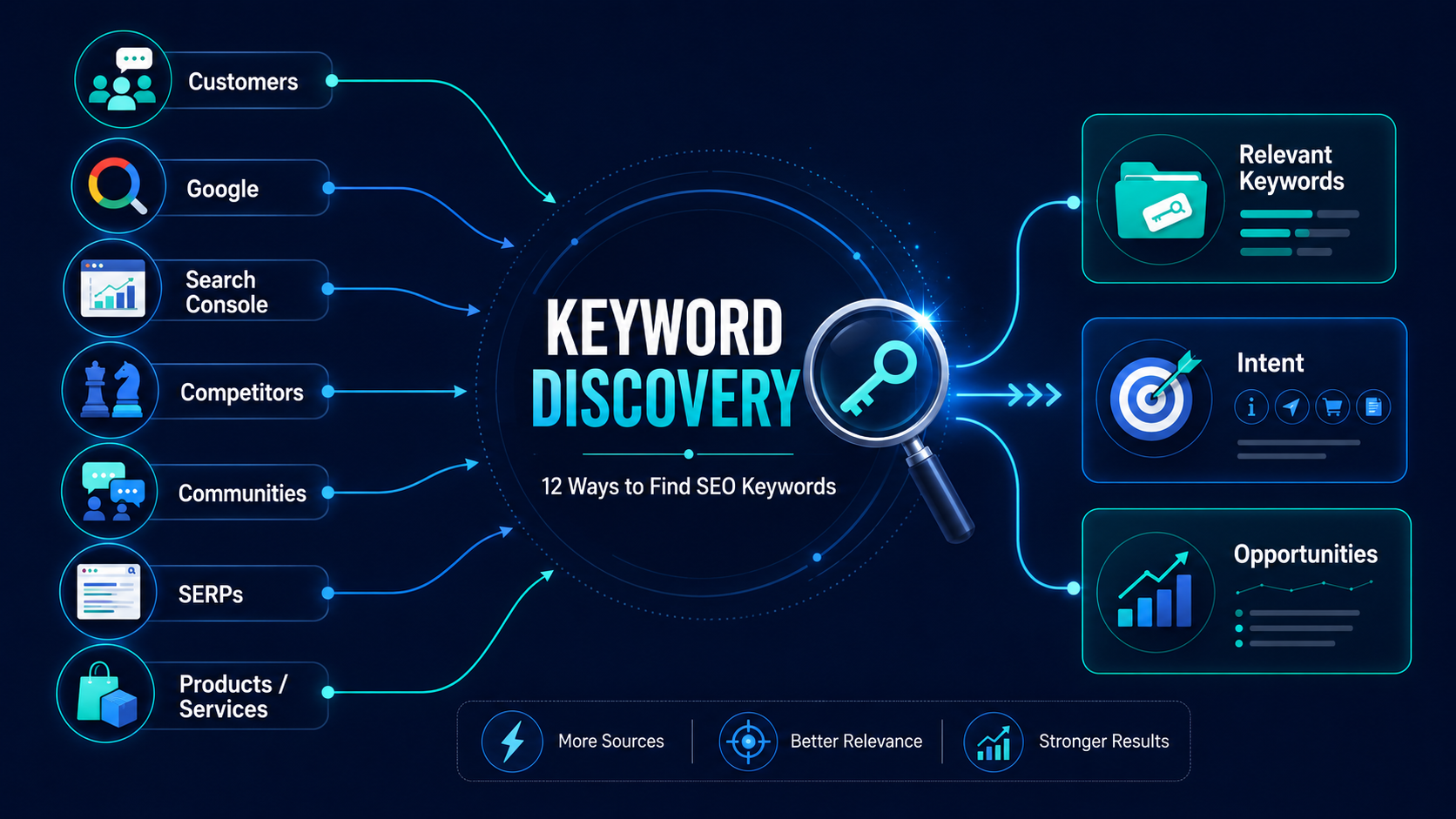
This guide explains 12 practical ways to discover SEO keywords, how to organize them, how to evaluate their relevance, and how to turn raw keyword ideas into useful content and business decisions.
What Is Keyword Discovery?
Keyword discovery is the process of identifying potential search queries that people use around a topic, problem, product, service, brand, or need.
It is the exploration stage of keyword research.
You are not necessarily deciding which keyword to target yet.
You are building the universe of possible search demand.
A simple keyword-research workflow might look like this:
Business Understanding → Keyword Discovery → Search Intent → Keyword Evaluation → Clustering → Mapping → Content Creation
Keyword discovery comes early because you cannot evaluate opportunities you have not discovered.
For example, imagine you sell accounting software.
Your first instinct might be to research:
accounting software
But your potential customers may also search:
- bookkeeping software
- invoicing software
- software for small business expenses
- how to manage business receipts
- alternatives to spreadsheets for accounting
- accounting software for freelancers
- Xero alternatives
- QuickBooks alternatives
A narrow discovery process would miss much of the real search market.
Why Keyword Discovery Matters
Keyword discovery helps you understand how customers describe their problems.
Businesses often use different language from customers.
A company might describe a service as:
Digital reputation management solutions.
Customers may simply search:
remove bad Google reviews
or:
how to improve online reviews
If you only research internal business terminology, you can miss the language people actually use.
Keyword discovery also helps you:
- understand your market
- identify content gaps
- discover customer questions
- build topic clusters
- uncover commercial opportunities
- understand competitor positioning
- plan landing pages
- create better internal links
- estimate future SEO opportunities
Most importantly, it prevents keyword research from becoming a search-volume spreadsheet with no connection to real user needs.
Keyword Discovery vs Keyword Research
The terms are often used interchangeably, but there is a useful distinction.
Keyword Discovery
Focuses on finding possibilities.
Questions include:
- What are people searching for?
- What related topics exist?
- Which problems do users describe?
- What terminology do customers use?
- Which questions appear repeatedly?
Keyword Research
Goes further by evaluating those discoveries.
Questions include:
- What is the search intent?
- How competitive is the query?
- Does it have business value?
- Which page should target it?
- Should we create new content?
- Does an existing page already satisfy it?
Think of keyword discovery as exploration and keyword research as decision-making.
Start With the Business Before the Keyword Tool
One of the most common mistakes in keyword research is opening a keyword tool too early.
Before entering phrases into software, understand the business.
Ask:
- What does the business sell?
- Which services are most profitable?
- Who are the customers?
- What problems do those customers experience?
- What questions do prospects ask before buying?
- What objections prevent conversion?
- Which competitors are considered?
- Which industries or use cases matter?
Your broader SEO strategy should provide much of this context.
Without it, keyword discovery can produce thousands of interesting keywords that have little strategic value.
12 Ways to Discover Valuable SEO Keywords
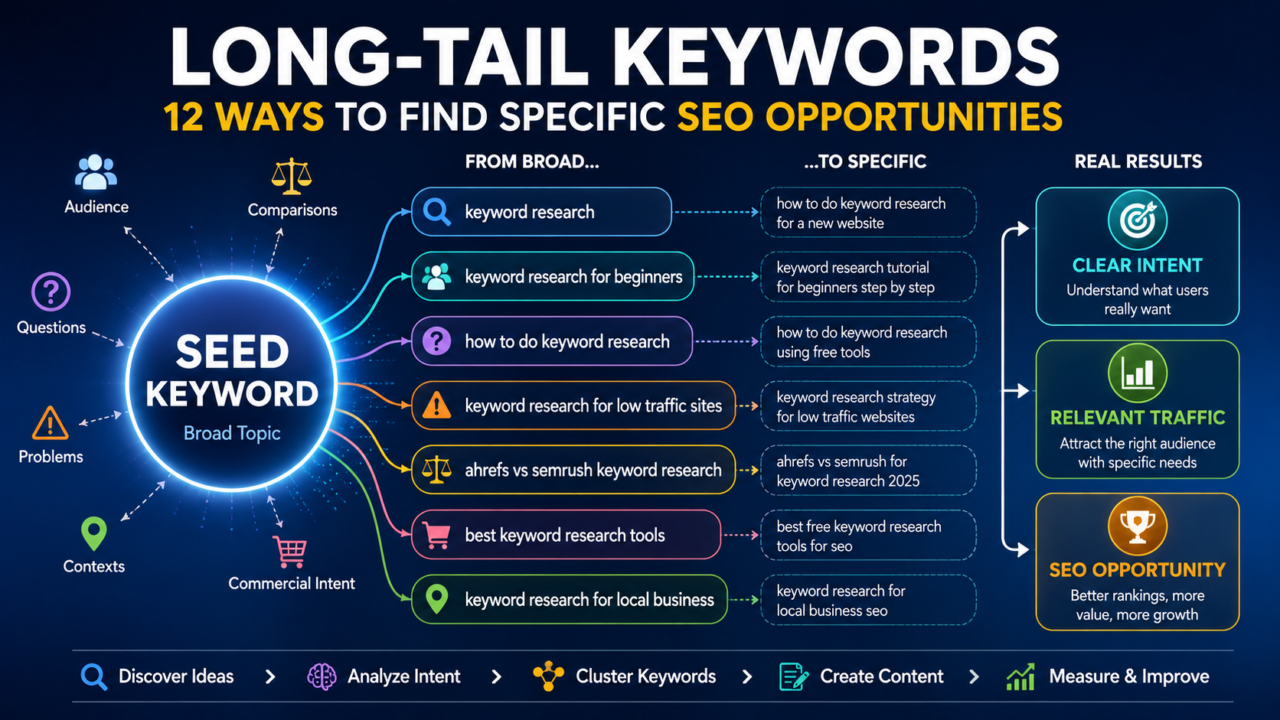
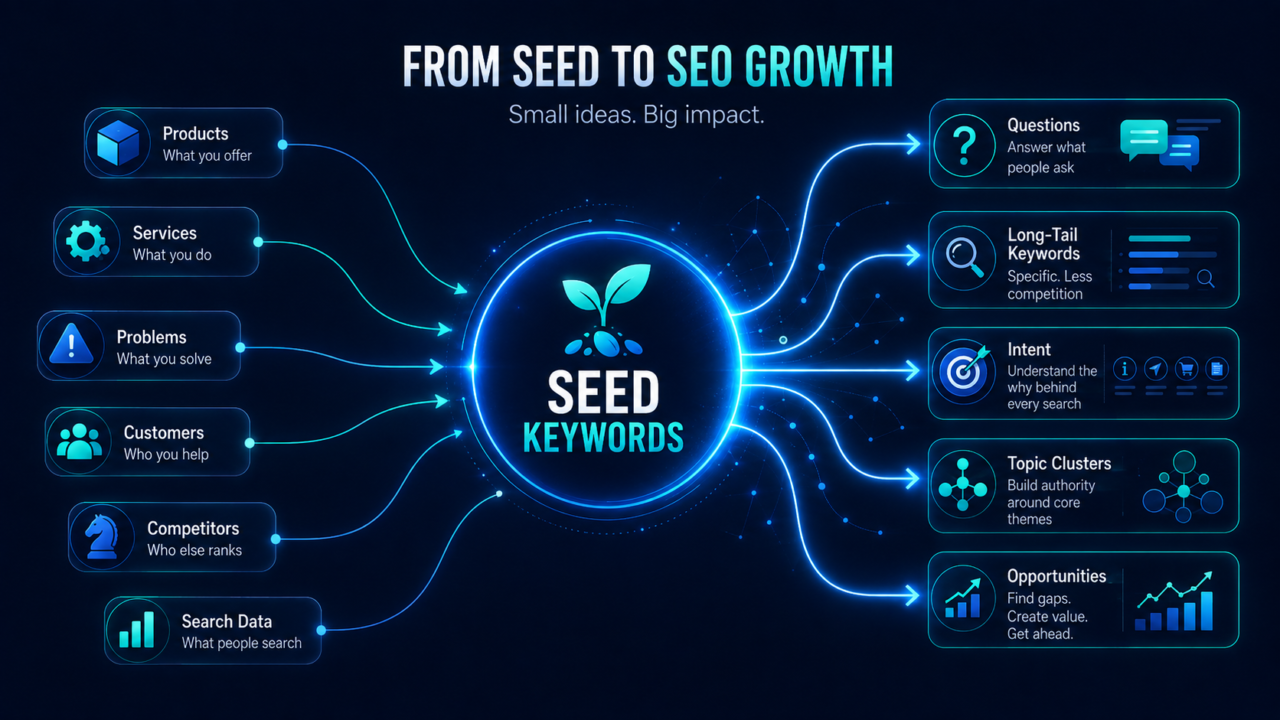
1. Start With Seed Topics
Begin with broad terms directly connected to the business.
These are commonly called seed keywords.
For an SEO website, seed topics might include:
- SEO
- keyword research
- technical SEO
- local SEO
- backlinks
- content SEO
- SEO audit
- Google Search Console
For a dentist:
- dentist
- teeth whitening
- dental implants
- root canal
- emergency dentist
- braces
Seed keywords are not necessarily the final keywords you will target.
They are starting points.
A seed term such as:
keyword research
might expand into:
- how to do keyword research
- keyword research tools
- keyword research for SEO
- keyword research for beginners
- ecommerce keyword research
- local keyword research
- keyword research checklist
The better your seed list, the broader your discovery process can become.
2. Study Your Customers’ Questions
Your customers can be one of the best keyword-research sources available.
Review:
- emails
- sales conversations
- support tickets
- contact forms
- live chat
- customer reviews
- consultation notes
- community discussions
Look for repeated questions.
For example, an SEO client may ask:
Why are my impressions increasing but clicks are not?
That question could lead to keywords around:
- Google impressions but no clicks
- high impressions low CTR
- improve organic CTR
- Search Console impressions explained
These ideas come directly from real customer language.
That makes them particularly useful.
Ask Sales and Support Teams
Sales teams often know:
- what prospects ask
- what confuses them
- which alternatives they compare
- what objections delay purchases
Support teams know what customers struggle with after buying.
Both sources can reveal search topics that keyword tools may not immediately suggest.
3. Use Google Search Suggestions
Start typing a topic into Google and observe the suggested completions.
For example:
keyword research…
Suggestions might include variations such as:
- keyword research for SEO
- keyword research tools
- keyword research for YouTube
- keyword research for local SEO
These suggestions can reveal common search patterns.
Try changing the beginning of the query:
- how to…
- why…
- best…
- vs…
- for beginners…
- for small business…
- without…
- alternatives to…
You can also explore alphabetical variations.
For example:
SEO audit a…
SEO audit b…
SEO audit c…
Do not automatically assume every suggestion deserves content.
Use suggestions as discovery inputs, then evaluate them later.
4. Analyze Related Searches
Search results often reveal closely related concepts.
These can help you understand how a topic expands.
Suppose you research:
SEO reporting
Related searches might reveal interest around:
- SEO reporting tools
- SEO report template
- monthly SEO report
- SEO KPIs
- SEO metrics
That suggests multiple possible user needs.
One may require an educational article.
Another may need a downloadable template.
Another may have commercial intent around reporting software.
Keyword discovery becomes stronger when you think in needs, not just phrases.
5. Use People Also Ask Questions
Question-based queries can be especially valuable for informational content.
Look for questions around your main topic.
For example:
- What is keyword research?
- How do I find keywords?
- How many keywords should a page target?
- What makes a good keyword?
- Are keywords still important for SEO?
These questions can help you:
- expand an article
- identify supporting content
- create FAQs
- discover separate search intents
Do not create a new article for every question automatically.
Several closely related questions may belong on the same comprehensive page.
Understanding search intent helps determine when a query deserves its own page.
6. Use Google Search Console
Once a website has search visibility, Google Search Console becomes one of the most valuable keyword-discovery sources.
Why?
Because it shows queries for which your website is already appearing.
Open performance data and examine:
- queries
- pages
- impressions
- clicks
- CTR
- average position
Look for queries that you did not intentionally target.
For example, an SEO audit article might unexpectedly receive impressions for:
how to prioritize SEO errors
That may tell you users want more information about audit prioritization.
You could:
- expand the existing article
- create a supporting article
- improve internal links
- create a downloadable prioritization template
This is keyword discovery based on real search exposure rather than only third-party estimates.
Your SEO reporting guide explains how Search Console data can be interpreted alongside broader performance metrics.
7. Analyze Your Existing Pages
Your own website can reveal additional keyword opportunities.
Choose a page and ask:
- What topic does it cover?
- Which related questions are missing?
- Which use cases are not discussed?
- Which audience segments could need separate content?
- Which related terms appear naturally?
Imagine an article about SEO audits.
Possible expansions might include:
- technical SEO audit
- content audit
- local SEO audit
- ecommerce SEO audit
- SEO audit tools
- SEO audit template
- SEO audit checklist
Some may belong inside the existing article.
Others may justify separate pages.
Your SEO audit guide can itself become a discovery source for several future topic clusters.
8. Study Competitor Keywords
Competitor research can expose parts of the search market you have not considered.
Identify competitors that consistently appear for topics relevant to your business.
Then investigate:
- their strongest organic pages
- keywords those pages rank for
- categories they cover
- topics you do not cover
- comparison pages
- tools and resources
- commercial landing pages
The objective is not to copy competitors.
It is to understand the market.
Look for Competitor Gaps
Suppose three competitors all publish content on:
- keyword research basics
- keyword difficulty
- search volume
- long-tail keywords
but very few explain:
- keyword ownership
- keyword cannibalization prevention
- topic-to-page mapping
That gap could become an opportunity.
Study Several Competitors
Do not base your entire content strategy on one website.
A competitor may have:
- outdated content
- poor targeting
- accidental rankings
- a different business model
Use multiple sources to identify patterns.
9. Study Community Discussions
Communities can reveal how people describe problems when they are not trying to impress a search engine.
Useful sources may include:
- industry forums
- Facebook groups
- LinkedIn discussions
- Quora
- niche communities
- YouTube comments
Look for recurring phrases such as:
I can’t figure out…
What’s the best way to…
Why does…
Is it worth…
What do you use for…
These statements can become keyword ideas.
For example:
How do I find keywords when my site is brand new?
could lead to topics around:
- keyword research for new websites
- finding keywords without Search Console
- beginner keyword discovery
Community research is particularly useful for identifying problems that traditional keyword databases may group poorly.
10. Analyze Internal Site Search
If your website has a search function, analyze what visitors type into it.
Internal search data can reveal:
- missing content
- difficult navigation
- product demand
- support questions
- terminology differences
Suppose users repeatedly search your site for:
SEO checklist
but you do not have a dedicated checklist.
That is a valuable signal.
These users already arrived on your website and still looked for that information.
The same principle applies to ecommerce stores.
Internal searches such as:
- black running shoes
- waterproof backpack
- USB-C charger
can expose merchandising and content opportunities.
11. Discover Keywords From Products, Services and Features
Businesses frequently overlook obvious discovery opportunities hidden in their own offerings.
Break each product or service into components.
For an SEO service:
Main Service
SEO consulting
Problems
- traffic decline
- indexing issues
- poor rankings
- low CTR
- weak leads
Deliverables
- SEO audit
- keyword research
- content strategy
- technical analysis
Audience
- small businesses
- ecommerce
- SaaS
- local businesses
Comparisons
- SEO consultant vs agency
- in-house SEO vs agency
Pricing
- SEO consulting cost
- SEO audit pricing
One service can therefore generate dozens of meaningful keyword directions.
12. Follow the Customer Journey
Strong keyword discovery covers more than the moment someone wants to buy.
Users search throughout their journey.
A simplified journey might look like:
Problem → Learning → Comparing → Deciding → Using → Improving
Imagine someone needs SEO help.
Problem Awareness
- why is my website traffic dropping
- why doesn’t my site appear on Google
Learning
- what is SEO
- how SEO works
Solution Exploration
- how to improve SEO
- SEO audit checklist
Comparison
- SEO consultant vs agency
- best SEO tools
Purchase
- hire SEO consultant
- SEO services
Post-Purchase
- how to measure SEO results
- SEO reporting KPIs
If you only discover transactional keywords, you miss much of the customer’s search journey.
Your existing SEO Fundamentals cluster demonstrates how educational content can support users before they are ready to purchase anything.
Discover Keywords by Search Intent
Once you have a large keyword list, begin organizing it by intent.
Informational Keywords
Users want to learn.
Examples:
- what is keyword research
- how to find SEO keywords
- keyword research for beginners
Navigational Keywords
Users want a specific destination.
Examples:
- Google Search Console login
- Ahrefs keyword explorer
- Semrush keyword tool
Commercial Investigation
Users are comparing choices.
Examples:
- best keyword research tools
- Ahrefs vs Semrush
- free vs paid keyword tools
Transactional Keywords
Users are ready to act.
Examples:
- hire keyword research consultant
- keyword research service
- buy SEO keyword report
Search volume does not tell you which of these is most valuable.
Intent provides the context.
Discover Problem-Based Keywords
Problem keywords are particularly valuable because users often describe symptoms rather than solutions.
For example, a user may not search:
technical SEO audit
They might search:
pages disappeared from Google
or:
website not getting indexed
That problem may eventually lead them to technical SEO.
Create a list of common customer problems.
Then ask:
How would someone describe this problem if they did not know the technical terminology?
This can reveal excellent keywords.
Example: SEO Problem Discovery
Technical term:
Keyword cannibalization
Possible user searches:
- two pages ranking for same keyword
- Google ranking wrong page
- multiple pages competing in search
- which page should target keyword
This is why understanding customer language matters.
Discover Comparison Keywords
Comparison queries often have strong commercial value.
Common patterns include:
- X vs Y
- X alternatives
- best X for Y
- X reviews
- X pricing
- X pros and cons
For example:
- Ahrefs vs Semrush
- Semrush alternatives
- best keyword research tools for beginners
- free keyword tools vs paid tools
These queries suggest that users already understand the problem and are comparing solutions.
Discover Modifier Keywords
Modifiers help expand broad topics into more specific needs.
Useful modifier categories include:
Audience
- for beginners
- for small businesses
- for agencies
- for ecommerce
- for bloggers
Location
- near me
- Dubai
- London
- New York
Quality
- best
- top
- affordable
- professional
Time
- 2026
- monthly
- quick
- long-term
Format
- checklist
- template
- guide
- examples
- tutorial
Problem
- not working
- low traffic
- declining
- slow
Comparison
- vs
- alternative
- comparison
- review
Modifiers can transform one broad topic into dozens of discovery pathways.
Discover Long-Tail Keyword Opportunities
A long-tail keyword is generally a more specific search query.
For example:
Broad:
SEO
More specific:
SEO for ecommerce
More specific:
technical SEO checklist for ecommerce websites
Long-tail queries can be valuable because they often reveal clearer intent.
They can also expose highly specific problems that large generic pages do not address well.
Do not assume long-tail means “low competition.”
Some highly specific commercial queries can be very competitive.
The important benefit is specificity.
Keyword Discovery Does Not Mean One Page Per Keyword
This mistake creates unnecessary content duplication.
Imagine discovering:
- SEO keyword discovery
- keyword discovery SEO
- how to discover SEO keywords
- find SEO keyword ideas
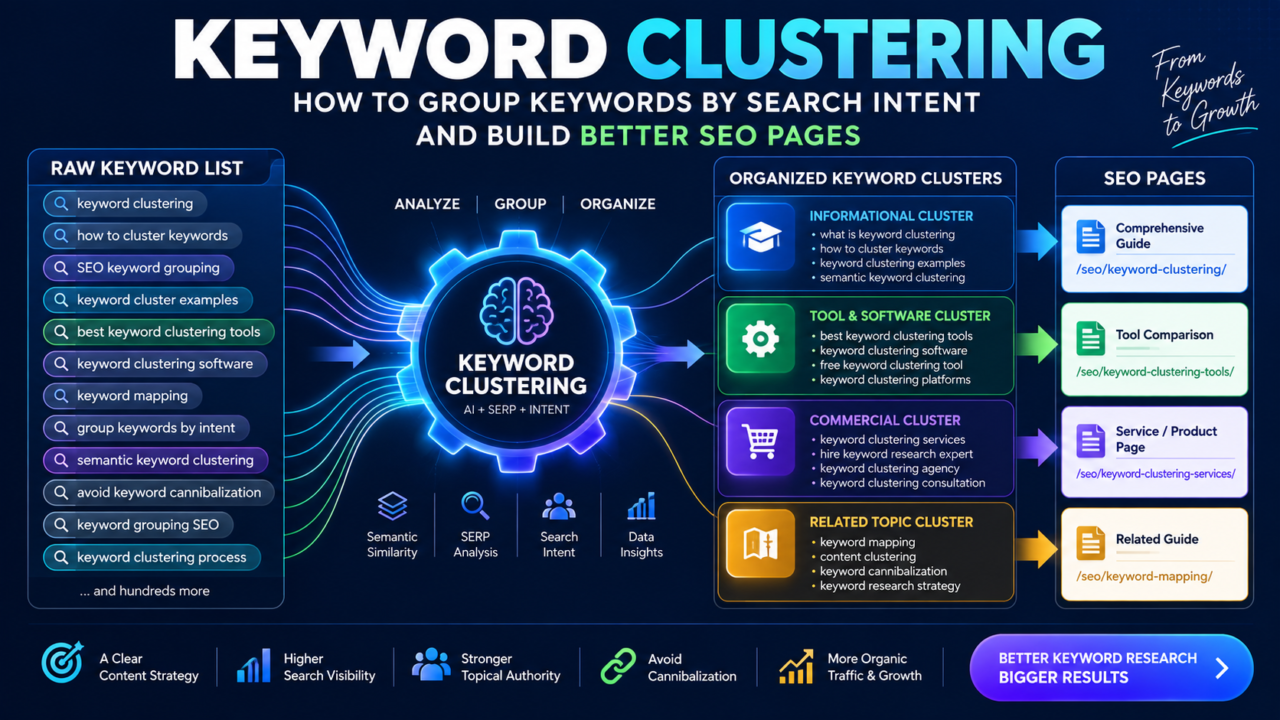
These may all represent essentially the same search intent.
You probably do not need four articles.
One strong page may satisfy the entire query group.
That is why discovery must eventually lead to clustering.
The process becomes:
100 keywords → 20 intent groups → 8 pages
not:
100 keywords → 100 pages
This prevents content cannibalization and keeps site architecture manageable.
Create a Keyword Discovery Sheet
A practical keyword-discovery database might include these columns:
| Field | Purpose |
|---|---|
| Keyword | Search query |
| Topic | Broad subject |
| Search Intent | Informational, commercial, etc. |
| Audience | Who is searching |
| Funnel Stage | Awareness, consideration, decision |
| Source | Search Console, competitor, customer, etc. |
| Search Volume | Estimated demand |
| Business Value | Low, medium, high |
| Existing URL | Current relevant page |
| New Page Needed? | Yes or no |
| Notes | Context |
Do not rush to fill every metric.
During discovery, capturing the idea is often more important than evaluating it immediately.
Separate Discovery From Evaluation
This is an important workflow principle.
During discovery, your goal is breadth.
During evaluation, your goal is quality.
If you evaluate every keyword while discovering it, you may reject useful ideas too early.
A better workflow is:
Discovery Phase
Collect:
- keywords
- questions
- problems
- products
- competitors
- modifiers
Evaluation Phase
Assess:
- search intent
- relevance
- business value
- demand
- competition
- current rankings
- required page type
This separation improves both creativity and decision-making.
Use Existing SEO Data to Prioritize Discoveries
Once the website has data, use it.
Suppose Search Console shows:
| Query | Impressions | Position |
|---|---|---|
| keyword discovery | 1,800 | 14 |
| keyword research ideas | 900 | 18 |
| how to find SEO keywords | 700 | 11 |
These are useful signals.
The website already has some relevance.
You might prioritize improving the existing page before pursuing a completely unrelated keyword.
The SEO testing guide can later help you determine whether changes such as improved titles, internal links, or expanded content actually improve performance.
Use Keyword Discovery for Content Clusters
Keyword discovery becomes particularly powerful when building topic clusters.
Suppose your pillar is:
Keyword Research
Discovery may reveal clusters such as:
- Keyword Discovery
- Seed Keywords
- Long-Tail Keywords
- Keyword Metrics
- Keyword Difficulty
- Search Volume
- Keyword Clustering
- Keyword Mapping
- Keyword Cannibalization
- Competitor Keywords
Each cluster can then contain supporting topics.
This creates a knowledge architecture rather than a random blog calendar.
Example
Keyword Discovery
Supporting topics might include:
- customer-question keyword research
- competitor keyword discovery
- Search Console keyword discovery
- Reddit keyword research
- keyword discovery tools
You can now see how one broad pillar grows into a structured library.
Keyword Discovery for Existing Websites
Existing websites have several advantages.
You can use:
- Search Console
- analytics
- internal search
- ranking data
- old articles
- competitor gaps
Start by identifying pages already receiving impressions.
Look for:
Near-Ranking Queries
Queries where the site appears but receives few clicks.
Unexpected Queries
Search terms you were not intentionally targeting.
Growing Queries
Keywords gaining impressions.
Declining Queries
Keywords that previously performed better.
This makes discovery evidence-driven.
Your SEO reporting and SEO forecasting processes can then help determine whether those opportunities deserve additional investment.
Keyword Discovery for New Websites
New sites usually do not have useful Search Console data yet.
You will depend more heavily on:
- customer research
- competitor analysis
- SERPs
- keyword tools
- communities
- product knowledge
Start narrow.
Instead of trying to discover every keyword in your industry, identify one important topic.
Then build depth.
For example:
Month 1
SEO Foundations
Month 2
Keyword Research
Month 3
Technical SEO
This creates coherent topical growth rather than spreading effort across unrelated subjects.
Common Keyword Discovery Mistakes
Starting With Search Volume
Search volume is useful later.
Start with audience relevance.
Ignoring Zero-Volume Keywords
Keyword databases are estimates.
A query showing zero volume can still receive real searches.
This is particularly common with:
- emerging topics
- highly specific questions
- local queries
- niche B2B searches
Copying Competitors Blindly
A competitor’s keyword is not automatically relevant to your business.
Creating One Page Per Keyword
Group keywords by intent.
Ignoring Customer Language
Internal business terminology may not match search behavior.
Chasing Only High-Volume Terms
Smaller commercial keywords can produce more business value.
Ignoring Existing Rankings
Your fastest opportunity may already be visible in Search Console.
Discovering Without Organizing
A list of 50,000 keywords is not a strategy.
Organize discoveries into topics, intent groups, and pages.
How Many Keywords Should You Discover?
There is no ideal number.
A local business may need hundreds.
A major ecommerce platform may need millions.
The goal is not to collect the largest keyword database.
The goal is to achieve enough coverage to understand:
- audience needs
- topic relationships
- commercial opportunities
- content requirements
Stop collecting when additional keywords are mostly repeating patterns you already understand.
How to Prioritize Discovered Keywords
After discovery, score opportunities using several factors.
Relevance
Does the keyword matter to your audience?
Intent
What does the searcher want?
Business Value
Could the query contribute to meaningful outcomes?
Existing Authority
Does your site already cover related topics?
Search Demand
Is there evidence people search for it?
Competition
How difficult is the SERP?
Resource Requirement
Can you create the page properly?
A keyword can have enormous volume and still be a poor priority.
Keyword Discovery and SEO Forecasting
Once you have grouped your keyword opportunities, you can estimate their potential.
For example:
Keyword Research Cluster
Total estimated relevant demand:
100,000 searches
Expected organic click capture:
5%
Potential traffic:
5,000 monthly clicks
You can then model:
Clicks → Leads → Revenue
The SEO forecasting guide explains how to build these scenarios without pretending the projections are guarantees.
Keyword discovery supplies the opportunity set.
Forecasting helps evaluate its potential value.
Keyword Discovery and SEO Ethics
Discovery tools can make mass content creation tempting.
For example:
We discovered 20,000 keywords, so let’s generate 20,000 articles.
That is not necessarily useful.
The scheduled SEO Ethics guide explains why sustainable SEO should prioritize genuine user value rather than scaled content created primarily to manipulate search visibility.
Keyword discovery should reveal problems worth solving.
It should not become an excuse to manufacture pages for every possible query.
Keyword Discovery Checklist
Before finishing your discovery phase, confirm that you have explored:
Business
- products
- services
- features
- audiences
- problems
Customers
- sales questions
- support requests
- objections
- reviews
- terminology
Search Results
- autocomplete
- related searches
- questions
- SERP formats
Your Website
- Search Console
- current pages
- internal search
- existing rankings
Competitors
- top pages
- ranking keywords
- missing topics
- commercial pages
Communities
- forums
- social discussions
- YouTube comments
Keyword Expansion
- modifiers
- long-tail queries
- comparisons
- problem searches
- audience variations
Organization
- topics
- search intent
- funnel stage
- business value
- existing URLs
Final Thoughts
Keyword discovery is where strong keyword research begins.
It is not simply about finding phrases with large search-volume numbers.
It is about understanding how people express their needs.
A useful keyword discovery process looks like:
Understand the Business → Listen to Customers → Explore Search Behavior → Analyze Existing Data → Study Competitors → Expand Topics → Organize by Intent → Evaluate Opportunities
The best keyword ideas often come from combining several sources.
A keyword tool may show demand.
Search Console may show existing visibility.
A customer conversation may reveal the real problem.
The SERP may reveal the expected content format.
Your strategy determines whether the opportunity matters.
When all of those signals come together, keyword research becomes much more useful than simply exporting a spreadsheet.
You stop asking:
Which keywords have the most searches?
And start asking:
Which searches reveal problems we can genuinely solve for the audience we want to reach?
That is the foundation of effective keyword discovery.