
Keyword research can quickly become messy.
You may start with a few seed topics and eventually collect hundreds or thousands of phrases such as:
- keyword clustering
- SEO keyword clustering
- keyword grouping
- how to cluster keywords
- keyword clustering tool
- group keywords by search intent
- semantic keyword clustering
- keyword cluster examples
At first glance, each phrase looks like a separate keyword opportunity.
That creates a dangerous temptation:
Should I create a separate page for every keyword?
Usually, no.
Many keywords are simply different ways of expressing the same underlying search intent.
Creating a separate article for each variation can lead to:
- duplicate content
- keyword cannibalization
- weak pages
- fragmented authority
- confusing site architecture
- unnecessary publishing work
This is where keyword clustering becomes essential.
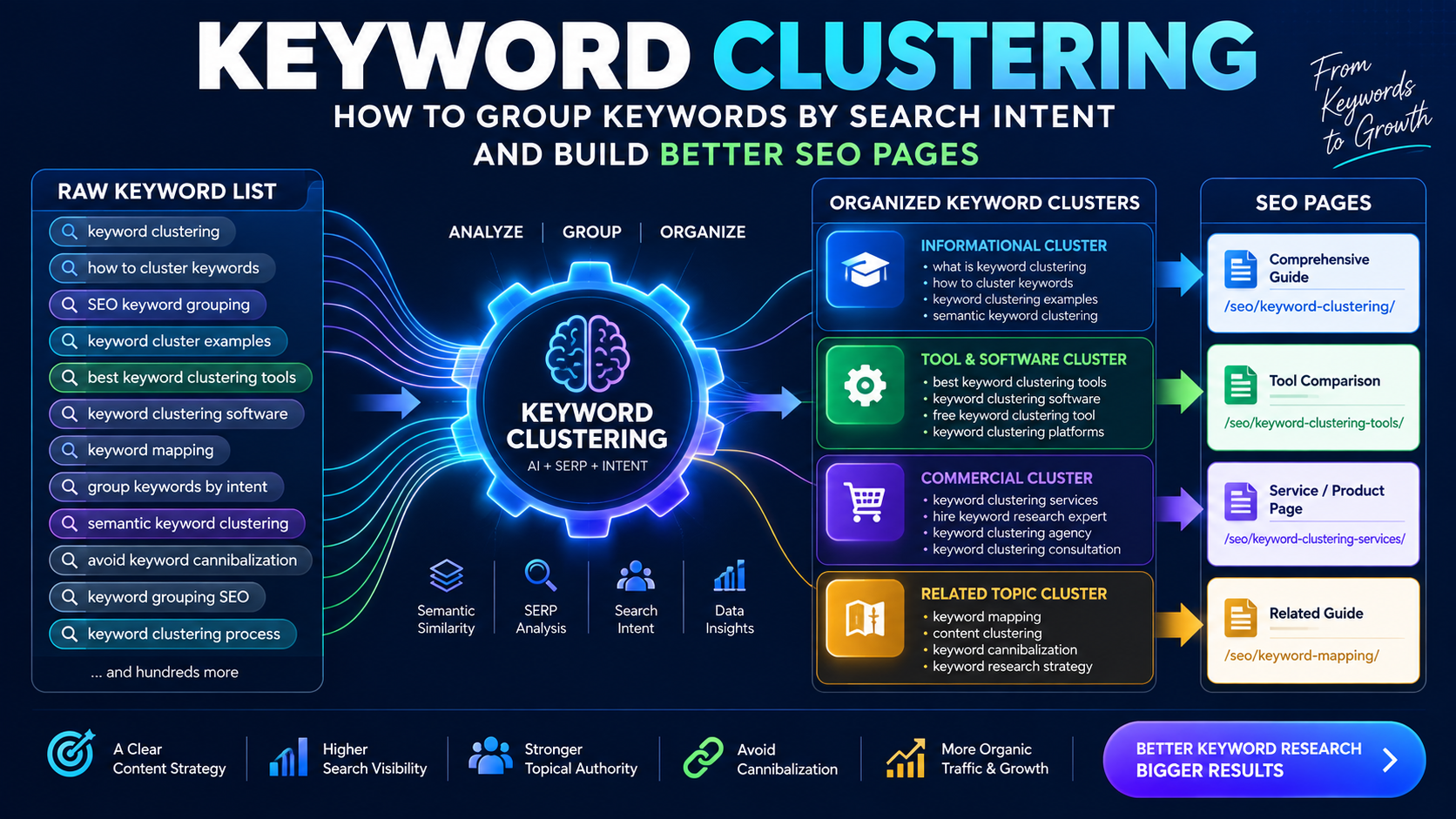
Keyword clustering is the process of grouping related search queries according to shared meaning, search intent, SERP similarity, or the page that should satisfy them.
Instead of treating 1,000 keywords as 1,000 pages, keyword clustering may reveal that those searches actually represent only 100 meaningful page opportunities.
A practical workflow looks like this:
Keyword Discovery → Keyword Metrics → Search Intent → Keyword Clustering → Keyword Mapping → Content
The goal is not to force similar words together.
The goal is to determine which searches should be satisfied by the same page and which genuinely deserve separate pages.
This guide explains how keyword clustering works, the different clustering methods, how to decide whether two keywords belong together, and how to turn keyword lists into a clean SEO content architecture.
What Is Keyword Clustering?
Keyword clustering is the process of organizing related keywords into groups that can usually be targeted by the same page or content asset.
A cluster may contain:
Primary Keyword
The main phrase that best represents the page.
Secondary Keywords
Closely related phrases expressing the same or highly similar intent.
Long-Tail Variations
More specific searches that can naturally be answered within the same page.
For example:
Primary keyword:
keyword clustering
Possible supporting keywords:
- SEO keyword clustering
- keyword grouping
- how to cluster keywords
- keyword clustering methods
- keyword clustering examples
- keyword clustering SEO
Those queries are different strings.
But they may not require six separate articles.
One strong page about keyword clustering can potentially satisfy all of them.
Why Keyword Clustering Matters
Keyword clustering solves one of the most important problems in modern keyword research:
Keywords do not map cleanly one-to-one with pages.
A page can rank for many related searches.
Likewise, many keywords may represent the same user need.
Without clustering, an SEO team might create:
/what-is-keyword-clustering//seo-keyword-clustering//how-to-cluster-keywords//keyword-grouping-guide/
If all four pages serve essentially the same search intent, the site has created unnecessary overlap.
A clustered approach might instead produce:
One page:
/seo/keyword-clustering/
targeting the entire intent group.
That gives you a stronger, clearer page.
Keyword Clustering vs Keyword Research
Keyword research discovers and evaluates search opportunities.
Keyword clustering organizes those opportunities into meaningful groups.
A simplified process is:
Keyword Discovery
Find possible searches.
Keyword Evaluation
Review:
- search volume
- difficulty
- intent
- relevance
- business value
Keyword Clustering
Determine which queries belong together.
Keyword Mapping
Assign each cluster to a URL.
This distinction matters.
Your earlier Keyword Discovery guide focuses on finding opportunities.
The Keyword Metrics guide helps evaluate them.
Keyword clustering determines how those opportunities should be organized before content is created.
Keyword Clustering vs Keyword Mapping
These terms are closely related but not identical.
Keyword Clustering
Answers:
Which keywords belong together?
Keyword Mapping
Answers:
Which URL should own this cluster?
For example:
Cluster
- keyword clustering
- how to cluster keywords
- SEO keyword grouping
- keyword clustering examples
Then:
Mapped URL
/seo/keyword-clustering/
Clustering creates the group.
Mapping assigns ownership.
We will cover keyword mapping in detail later in this Keyword Research series.
Why One Page Can Rank for Many Keywords
Search engines do not require a page to repeat every possible keyword variation.
A strong page can be relevant to many related searches because those searches express similar concepts.
For example, a page about:
keyword difficulty
might naturally rank for:
- keyword difficulty
- SEO keyword difficulty
- keyword competition
- keyword difficulty score
- how hard is a keyword to rank for
Those phrases are linguistically different.
Conceptually, they overlap heavily.
Your Keyword Difficulty guide is therefore designed around a topic and intent—not a single exact-match phrase.
This is one of the main reasons keyword clustering works.
The Main Types of Keyword Clustering
There is no single universal clustering method.
Several approaches can be useful.
1. Semantic Clustering
Semantic clustering groups keywords based on meaning.
Example:
- keyword grouping
- keyword clustering
- SEO keyword clusters
- grouping SEO keywords
These phrases mean roughly the same thing.
This is usually the easiest type of clustering to recognize.
Limitation
Similar wording does not always mean identical intent.
For example:
keyword clustering
and:
keyword clustering tool
are semantically related.
But the second query may have stronger tool-selection or commercial intent.
That may justify different content.
2. Search Intent Clustering
Intent clustering groups keywords according to what the user is trying to accomplish.
Consider:
Group A — Learn
- what is keyword clustering
- how does keyword clustering work
- keyword clustering explained
Group B — Do
- how to cluster keywords
- keyword clustering process
- keyword clustering step by step
These groups are closely related and could probably fit one comprehensive guide.
Now consider:
Group C — Buy or Select a Tool
- best keyword clustering tools
- keyword clustering software
- keyword clustering tool
That intent is meaningfully different.
A dedicated comparison or tool page may be more appropriate.
Search intent should usually carry more weight than keyword wording.
3. SERP-Based Clustering
SERP clustering compares which URLs rank for different keywords.
This can provide powerful evidence.
Suppose:
Keyword A: keyword clustering
and:
Keyword B: how to cluster keywords
share seven of the same top ten results.
That strongly suggests search engines view the two queries as closely related.
Now suppose:
Keyword C: keyword clustering tools
shares only one result with Keyword A.
That suggests a different search intent or page format.
SERP Overlap Principle
The greater the overlap between ranking URLs, the stronger the evidence that keywords may belong in the same cluster.
This is often more reliable than grouping keywords only because they contain similar words.
4. Topic-Based Clustering
Topic clustering groups queries under a wider subject.
For example:
Parent Topic
Keyword Research
Clusters
- Keyword Discovery
- Seed Keywords
- Long-Tail Keywords
- Keyword Metrics
- Keyword Difficulty
- Keyword Clustering
- Competitor Keyword Research
- SERP Analysis
- Keyword Mapping
These are all related.
But they are too distinct to belong on one page.
Topic similarity alone does not mean identical search intent.
This distinction is important.
5. Funnel-Based Clustering
You can also group keywords by buyer journey.
For example, around keyword research software:
Awareness
- what is keyword research
- how keyword research works
Consideration
- keyword research tools
- free keyword research tools
Comparison
- Ahrefs vs Semrush keyword research
- best keyword research software
Purchase
- Semrush pricing
- buy Ahrefs subscription
The topics overlap.
The required pages differ.
How to Tell Whether Two Keywords Belong on the Same Page
This is the core skill in keyword clustering.
Ask these questions.
Do They Have the Same Search Intent?
Compare:
keyword clustering
and:
what is keyword clustering
Likely same page.
Now compare:
keyword clustering
and:
keyword clustering software
Possibly different page.
Do the Same Types of Pages Rank?
If one query produces:
- guides
- tutorials
- educational articles
while another produces:
- software products
- comparison pages
- tools
the searches probably deserve different content.
Do the Same URLs Rank?
High SERP overlap is strong evidence for combining queries.
Can One Page Satisfy Both Searches Completely?
This is a practical test.
Ask:
Would a visitor searching either keyword be satisfied by the same page?
If yes, cluster them.
If no, separate them.
Would Separate Pages Be Meaningfully Different?
Imagine writing both pages.
If 80–90% of the content would be identical, they probably should not be separate.
A Simple Keyword Clustering Example
Suppose you start with these 12 keywords:
- keyword clustering
- SEO keyword clustering
- keyword grouping
- how to cluster keywords
- cluster keywords for SEO
- keyword clustering examples
- best keyword clustering tools
- keyword clustering software
- free keyword clustering tool
- keyword mapping
- how to map keywords to URLs
- keyword map template
A poor approach creates 12 pages.
A better analysis might produce three clusters.
Cluster 1: Keyword Clustering Guide
- keyword clustering
- SEO keyword clustering
- keyword grouping
- how to cluster keywords
- cluster keywords for SEO
- keyword clustering examples
Page Type
Educational guide.
Cluster 2: Keyword Clustering Tools
- best keyword clustering tools
- keyword clustering software
- free keyword clustering tool
Page Type
Tool comparison.
Cluster 3: Keyword Mapping
- keyword mapping
- how to map keywords to URLs
- keyword map template
Page Type
Keyword-mapping guide.
Twelve keywords became three useful page opportunities.
That is the value of clustering.
How to Cluster Keywords Step by Step
Step 1: Collect the Keyword Universe
Begin with everything discovered during research.
Possible sources include:
- keyword tools
- Search Console
- competitors
- Google autocomplete
- customer questions
- forums
- internal search
Your Seed Keywords guide explains how broad starting topics can expand into these larger keyword sets.
Do not cluster too early.
First collect enough data to understand the search market.
Step 2: Remove Obvious Irrelevant Keywords
Delete phrases that clearly do not fit:
- your audience
- products
- services
- topic
- market
For example, if you offer B2B CRM consulting, a query such as:
CRM video game
does not belong simply because it contains the same acronym.
Relevance comes first.
Step 3: Normalize Obvious Variations
Some keywords are nearly identical:
- SEO keyword cluster
- SEO keyword clusters
- keyword clusters SEO
You do not necessarily need to delete these.
But mark them as close variations so they do not dominate your analysis.
Step 4: Identify Search Intent
Classify keywords broadly as:
- informational
- navigational
- commercial investigation
- transactional
Your Search Intent guide provides the detailed framework.
Intent classification immediately prevents many bad clusters.
For example:
Informational:
what is keyword clustering
Commercial:
best keyword clustering tool
These may belong under the same broader topic but not on the same page.
Step 5: Group by Semantic Similarity
Now identify keywords with similar meaning.
For example:
- keyword clustering
- keyword grouping
- cluster SEO keywords
Create a provisional group.
Do not finalize it yet.
Step 6: Compare Search Results
Search representative keywords from each provisional group.
Record:
- ranking URLs
- page types
- SERP features
If the same pages repeatedly appear, your grouping is stronger.
If entirely different results appear, split the cluster.
Step 7: Choose a Primary Keyword
Each cluster should have one primary keyword.
The primary keyword usually represents:
- the clearest topic
- appropriate search intent
- meaningful demand
- natural page wording
It does not have to be the highest-volume phrase.
For example:
Cluster
- keyword clustering
- SEO keyword clustering
- keyword grouping
- keyword clustering examples
Primary Keyword
keyword clustering
It is the simplest description of the intent.
Step 8: Add Secondary Keywords
Secondary keywords help define supporting coverage.
For this page, possible secondary terms include:
- SEO keyword clustering
- keyword grouping
- keyword clusters
- semantic keyword clustering
These should guide content naturally.
Do not force every phrase into the article a fixed number of times.
Step 9: Add Long-Tail Targets
Now attach specific variations.
Examples:
- how to cluster keywords for SEO
- how to group keywords by search intent
- keyword clustering examples
- how to create keyword clusters
These often become:
- subheadings
- examples
- FAQs
- explanatory paragraphs
Step 10: Assign the Cluster to a URL
The final step is ownership.
Example:
Cluster: Keyword Clustering
Primary: keyword clustering
Mapped URL:
/seo/keyword-clustering/
This prevents another page from being created later for the same intent.
Keyword Clustering by SERP Overlap
SERP overlap is one of the most practical advanced approaches.
Imagine two keywords.
Keyword A
keyword clustering
Top results:
- Site A
- Site B
- Site C
- Site D
- Site E
Keyword B
how to cluster keywords
Top results:
- Site B
- Site A
- Site F
- Site C
- Site D
Four out of five URLs overlap.
That is strong evidence these searches share intent.
Now compare:
Keyword C
keyword clustering tools
Top results:
- Tool X
- Tool Y
- Software comparison
- Tool Z
- Product page
Almost no overlap.
Keyword C probably belongs in another cluster.
How Much SERP Overlap Is Enough?
There is no universal threshold.
Some tools may use:
- 3 matching URLs
- 4 matching URLs
- percentage overlap
- weighted ranking similarity
The exact threshold matters less than understanding the principle.
Higher overlap suggests stronger shared intent.
Lower overlap suggests caution.
Soft vs Hard Keyword Clustering
SEO tools may use different clustering rules.
Soft Clustering
A keyword can belong to a cluster if it overlaps with the primary keyword.
Example:
Keyword A overlaps with Primary.
Keyword B overlaps with Primary.
Even if A and B do not overlap much with each other, they may stay in the same cluster.
Benefit
Creates larger clusters.
Risk
Can combine queries too aggressively.
Hard Clustering
Every keyword needs stronger overlap across the cluster.
Benefit
Produces tighter intent groups.
Risk
May create too many small clusters.
Neither method is always superior.
The right choice depends on:
- site size
- content strategy
- query complexity
- automation needs
Manual review is still valuable.
Semantic Clustering vs SERP Clustering
These approaches answer different questions.
Semantic Clustering
Do these phrases mean similar things?
SERP Clustering
Does Google rank similar pages for these searches?
The strongest workflow often uses both.
For example:
Semantically Similar
keyword metrics
keyword difficulty
Both concern keyword evaluation.
But SERPs may differ significantly.
Therefore they deserve separate pages.
This is exactly why our Keyword Research series separates Keyword Metrics from Keyword Difficulty.
Semantic similarity alone would be too broad.
Keyword Clustering and Cannibalization
Poor clustering can create keyword cannibalization.
Imagine publishing:
Page A
Keyword Clustering Guide
Page B
How to Cluster Keywords
Page C
SEO Keyword Grouping Tutorial
All three target essentially identical intent.
Search engines may struggle to understand which page represents the strongest answer.
Your own internal links may also become inconsistent.
A stronger approach is:
one intent owner → one primary URL
This is why every cluster should have clearly defined page ownership.
Cannibalization Is Not Simply Two Pages Ranking for Similar Keywords
Two pages can legitimately appear for overlapping terms if they satisfy different intents.
For example:
Educational
keyword clustering
Tool Selection
best keyword clustering tools
Related topic.
Different purpose.
That is not automatically cannibalization.
Keyword Clustering and Content Architecture
Keyword clusters become building blocks for your website.
For example:
Pillar: Keyword Research
Clusters:
- Keyword Discovery
- Seed Keywords
- Long-Tail Keywords
- Keyword Metrics
- Keyword Difficulty
- Keyword Clustering
- Competitor Keyword Research
- Content Gap Analysis
- SERP Analysis
- Keyword Mapping
Each cluster owns one primary search intent.
Supporting articles can later expand narrower subtopics.
This is much stronger than creating a flat blog where every keyword becomes an isolated post.
Keyword Clustering and Internal Linking
Once keywords are clustered into pages, internal linking becomes more logical.
For example:
Keyword Metrics
links forward to:
Keyword Difficulty
which links to:
Keyword Clustering
Keyword Clustering can then naturally lead readers to:
Competitor Keyword Research
because competitor data is one of the major sources used to expand and compare keyword groups.
The result is a learning path rather than a random list of articles.
Use Descriptive Anchors
Instead of:
click here
use anchors such as:
understand keyword difficultyevaluate keyword metricsfind long-tail keyword opportunities
Internal anchors should describe why the destination is useful.
Keyword Clustering for Existing Websites
An existing site requires an extra step:
URL reconciliation.
Before creating a new cluster page, search your existing content.
Ask:
- Do we already have a page targeting this intent?
- Is another article partially targeting it?
- Should an existing page be expanded?
- Should two older pages be consolidated?
For example, your keyword list may suggest:
SEO audit checklist
But if your existing SEO Audit guide already satisfies that intent, another article may be unnecessary.
Clustering is therefore not just about planning new content.
It can also help clean up existing content architecture.
Keyword Clustering for New Websites
New websites have an advantage:
you can design ownership before publishing.
A simple keyword map could look like:
| Cluster | Primary Keyword | URL |
|---|---|---|
| Keyword Discovery | keyword discovery | /seo/keyword-discovery/ |
| Seed Keywords | seed keywords | /seo/seed-keywords/ |
| Long-Tail Keywords | long-tail keywords | /seo/long-tail-keywords/ |
| Keyword Metrics | keyword metrics | /seo/keyword-metrics/ |
| Keyword Difficulty | keyword difficulty | /seo/keyword-difficulty/ |
| Keyword Clustering | keyword clustering | /seo/keyword-clustering/ |
This reduces future duplication.
Keyword Clustering for Ecommerce
Ecommerce websites often have extremely large keyword sets.
Imagine an apparel store researching:
- men’s running shoes
- running shoes men
- men’s road running shoes
- men’s waterproof running shoes
- men’s trail running shoes
A clustering process might produce:
Cluster 1
Men’s Running Shoes
Cluster 2
Men’s Trail Running Shoes
Cluster 3
Men’s Waterproof Running Shoes
The challenge is deciding which attributes represent meaningful separate search intents.
Do not automatically create indexable category pages for every possible filter combination.
That can create:
- thin categories
- crawl waste
- duplication
- faceted-navigation problems
Clustering should support architecture—not multiply URLs unnecessarily.
Keyword Clustering for Local SEO
Local keyword sets often contain repetitive variations.
Example:
- SEO consultant Karachi
- Karachi SEO consultant
- SEO expert Karachi
- SEO specialist Karachi
These may belong to one local service-page cluster.
But:
- SEO consultant Karachi
- local SEO consultant Karachi
could potentially represent slightly different services depending on your offering and SERP.
Check the actual results.
Do not create near-identical location pages simply because word order changes.
Keyword Clustering for SaaS
SaaS keyword research often contains several intent types.
Consider CRM:
Educational Cluster
- what is CRM
- how CRM works
- CRM meaning
Commercial Cluster
- best CRM
- CRM software
- top CRM platforms
Comparison Cluster
- HubSpot vs Salesforce
- Salesforce vs HubSpot
Alternatives Cluster
- Salesforce alternatives
- HubSpot alternatives
Each cluster can support a distinct page type.
Trying to place everything on one “CRM” page would weaken intent alignment.
Keyword Clustering for B2B
B2B keyword sets may have low search volumes but high commercial value.
For example:
- CRM for manufacturing
- manufacturing CRM
- CRM software for manufacturers
These likely belong together.
But:
- CRM implementation for manufacturers
may represent a service intent.
That might deserve a separate commercial page.
This is why intent matters more than word similarity.
Keyword Clustering and Search Volume
Do not simply add search volumes together and assume the total equals traffic potential.
Keyword tools may group or estimate related searches differently.
Several phrases can represent overlapping search demand.
Use combined cluster volume as a directional signal.
Do not treat it as an exact traffic forecast.
For actual forecasting, use the scenario-based approach covered in the SEO Forecasting guide.
Keyword Clustering and Keyword Difficulty
Each keyword in a cluster may have a different difficulty score.
Example:
| Keyword | Difficulty |
|---|---|
| keyword clustering | 52 |
| SEO keyword clustering | 34 |
| keyword grouping | 41 |
| how to cluster keywords | 29 |
Do not create separate pages simply because difficulty scores differ.
The cluster should be defined by intent.
Then evaluate whether the topic as a whole is realistically competitive.
Your Keyword Difficulty guide explains how to combine tool scores with real SERP analysis.
Keyword Clustering and Business Value
Two semantically related keywords may have very different business value.
Consider:
what is CRM
and:
best CRM for digital agencies
They are related.
But the second query may be much closer to purchase.
You might therefore separate them into:
Informational Cluster
What Is CRM?
Commercial Cluster
Best CRM for Digital Agencies
This creates better conversion alignment.
Keyword Clustering and Search Console
For existing websites, Search Console can reveal natural clusters.
Suppose one page receives impressions for:
- keyword clustering
- SEO keyword groups
- grouping keywords
- how to cluster keywords
That is evidence Google already associates those queries with one URL.
This information can help validate your clustering assumptions.
Search Console is especially useful because it reflects your site’s actual visibility rather than only third-party keyword estimates.
Keyword Clustering Tools
Keyword clustering can be performed using:
- spreadsheets
- keyword research platforms
- dedicated clustering software
- scripts
- APIs
- AI-assisted workflows
Automation becomes useful when working with thousands or millions of queries.
But automation should not eliminate human review.
Tools can accidentally combine:
- similar wording with different intent
- informational and transactional terms
- broad and niche audiences
- unrelated meanings of ambiguous words
Use tools to accelerate clustering.
Use judgment to validate it.
Can AI Cluster Keywords?
Yes.
AI can help group keywords by:
- semantic similarity
- topic
- intent
- customer journey
This can dramatically accelerate early organization.
However, semantic AI clustering may not know what the live search results actually show.
For important clusters, validate with:
- SERP analysis
- ranking-page types
- real search intent
A good workflow is:
AI/Semantic Grouping → SERP Validation → Manual Review → Final Cluster
AI helps organize.
Search evidence confirms.
How Large Should a Keyword Cluster Be?
There is no ideal size.
One cluster may contain:
- 5 keywords
Another may contain:
- 500 related queries
The important question is not:
How many keywords are in the cluster?
It is:
Can one page satisfy the search intent represented by this cluster?
Do not split clusters simply because they look large.
Do not merge them simply because they look small.
Primary vs Secondary Keywords in a Cluster
A clean cluster usually has hierarchy.
Primary Keyword
Represents the main intent.
Secondary Keywords
Closely related variations.
Long-Tail Keywords
Specific questions and modifiers.
Example:
Primary
keyword clustering
Secondary
SEO keyword clustering
keyword grouping
keyword clusters
Long-tail
how to cluster keywords for SEO
how to group keywords by search intent
keyword clustering examples for SEO
This structure is useful when writing content briefs.
Keyword Clustering Mistakes
Grouping by Words Instead of Intent
Similar vocabulary can hide different goals.
Creating One Page Per Keyword
This creates unnecessary overlap.
Making Clusters Too Broad
“SEO” is not one cluster.
It is an entire subject area.
Making Clusters Too Narrow
Minor wording changes rarely deserve separate URLs.
Ignoring SERPs
Actual ranking pages provide important evidence.
Ignoring Existing Content
Clustering should account for URLs you already have.
Letting Tools Make Every Decision
Automation still needs review.
Mixing Page Types
A guide, tool, product page, and comparison may target related keywords but satisfy different intents.
Ignoring Business Value
A cluster should support the audience and business.
A Practical Keyword Clustering Workflow
Use this process for your keyword research projects.
1. Discover Keywords
Collect a broad keyword universe.
2. Remove Irrelevant Queries
Keep the research aligned with the audience.
3. Add Keyword Metrics
Include:
- volume
- trend
- difficulty
- CPC
- current rankings
4. Identify Search Intent
Understand what each query wants.
5. Create Semantic Groups
Group obvious topic variations.
6. Validate With SERPs
Compare ranking URLs and page types.
7. Split Conflicting Intents
Separate informational, commercial, transactional, or navigational needs where appropriate.
8. Select a Primary Keyword
Choose the clearest representative term.
9. Assign Secondary and Long-Tail Keywords
Use them to define supporting coverage.
10. Map the Cluster to One URL
Establish ownership.
11. Review Cannibalization
Make sure another page does not already own the same intent.
12. Build Internal Links
Connect the cluster with related pages.
This turns keyword research into a usable content architecture.
Keyword Clustering Checklist
Before finalizing a cluster, ask:
Relevance
- Are all keywords relevant to the same audience?
- Do they belong to the same broader topic?
Intent
- Do users want essentially the same outcome?
- Are informational and commercial intents being mixed?
SERP
- Do similar pages rank?
- Is there meaningful URL overlap?
Page Type
- Can one content format satisfy every query?
Existing Content
- Does a current page already own the intent?
- Would a new page cause cannibalization?
Keyword Hierarchy
- Is there a clear primary keyword?
- Are secondary keywords meaningful?
- Are long-tail variations covered?
Business Value
- Does the cluster support your business goals?
Architecture
- Does the cluster belong clearly within a pillar?
- Which related pages should link to it?
If these questions produce clear answers, the cluster is probably ready for keyword mapping and content production.
Final Thoughts
Keyword clustering transforms raw keyword lists into useful SEO architecture.
The process can be summarized as:
Keywords → Meaning → Search Intent → SERP Similarity → Cluster → URL
The most important principle is simple:
Do not create pages for keywords. Create pages for distinct search needs.
One page may satisfy dozens or hundreds of related queries.
Two phrases that look almost identical may require separate pages if the underlying intent differs.
Use semantics to identify possibilities.
Use search intent to understand users.
Use SERP overlap to validate decisions.
Use existing content to prevent cannibalization.
And use keyword mapping to establish clear ownership.
When keyword clustering is done well, your content strategy becomes cleaner.
You publish fewer unnecessary pages.
Each page has a clearer purpose.
Internal linking becomes easier.
Cannibalization risk falls.
And your website begins to look less like a collection of keyword-targeted articles and more like an organized knowledge system.
Once your clusters are established, the next step is to study what competing websites already rank for and identify opportunities you may have missed through competitor keyword research.