
Traditional keyword research starts with words.
Modern SEO research often needs to go further.
A user may search for:
technical SEO
But understanding that topic involves much more than repeating the phrase “technical SEO.”
The subject is connected with concepts such as:
- crawling
- indexing
- robots.txt
- canonical URLs
- XML sitemaps
- redirects
- JavaScript rendering
- structured data
- Core Web Vitals
These concepts are not merely keyword variations.
They are entities and related concepts that help define the topic.
That is where entity research for SEO becomes useful.
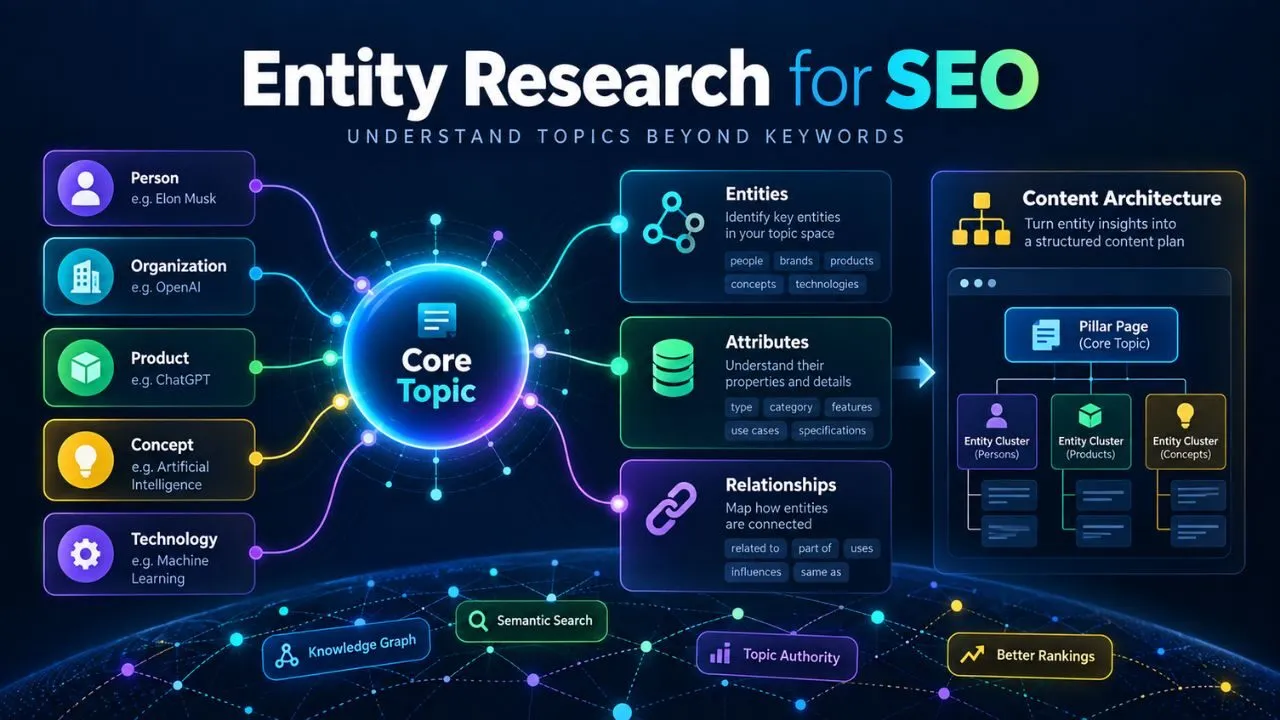
Entity research is the process of identifying the people, organizations, products, places, concepts, technologies, and relationships that are important to a topic.
Instead of asking only:
Which keywords should this page mention?
entity research asks:
Which concepts must someone understand to genuinely understand this subject?
This can improve:
- topical coverage
- content planning
- internal linking
- information architecture
- content briefs
- semantic clarity
- research depth
Entity research does not replace keyword research.
It complements it.
A practical process looks like:
Keyword Research → Search Intent → SERP Analysis → Keyword Mapping → Entity Research → Content Structure
This guide explains what entities are, how entity research works, where to find relevant entities, how to distinguish useful concepts from random terminology, and how to apply entity research without turning content into a list of forced “semantic keywords.”
What Is an Entity in SEO?
An entity is a distinct thing or concept that can be identified and understood independently.
Examples include:
People
- Bill Gates
- Tim Berners-Lee
Organizations
- Microsoft
- OpenAI
Products
- Google Search Console
- WordPress
- Shopify
Places
- Karachi
- London
- New York
Technologies
- HTML
- JavaScript
- HTTP
Concepts
- search intent
- crawling
- indexing
- keyword clustering
The important idea is that an entity represents a thing, not merely a string of text.
For example:
Apple
can refer to:
- the fruit
- Apple Inc.
Context determines which entity is meant.
Search systems use context and relationships to understand meaning more accurately.
What Is Entity Research for SEO?
Entity research for SEO is the process of identifying important entities, attributes, relationships, subtopics, and supporting concepts associated with a target subject.
Suppose your target topic is:
keyword research
Relevant entities and concepts might include:
- Google Search Console
- Google Keyword Planner
- search volume
- keyword difficulty
- search intent
- long-tail keywords
- SERPs
- keyword clustering
- competitor analysis
- keyword mapping
An entity-research process helps you determine which of these concepts are necessary for a useful, complete explanation.
The goal is not:
Mention as many related words as possible.
The goal is:
Understand the conceptual structure of the topic.
Keywords vs Entities
Keywords and entities are related but different.
Keyword
A phrase someone types into a search engine.
Example:
keyword mapping
Entity
A concept, product, organization, person, or thing associated with the topic.
Examples:
- search intent
- URL
- SERP
- content cluster
- canonical page
A keyword represents search demand.
An entity represents meaning.
This distinction is useful when building comprehensive content.
Entity Research Does Not Replace Keyword Research
Keyword research still helps you understand:
- demand
- language
- intent
- competition
- search behavior
Entity research helps you understand:
- conceptual coverage
- relationships
- terminology
- supporting subjects
- topic structure
The two should work together.
For example:
Primary keyword: keyword mapping
Search intent: informational
Relevant entities/concepts:
- keyword cluster
- search intent
- URL
- page type
- cannibalization
- internal linking
- SERP analysis
Your Keyword Mapping guide already demonstrates this naturally: the article does not merely repeat “keyword mapping”; it explains the concepts required to understand the process.
Why Entity Research Matters
Entity research improves content because it encourages deeper subject understanding.
It Helps You Cover the Topic Properly
Imagine writing about:
technical SEO
but never discussing:
- crawling
- indexing
- status codes
- canonical tags
- XML sitemaps
The article would probably feel incomplete.
Entity research helps identify these missing conceptual components before writing.
It Helps Build Better Content Briefs
Instead of giving a writer:
Write 2,000 words about technical SEO and use the keyword eight times.
a stronger brief can say:
Explain technical SEO through crawling, indexing, rendering, redirects, canonicals, sitemaps, performance, structured data, and measurement.
That creates much more useful content.
It Helps Build Topic Architecture
Entities can also reveal relationships between pages.
For example:
Keyword Research
connects with:
- Search Intent
- Keyword Difficulty
- SERP Analysis
- Keyword Mapping
- Entity Research
These relationships can guide:
- clusters
- internal links
- future content
It Helps Reduce Thin Keyword-First Content
Keyword-first writing can become repetitive.
Entity-first thinking encourages writers to explain:
- how things relate
- why they matter
- what depends on what
This usually results in more useful material.
12 Steps to Perform Entity Research for SEO
Step 1: Define the Core Topic
Start with one clearly defined subject.
For example:
keyword mapping
Do not begin with an enormous concept such as:
digital marketing
Broad subjects contain too many unrelated entities.
A narrower topic produces more useful research.
Ask:
What does the reader need to understand by the end of this page?
That question gives the research boundaries.
Step 2: Confirm Search Intent
Before researching entities, understand the user’s goal.
For:
keyword mapping
the intent may be:
- learn what keyword mapping means
- understand the process
- create a mapping workflow
- prevent cannibalization
That tells you which entities matter.
A user wanting a definition may need different depth from someone searching for:
keyword mapping tool
Your Search Intent guide helps establish this context.
Step 3: Study the SERP
Search the topic.
Review the pages currently ranking.
Look for concepts that appear repeatedly.
For example, results around keyword mapping may repeatedly mention:
- keyword clusters
- URLs
- search intent
- cannibalization
- page types
- spreadsheets
Repeated concepts can indicate important topical relationships.
Your SERP Analysis guide explains how to study ranking pages systematically.
Do not assume that every repeated term must appear in your content.
Use the SERP as research evidence.
Step 4: Review Authoritative Sources
Strong entity research should include authoritative sources when the topic has formal terminology.
Depending on the subject, useful sources may include:
- official documentation
- standards organizations
- product documentation
- academic sources
- government resources
- trusted industry documentation
For example, an article about structured data should rely heavily on official structured-data documentation rather than random blog definitions.
Authoritative sources help establish correct terminology and relationships.
Step 5: Extract Core Entities
Now identify the concepts without which the topic cannot be explained properly.
Suppose the subject is:
SERP Analysis
Core entities might include:
- search query
- search intent
- organic result
- paid result
- SERP feature
- ranking URL
- competitor
- search result page
These are central.
Without them, the article would not explain the subject adequately.
Step 6: Identify Supporting Entities
Supporting entities provide additional depth.
For SERP Analysis, these could include:
- featured snippets
- local packs
- videos
- image results
- discussion results
- shopping results
They are related, but not necessarily central to every explanation.
This distinction is useful when prioritizing content.
Step 7: Identify Attributes
Entities often have attributes.
For example:
Entity
Keyword
Attributes
- search volume
- difficulty
- CPC
- trend
- intent
Or:
Entity
Web Page
Attributes
- URL
- title
- status code
- canonical
- content type
Attributes can reveal useful sections for an article.
Step 8: Identify Relationships
This is one of the most valuable parts of entity research.
Ask:
How do these concepts relate?
For example:
Keyword
→ belongs to →
Keyword Cluster
→ maps to →
URL
→ satisfies →
Search Intent
That sequence describes a conceptual relationship.
Entity research becomes much more useful when you map connections rather than simply collecting nouns.
Step 9: Identify Missing Concepts
Compare your planned article structure with the entity list.
Ask:
- Are any core concepts missing?
- Does the article explain key relationships?
- Is important terminology undefined?
For example, if your keyword-mapping guide discusses URLs but never explains search intent, there may be a conceptual gap.
This is similar to your Content Gap Analysis workflow, but focused on topic meaning rather than only missing pages or keywords.
Step 10: Separate Relevant From Incidental Entities
This prevents over-optimization.
Suppose ranking articles mention:
- Semrush
- Ahrefs
- Excel
- Airtable
- Notion
Do you need all of those in your article?
Probably not.
They may simply be tools used in examples.
Ask:
Is this entity essential to understanding the topic?
If not, it is optional.
Entity research should improve clarity.
It should not turn the page into a checklist of product names.
Step 11: Map Entities to Sections
Now assign important entities to the content structure.
Example:
Section: What Is Keyword Mapping?
Entities:
- keyword
- keyword cluster
- URL
- search intent
Section: How to Build a Keyword Map
Entities:
- spreadsheet
- page type
- primary keyword
- secondary keyword
- content status
Section: Cannibalization
Entities:
- duplicate intent
- competing URLs
- consolidation
- redirect
This creates a content brief based on knowledge rather than word count.
Step 12: Validate the Final Content
Before publishing, review the article.
Ask:
- Does it explain the main entities?
- Are relationships clear?
- Are concepts used accurately?
- Are unnecessary terms being forced in?
- Would a beginner understand how the concepts connect?
This final quality check prevents semantic optimization from becoming mechanical.
Build an Entity Map
A useful entity map can show:
Core Topic
↓
Primary Concepts
↓
Supporting Concepts
↓
Relationships
For example:
Core Topic
Keyword Mapping
Primary Entities
- keyword
- cluster
- search intent
- URL
- page
Supporting Entities
- SERP
- content brief
- internal link
- cannibalization
- page type
Relationships
Keyword → grouped into → Cluster
Cluster → represents → Intent
Cluster → assigned to → URL
URL → belongs to → Site Architecture
This map can help both writers and editors.
Entity Research and Keyword Clustering
Keyword clustering groups search queries.
Entity research groups concepts.
These processes can reinforce each other.
Suppose your keyword cluster contains:
- keyword mapping
- map keywords to URLs
- SEO keyword map
Entity research may reveal that the page also needs to explain:
- search intent
- page ownership
- cannibalization
- URL structure
Those concepts may not have large search volumes themselves.
They are still necessary for topical completeness.
Your Keyword Clustering guide therefore handles the search-query side, while entity research helps with the knowledge side.
Entity Research and SERP Analysis
SERP analysis is one of the richest entity-research inputs.
Ranking pages can reveal:
- repeated concepts
- repeated brands
- common tools
- expected terminology
- important subtopics
But do not blindly copy competitor vocabulary.
The fact that ten pages mention a term does not mean Google requires it.
A repeated entity is evidence that the concept may be important.
You still need to determine whether it helps your reader.
Entity Research and Content Gap Analysis
Content gap analysis looks for missing opportunities across your site.
Entity research can reveal missing concepts inside an individual article.
For example:
Your article about keyword difficulty may already cover:
- difficulty scores
- backlinks
- SERP competition
But entity research may reveal that it should also explain:
- referring domains
- search intent
- topical authority
That is a conceptual content gap.
The fix may simply be a better section inside the existing article.
Entity Research and Keyword Mapping
Keyword mapping decides which page owns an intent.
Entity research helps define what that page should understand and explain.
For example:
Target Page
/seo/keyword-mapping/
Primary Keyword
keyword mapping
Related Entities
- keyword cluster
- search intent
- URL
- page type
- cannibalization
- internal link
This produces a much richer brief than a primary keyword alone.
Entity Research and Internal Linking
Entities can reveal logical internal-link opportunities.
Suppose an article mentions:
keyword clustering
and your website has a dedicated Keyword Clustering guide.
That entity relationship creates a natural internal link.
Likewise:
search intent
can link to your Search Intent guide.
Entity-based linking is useful because it connects related concepts when the reader may actually benefit from deeper explanation.
Do not turn every entity mention into a link.
Use the strongest contextual opportunities.
Entity Research and Site Architecture
A website can also be viewed as an entity network.
For example:
Pillar
Keyword Research
Connected Concepts
- Keyword Discovery
- Seed Keywords
- Long-Tail Keywords
- Keyword Metrics
- Keyword Difficulty
- Keyword Clustering
- Competitor Keyword Research
- Content Gap Analysis
- SERP Analysis
- Keyword Mapping
- Entity Research
These pages form a conceptual network.
The architecture becomes stronger when:
- pages have distinct ownership
- relationships are clear
- internal links reflect those relationships
Your content roadmap already follows this approach structurally.
Entity Research for Existing Content
Entity research is particularly useful when refreshing an old article.
Start with the existing page.
Then ask:
- Which entities are already covered?
- Which important concepts are missing?
- Which terminology is outdated?
- Which relationships are unclear?
This can lead to targeted improvements rather than complete rewrites.
For example:
An older technical SEO article may cover:
- crawling
- indexing
- sitemaps
but omit:
- JavaScript rendering
- structured data
- Core Web Vitals
Those could become meaningful refresh opportunities depending on the page’s scope.
Entity Research for New Content
For a new article, use entity research during the briefing stage.
A useful workflow is:
Topic → Intent → Keywords → SERP → Entities → Outline → Draft
This prevents writers from building the article around keyword repetition.
Instead, the draft begins with a clear understanding of the subject.
Entity Research for Ecommerce
Entities can help ecommerce content become more specific.
Suppose the topic is:
trail running shoes
Relevant entities and attributes may include:
Product Type
running shoes
Use Case
trail running
Attributes
- grip
- cushioning
- waterproofing
- weight
- drop
Conditions
- rocky terrain
- mud
- wet weather
These concepts help create useful category descriptions and buying guides.
Entity Research for SaaS
Suppose the topic is:
CRM automation
Relevant entities might include:
- CRM
- workflow
- lead
- contact
- sales pipeline
- trigger
- task
- automation rule
Relationships matter.
For example:
Lead enters CRM
→ trigger fires
→ workflow starts
→ email sent
→ sales task created
That relationship explains the concept better than keyword repetition.
Entity Research for Local SEO
Local SEO contains many entities.
Examples:
- business
- location
- service
- Google Business Profile
- review
- map
- address
- service area
A local service page may need to establish relationships such as:
Business → provides → Service → in → Location
This should be done naturally through useful information.
Do not fabricate local associations.
Entity Research for B2B
B2B topics often involve complex relationships.
For example:
Manufacturing CRM
may involve:
- manufacturer
- sales representative
- distributor
- account
- lead
- ERP
- pipeline
- quote
Understanding these entities can make content much more precise.
This is especially helpful for niche topics with low search volume but high business value.
Sources for Entity Research
Possible sources include:
Search Results
Useful for identifying recurring concepts and patterns.
Competitor Content
Useful for understanding common topic coverage.
Official Documentation
Important for formal concepts and technologies.
Knowledge Bases
Useful for terminology and product relationships.
Customer Conversations
Useful for real-world vocabulary.
Search Console
Useful for seeing how users phrase related searches.
Internal Site Search
Useful for identifying terms your own visitors use.
Use several sources when the topic is important.
One source can introduce bias.
Entity Research Tools
You can perform entity research with:
- spreadsheets
- SERP analysis
- NLP tools
- AI systems
- knowledge graphs
- content-analysis platforms
Tools can help extract:
- repeated concepts
- named entities
- relationships
- missing terminology
But they should not decide what belongs in the article automatically.
A tool can identify:
“Google” appears in 80% of competitor pages.
That does not mean your article needs to mention Google repeatedly.
The writer still needs judgment.
Can AI Help With Entity Research?
Yes.
AI can be useful for:
- extracting entities from documents
- grouping concepts
- identifying relationships
- building topic maps
- comparing article coverage
A practical AI-assisted workflow might be:
Collect Sources → Extract Concepts → Group Entities → Identify Relationships → Manual Review
The manual review matters.
AI can:
- invent relationships
- overgeneralize
- confuse ambiguous entities
- include irrelevant concepts
Use AI to accelerate analysis.
Do not outsource subject judgment.
Entity Research Is Not “LSI Keywords”
You may encounter advice telling writers to add “LSI keywords.”
That phrase is often used loosely in SEO discussions to mean related words.
A better approach is to think in terms of:
- entities
- concepts
- relationships
- search intent
You do not need to stuff articles with lists of semantically related phrases.
You need to explain the topic properly.
Do You Need Every Related Entity?
No.
Suppose you are writing:
What Is Keyword Mapping?
There may be hundreds of related SEO entities.
Including all of them would make the page worse.
Prioritize:
Essential
Required to explain the topic.
Helpful
Adds useful depth.
Optional
Useful only in specific examples.
Irrelevant
Does not help answer the query.
This hierarchy keeps the article focused.
Entity Research and Topical Authority
Entity coverage alone does not create authority.
A website does not become authoritative simply by mentioning every related concept.
Authority comes from building genuinely useful, interconnected content around a subject.
Entity research can help identify the conceptual landscape.
Your job is still to:
- explain it accurately
- provide useful examples
- build strong pages
- connect related topics
Think of entity research as content intelligence, not a ranking trick.
Entity Research and Structured Data
Entities and structured data are related but not identical.
Structured data can describe specific things on a page in a machine-readable format.
Examples include:
- Person
- Organization
- Product
- Article
- BreadcrumbList
However, do not add schema solely because an entity appears in your article.
Structured data should accurately represent visible content and the actual page.
For a standard educational blog article such as this one, your existing BlogPosting schema is sufficient unless there is a genuine need for additional structured data.
Build an Entity Research Spreadsheet
A simple entity-research sheet can include:
| Field | Purpose |
|---|---|
| Entity | Concept or thing |
| Type | Person, organization, concept, technology |
| Importance | Core, supporting, optional |
| Relationship | How it connects to the topic |
| Source | Where it was identified |
| Article Section | Where it should be covered |
| Existing Page | Internal-link opportunity |
| Notes | Context |
Example:
| Entity | Importance | Relationship |
|---|---|---|
| Search Intent | Core | Determines page purpose |
| Keyword Cluster | Core | Groups related queries |
| URL | Core | Owns the keyword cluster |
| Cannibalization | Supporting | Risk mapping helps prevent |
| Internal Linking | Supporting | Connects related mapped pages |
This converts entity research into a usable content brief.
Measuring the Usefulness of Entity Research
Do not measure entity research by:
number of entities mentioned.
That encourages stuffing.
Instead, evaluate outcomes such as:
Content Completeness
Does the page explain the subject properly?
Search Query Coverage
Does the page gain impressions for relevant variations?
User Engagement
Can readers navigate logically to related topics?
Editorial Quality
Does the article require fewer major conceptual revisions?
Internal Linking
Are relevant topic relationships represented?
The goal is improved understanding.
Common Entity Research Mistakes
Treating Entities Like Keywords
Do not force exact repetitions.
Collecting Too Many Entities
Focus on what matters to the page.
Copying Competitor Terminology
Verify whether the concept is actually useful.
Ignoring Search Intent
An entity can be related but unnecessary for the specific query.
Confusing Products With Core Concepts
Tools used in examples may not be essential entities.
Stuffing Brand Names
Mention brands only when useful.
Ignoring Relationships
A flat list is less useful than a conceptual map.
Adding Unsupported Schema
Structured data should reflect real page content.
Trusting AI Without Review
Validate extracted relationships.
Measuring Success by Entity Count
Quality matters more than quantity.
A Practical Entity Research Workflow
Use this process:
1. Define the Topic
Choose the exact subject.
2. Confirm Search Intent
Understand the reader’s goal.
3. Review Keywords
Understand the language users use.
4. Analyze the SERP
Identify recurring concepts.
5. Review Authoritative Sources
Validate terminology.
6. Extract Core Entities
Identify essential concepts.
7. Extract Supporting Entities
Find useful secondary concepts.
8. Identify Attributes
Understand important characteristics.
9. Map Relationships
Document how concepts connect.
10. Identify Gaps
Compare entities with your planned content.
11. Map Entities to Sections
Turn research into an outline.
12. Review the Final Draft
Remove forced terminology and confirm conceptual completeness.
Entity Research Checklist
Before publishing, confirm:
Topic
- core topic clearly defined
- search intent understood
- scope controlled
Research
- SERPs reviewed
- authoritative sources considered
- competitor coverage reviewed
Entities
- core entities identified
- supporting entities identified
- irrelevant concepts removed
Relationships
- major relationships understood
- concepts connected logically
- terminology used correctly
Content
- entities mapped to useful sections
- content does not feel stuffed
- examples support understanding
Architecture
- related internal pages identified
- logical internal links added
- page ownership remains distinct
Quality
- AI output manually reviewed
- no unsupported claims added
- unnecessary entities removed
Final Thoughts
Entity research helps SEO content move beyond keyword strings.
A useful workflow looks like:
Topic → Search Intent → Keywords → SERP → Entities → Relationships → Content Structure
Keywords tell you how people search.
Entities help you understand what the topic actually contains.
When these two forms of research work together, content becomes more complete and easier to structure.
The objective is not to mention every related concept.
It is to identify the concepts that matter, understand how they relate, and explain them clearly.
Good entity research helps you answer a better question:
What does someone genuinely need to understand this topic?
rather than:
Which related words should I insert into this article?
That distinction leads to stronger research, clearer writing, better internal linking, and more coherent topic architecture.
The next article in this Keyword Research series moves to another commonly misunderstood opportunity: zero-volume keywords – searches that keyword tools may report as having little or no measurable demand but that can still represent valuable user needs.