
Publishing more content does not automatically make a website more authoritative.
A website can have hundreds of articles and still miss the topics that matter most to its audience.
That is where content gap analysis becomes useful.
Content gap analysis is the process of identifying important topics, keywords, questions, page types, or customer needs that your website does not currently cover well enough.
A gap may exist because:
- competitors rank for topics you have ignored
- customers ask questions you have never answered
- an existing article covers a topic too shallowly
- a commercial page is missing
- an important search intent has no suitable page
- your content cluster is incomplete
- your current page ranks, but not strongly enough
- users need a format you do not currently provide
The goal is not to copy everything competitors publish.
It is to identify meaningful gaps between what your audience needs and what your website currently provides.
A practical content gap analysis can help you decide:
- what new pages to create
- what existing pages to improve
- what content to consolidate
- which topics deserve priority
- where your website lacks topical depth
- which missing pages could support leads, sales, or authority
This guide explains how to perform a content gap analysis step by step, how to combine competitor data with your own search data, how to separate real opportunities from noise, and how to turn gaps into a practical SEO roadmap.
What Is Content Gap Analysis?
Content gap analysis is the process of finding topics, keywords, search intents, questions, and content formats that are important to your audience but are missing or underdeveloped on your website.
A gap can exist at several levels.
Keyword Gap
You do not rank for a keyword that relevant competitors rank for.
Topic Gap
You have not covered an important subject within your niche.
Intent Gap
You cover the topic, but not the user’s specific intent.
Funnel Gap
You have content for awareness but little content for evaluation or purchase.
Format Gap
The user may need:
- a checklist
- template
- calculator
- comparison
- tool
- video
- landing page
rather than another article.
Depth Gap
You have a page on the topic, but it does not cover the subject sufficiently.
A good content gap analysis looks beyond missing keywords.
It asks:
What is the audience looking for that our current site does not satisfy well enough?
Why Content Gap Analysis Matters
Without a gap-analysis process, content planning can become random.
Teams often publish based on:
- whatever topic sounds interesting
- whatever a competitor published recently
- whatever keyword has the highest volume
- whatever the writer wants to cover
That creates inconsistent coverage.
A structured content gap analysis helps you find opportunities based on evidence.
It Helps Build Topical Depth
Suppose your website has a Keyword Research pillar containing:
- Keyword Discovery
- Seed Keywords
- Long-Tail Keywords
- Keyword Metrics
- Keyword Difficulty
- Keyword Clustering
But you do not cover:
- competitor keyword research
- content gap analysis
- SERP analysis
- keyword mapping
Those missing areas create an incomplete learning journey.
Adding the right pages strengthens the entire topic cluster.
It Helps Identify Commercial Opportunities
A content gap is not always another educational blog post.
Imagine your website contains:
- what is technical SEO
- technical SEO checklist
- technical SEO audit guide
but no page offering:
technical SEO consulting
That is a commercial content gap.
Your educational coverage may be strong while the conversion path remains weak.
It Helps Improve Existing Content
Gap analysis does not always lead to new pages.
Sometimes the better action is to improve an existing URL.
For example, your page about keyword clustering may rank for:
keyword clustering examples
but contain no practical example.
That is a content-depth gap within an existing page.
The correct action is probably to improve the page, not publish a second article.
Content Gap Analysis vs Competitor Keyword Research
These processes overlap, but they are not the same.
Competitor Keyword Research
Asks:
What keywords and pages are competitors ranking for?
Content Gap Analysis
Asks:
Which important topics, intents, or content needs are missing or underdeveloped on our website?
Competitor research is one input.
It is not the entire analysis.
Your previous guide on Competitor Keyword Research explains how to find competitor rankings and opportunities.
Content gap analysis takes that intelligence and combines it with:
- your existing content
- customer needs
- search intent
- business priorities
- Search Console data
- funnel stages
- site architecture
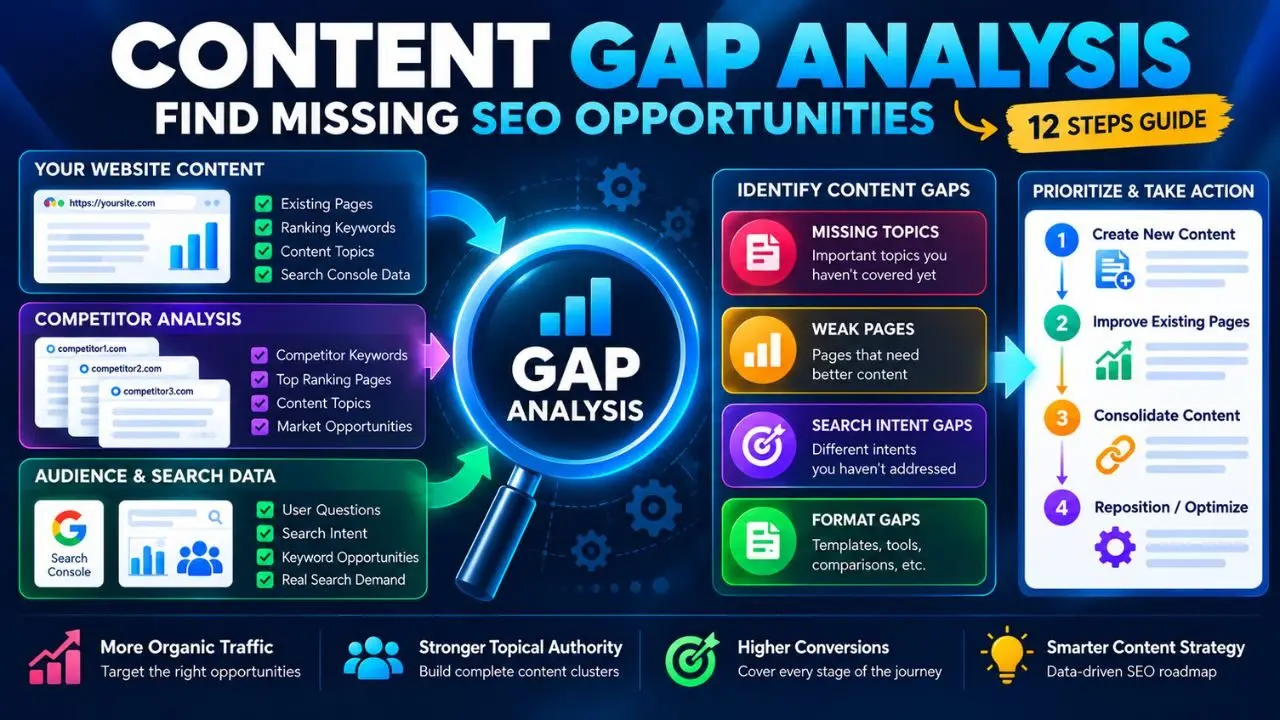
12 Steps to Perform a Content Gap Analysis
Step 1: Define the Scope
Do not analyze the entire internet.
Choose a specific scope.
Examples:
- Keyword Research pillar
- Technical SEO cluster
- ecommerce category
- local service area
- one product line
- one customer segment
For example:
Find missing topics within our Keyword Research pillar.
is much easier to act on than:
Find every possible missing marketing topic.
A clear scope prevents the analysis from becoming an endless spreadsheet.
Step 2: Inventory Your Existing Content
Before looking for gaps, document what you already have.
Create a list of:
- URLs
- page titles
- primary topics
- target keywords
- search intent
- content type
- performance
For example:
| URL | Topic | Intent |
|---|---|---|
| /seo/keyword-discovery/ | Keyword Discovery | Informational |
| /seo/seed-keywords/ | Seed Keywords | Informational |
| /seo/long-tail-keywords/ | Long-Tail Keywords | Informational |
| /seo/keyword-metrics/ | Keyword Metrics | Informational |
| /seo/keyword-difficulty/ | Keyword Difficulty | Informational |
| /seo/keyword-clustering/ | Keyword Clustering | Informational |
This gives you the baseline.
Without an inventory, you may accidentally recommend pages that already exist.
Step 3: Review Your Topic Architecture
Now step back from individual URLs.
Ask:
- What are the major pillars?
- Which clusters should exist under each pillar?
- Is the learning journey complete?
- Are commercial pages present?
- Are supporting resources missing?
For example:
Keyword Research
Existing:
- Keyword Discovery
- Seed Keywords
- Long-Tail Keywords
- Keyword Metrics
- Keyword Difficulty
- Keyword Clustering
- Competitor Keyword Research
Potential gaps:
- Content Gap Analysis
- SERP Analysis
- Keyword Mapping
- Keyword Cannibalization
- Keyword Research Tools
This is a structural gap analysis.
It identifies missing pieces in the knowledge architecture.
Step 4: Analyze Competitor Keywords
Competitors can reveal topics you have missed.
Collect:
- competitor keywords
- top organic pages
- keyword clusters
- page types
Then compare them against your content inventory.
Classify findings as:
Covered
You already have a strong page.
Partially Covered
Your page exists but misses important sections or intent.
Missing
You have no relevant page.
Irrelevant
The competitor ranks for it, but it does not matter to your audience or business.
This classification prevents you from copying competitor strategies blindly.
Step 5: Compare Competitor Pages, Not Just Keywords
A competitor may rank for hundreds of keywords with one page.
That page can reveal a broader content opportunity.
For each strong competitor page, ask:
- What topic does it own?
- Which intent does it satisfy?
- Which supporting questions does it answer?
- Which content format does it use?
- Why might it perform well?
Suppose a competitor has a page:
Keyword Mapping Guide + Template
Your website has:
Keyword Mapping Guide
but no downloadable template.
That could be a format gap, not a new keyword gap.
The correct improvement may be to add a template to the existing page.
Step 6: Use Search Console to Find Hidden Gaps
Your own search data can reveal gaps competitors cannot.
Look for queries where:
- impressions are high
- rankings are weak
- clicks are low
- the current page is only partially relevant
For example:
Your Keyword Difficulty article receives impressions for:
keyword difficulty calculator
but the article does not offer a calculator.
That may reveal:
Option A
Add a calculator.
Option B
Create a separate calculator page if the intent is distinct.
Search Console helps identify what users already associate with your website.
Your SEO Reporting guide explains how to use impressions, clicks, CTR, and ranking data to find these opportunities.
Step 7: Look for Search Intent Gaps
A site can cover a topic but still miss an important intent.
Consider:
keyword research
You may have informational content explaining how keyword research works.
But users may also search:
- keyword research tools
- keyword research services
- keyword research template
- best keyword research software
These represent different needs.
A complete topic ecosystem may require several page types.
Your Search Intent guide helps separate:
- informational
- navigational
- commercial investigation
- transactional
A content gap often exists because a site covers only one intent.
Step 8: Look for Funnel Gaps
Map your content across the customer journey.
A simple model is:
Awareness → Consideration → Evaluation → Decision
For example:
Awareness
What is SEO?
Consideration
How to perform an SEO audit?
Evaluation
Best SEO audit tools
Decision
SEO audit service
If your website covers only awareness topics, you may attract traffic without creating a clear path toward business outcomes.
Content gap analysis should therefore evaluate the funnel, not just organic traffic.
Step 9: Look for Format Gaps
Sometimes users want a different content format.
Examples include:
- template
- checklist
- worksheet
- calculator
- comparison table
- video
- interactive tool
- downloadable PDF
Suppose the SERP for:
SEO audit template
is dominated by downloadable templates.
Publishing another 4,000-word article may not satisfy the intent.
The content gap is the format.
This is why gap analysis should include manual SERP inspection.
Step 10: Evaluate Difficulty and Business Value
Not every gap deserves action.
Once you identify a potential gap, evaluate it using:
- relevance
- search demand
- search intent
- keyword difficulty
- traffic potential
- business value
- resource requirement
Your Keyword Metrics guide explains how to combine these signals instead of relying only on search volume.
Then use Keyword Difficulty to decide whether the opportunity is realistic.
Step 11: Cluster Related Gaps
A gap-analysis export may contain:
- content gap analysis
- SEO content gap analysis
- how to find content gaps
- content gap analysis SEO
- content gap analysis example
These do not require five pages.
Cluster them.
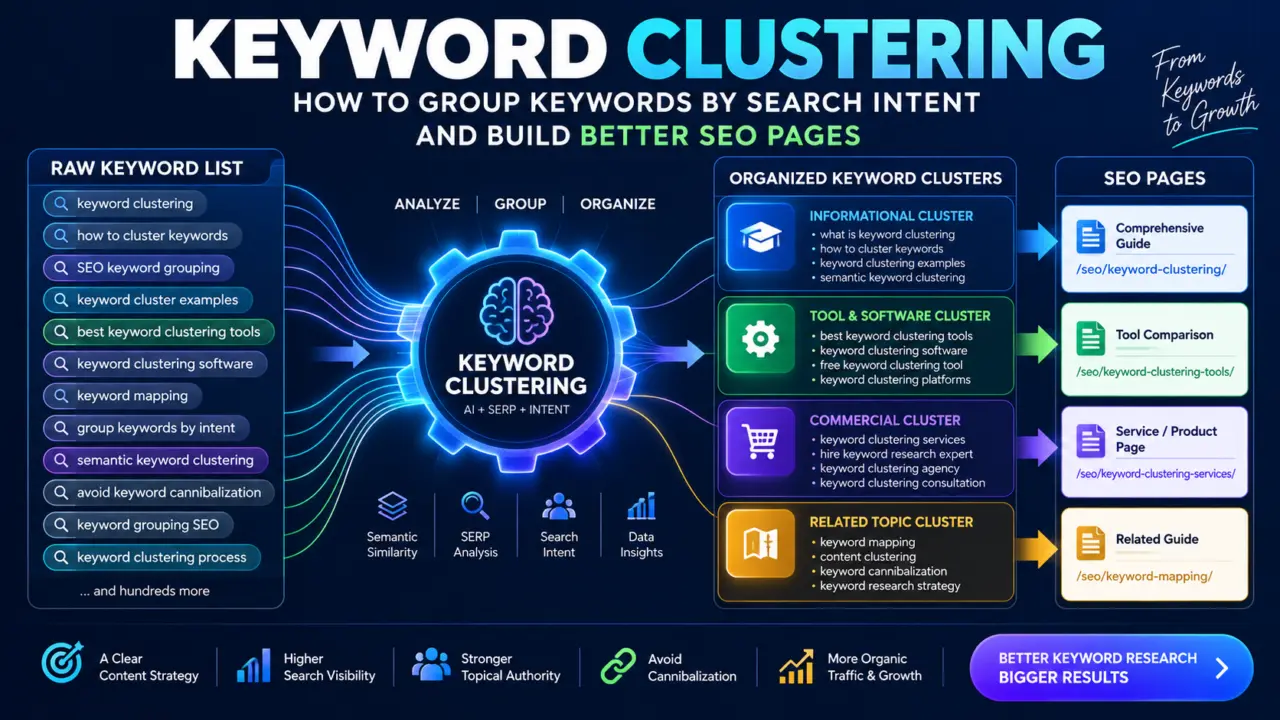
Your Keyword Clustering guide explains how to group related queries by:
- meaning
- intent
- SERP overlap
The output should be a list of distinct page opportunities—not a list of keyword variations.
Step 12: Assign an Action
Every gap should end with a decision.
Possible actions include:
Create
A genuinely new page is needed.
Improve
An existing page is incomplete.
Consolidate
Multiple weak pages should become one stronger resource.
Reposition
The current page targets the wrong intent.
Add a Resource
A template, tool, checklist, or visual is missing.
Ignore
The gap is not strategically relevant.
This final step converts research into execution.
The Five Main Types of Content Gaps
A practical analysis usually reveals five kinds of gaps.
1. Missing Topic Gaps
You have no page for an important subject.
Example:
Your Keyword Research pillar lacks:
SERP Analysis
Action:
Create a dedicated guide.
2. Missing Keyword Gaps
You have related coverage but do not target an important query cluster.
Example:
You cover keyword research but not:
competitor keyword research
Action:
Create or expand content depending on intent.
3. Search Intent Gaps
You cover the topic but with the wrong page type.
Example:
You have a guide:
Best SEO Tools
but users searching:
SEO tool pricing
expect commercial product information.
Action:
Create an appropriate commercial page.
4. Content Depth Gaps
The page exists but lacks important information.
Example:
An article about long-tail keywords does not explain:
- modifier research
- Search Console discovery
- commercial long-tail queries
Action:
Expand the existing article.
5. Format Gaps
The information exists, but users want a better format.
Example:
You have an SEO audit guide.
Users also want:
SEO audit checklist PDF
Action:
Add or create a downloadable checklist.
Content Gap Analysis by Competitor
A common method is:
Your Site vs Competitor A vs Competitor B vs Competitor C
You can create a matrix.
| Topic | You | A | B | C |
|---|---|---|---|---|
| Keyword Discovery | ✓ | ✓ | ✓ | ✓ |
| Seed Keywords | ✓ | ✓ | ✓ | |
| Keyword Mapping | ✓ | ✓ | ✓ | |
| Content Gap Analysis | ✓ | ✓ | ||
| SERP Analysis | ✓ | ✓ | ✓ |
Missing topics repeated across multiple relevant competitors deserve investigation.
They do not automatically deserve publication.
Ask whether the topic fits your strategy.
Content Gap Analysis Without Competitors
Competitor data is useful, but you can perform gap analysis without it.
Use:
- customer questions
- sales conversations
- support tickets
- Search Console
- internal search
- community discussions
- site architecture
For example, customers may repeatedly ask:
How do I map keywords to pages?
Even if competitors have not created strong content around that question, the demand may be real.
A customer-driven gap can be more valuable than a competitor-driven one.
Content Gaps From Customer Questions
Review:
- sales calls
- email inquiries
- support messages
- live chat
- comments
Look for questions that your website does not answer.
For example:
How long should I wait before updating an SEO article?
If this question appears repeatedly and your site has no useful answer, that is a content gap.
Real customer questions are powerful because they reveal actual needs rather than estimated demand alone.
Content Gaps From Internal Search
If your website has search functionality, analyze internal searches.
Suppose visitors repeatedly type:
SEO checklist
but your site has no checklist.
That is a strong signal.
The user is already on your site and still cannot find what they need.
Internal search can reveal:
- missing content
- poor navigation
- unclear terminology
Not every internal query needs a page, but repeated searches deserve attention.
Content Gaps From Search Console
Search Console can reveal partial relevance.
Imagine an article receives impressions for:
competitor keyword research template
but has no template.
You have several choices:
- add a template
- create a dedicated template
- ignore the query if it is not strategically important
The data shows what Google already associates with the page.
That makes it useful for finding deeper gaps.
Content Gap Analysis and Topic Clusters
Gap analysis works especially well inside structured topic clusters.
For example:
Keyword Research Pillar
Current:
- Keyword Discovery
- Seed Keywords
- Long-Tail Keywords
- Keyword Metrics
- Keyword Difficulty
- Keyword Clustering
- Competitor Keyword Research
- Content Gap Analysis
Next potential supporting areas:
- SERP Analysis
- Keyword Mapping
- Keyword Cannibalization
This creates a logical learning path.
A cluster-level analysis is more useful than asking:
What random article should we publish next?
Content Gap Analysis and Cannibalization
A gap analysis can accidentally create cannibalization if you mistake a keyword variation for a new opportunity.
Suppose you already have:
Competitor Keyword Research
and discover:
How to Find Competitor Keywords
These may represent the same search intent.
The correct action may be:
Improve the existing page
rather than:
Create a new page
Always check:
- existing URLs
- search intent
- SERP overlap
before creating content.
Content Gap Analysis for New Websites
New websites have many gaps by definition.
That means you must prioritize.
Do not try to cover the entire industry immediately.
Build one authority area at a time.
For example:
Phase 1
SEO Foundations
Phase 2
Keyword Research
Phase 3
Technical SEO
Within each pillar, identify the most important missing clusters.
This creates focused growth.
Content Gap Analysis for Established Websites
Established websites need a different approach.
They may already have:
- hundreds of articles
- duplicate topics
- outdated content
- partial coverage
Their gap analysis should classify opportunities as:
- new content
- refresh
- consolidation
- deletion
- repositioning
A mature site often needs fewer new pages and more improvement of existing assets.
Content Gap Analysis for Ecommerce
Ecommerce gaps can appear across:
- categories
- product pages
- filters
- buying guides
- comparisons
- use cases
Example:
A running shoe store covers:
- men’s running shoes
- women’s running shoes
but not:
- trail running shoes
- waterproof running shoes
- running shoes for flat feet
These may represent category, filter, or informational gaps.
Do not automatically create an indexable page for every combination.
Consider:
- demand
- inventory
- duplication
- crawlability
- user value
Content Gap Analysis for SaaS
SaaS sites commonly have gaps in:
Education
What the category is.
Features
What the product does.
Use Cases
How different audiences use it.
Comparisons
How it compares with alternatives.
Integrations
How it connects with other tools.
Commercial Pages
Pricing and product positioning.
For a CRM product, a mature content ecosystem may include:
- what is CRM
- CRM for agencies
- CRM automation
- CRM integrations
- best CRM software
- competitor alternatives
- pricing
- onboarding
Gap analysis reveals where this journey is incomplete.
Content Gap Analysis for Local Businesses
Local content gaps may include:
- missing services
- missing service-area pages
- unanswered customer questions
- local guides
- conversion pages
For example, a dentist may have:
Dental Implants
but no page for:
Emergency Dentist
if that is a real service offered.
That is a meaningful commercial gap.
Do not create location pages for places you do not actually serve.
Content Gap Analysis for B2B
B2B gap analysis should pay close attention to:
- industries
- use cases
- job roles
- integrations
- problems
- decision-stage content
For example:
A B2B platform may cover its features but miss:
CRM for manufacturing sales teams
Search volume may be relatively small.
One qualified lead may be highly valuable.
Business relevance matters more than raw volume.
How to Prioritize Content Gaps
Once you identify gaps, score them.
A practical framework can use:
Relevance
Does this matter to the audience?
Search Demand
Is there evidence of interest?
Business Value
Can the topic contribute to meaningful outcomes?
Difficulty
Can the site realistically compete?
Existing Authority
Do you already cover related topics?
Effort
How difficult is the content to produce?
You can think of it as:
Priority = Relevance × Business Value × Opportunity ÷ Effort
This is a conceptual model.
Do not treat the score as scientific precision.
Quick Wins vs Strategic Gaps
Not all content gaps belong in the same timeframe.
Quick Wins
Examples:
- missing section in an existing article
- internal-link improvement
- page ranking on page two
- missing FAQ
- outdated screenshot
Medium-Term Gaps
Examples:
- new supporting article
- comparison guide
- downloadable resource
Strategic Gaps
Examples:
- major pillar page
- new service area
- complex tool
- entire topic cluster
This classification makes execution more realistic.
Measure Whether Closing a Gap Worked
Publishing the content is not the end.
Measure the outcome.
Depending on the gap, track:
- impressions
- clicks
- ranking queries
- organic sessions
- conversions
- internal-link engagement
- backlinks
- assisted conversions
For example:
Before:
No page for Content Gap Analysis.
After publication:
- indexed
- receiving relevant impressions
- ranking for related queries
- generating organic clicks
- supporting Keyword Research internal links
This helps validate whether the gap deserved the investment.
Content Gap Analysis Tools
Tools can help with:
- competitor keyword comparison
- keyword gaps
- top competitor pages
- SERP data
- ranking differences
You can also use:
- spreadsheets
- Search Console
- analytics
- crawlers
- internal search data
No tool can automatically determine strategic value perfectly.
A tool may identify:
Competitor ranks for 15,000 keywords you do not.
Your actual useful opportunity might be:
120 relevant keyword clusters.
Human filtering is essential.
Can AI Help With Content Gap Analysis?
Yes.
AI can help:
- compare topic lists
- classify gaps
- group keywords
- summarize competitor coverage
- identify missing subtopics
- organize large exports
But AI can also produce false gaps.
For example, it may suggest topics that:
- have no meaningful search demand
- duplicate existing pages
- do not match live search intent
- are irrelevant to the business
Use AI for analysis and organization.
Validate important decisions with:
- search data
- SERPs
- audience knowledge
- existing site architecture
Common Content Gap Analysis Mistakes
Copying Every Competitor Topic
Their audience and business model may differ.
Treating Every Missing Keyword as a Gap
Many keyword variations belong to existing pages.
Ignoring Existing Content
Improve before creating duplicates.
Looking Only at Search Volume
Business value matters.
Ignoring Search Intent
The gap may be a different page type.
Ignoring Format
Users may want a tool or template.
Creating Thin Pages
Not every gap deserves a standalone URL.
Ignoring Customer Questions
Competitor tools do not capture everything.
Failing to Prioritize
A list of 500 gaps is not a strategy.
Never Measuring Results
You need to know whether closing the gap actually helped.
A Practical Content Gap Workflow
Use this process:
1. Define the Scope
Choose the pillar, product, service, or audience.
2. Inventory Existing Pages
Document what already exists.
3. Review Topic Architecture
Identify obvious missing clusters.
4. Analyze Competitors
Compare relevant topics and rankings.
5. Review Your Search Data
Find hidden opportunities in Search Console.
6. Analyze Search Intent
Identify missing intent types.
7. Analyze the Funnel
Check awareness through decision-stage coverage.
8. Identify Format Gaps
Look for tools, templates, checklists, and comparisons.
9. Evaluate Metrics
Review demand, difficulty, and business value.
10. Cluster Similar Gaps
Avoid duplicate page recommendations.
11. Assign an Action
Create, improve, consolidate, reposition, or ignore.
12. Prioritize the Roadmap
Turn research into execution.
Content Gap Analysis Checklist
Before completing your analysis, confirm:
Scope
- objective defined
- topic or business area selected
Existing Content
- URLs inventoried
- intents documented
- performance reviewed
Competitors
- relevant competitors analyzed
- top pages reviewed
- keyword gaps identified
Audience
- customer questions reviewed
- internal search reviewed
- common problems documented
Search Data
- Search Console reviewed
- high-impression queries checked
- weak rankings identified
Intent
- informational gaps reviewed
- commercial gaps reviewed
- transactional gaps reviewed
Format
- checklist opportunities reviewed
- template opportunities reviewed
- tool opportunities reviewed
- comparison opportunities reviewed
SEO
- keyword difficulty considered
- keyword clusters created
- cannibalization checked
Business
- relevance confirmed
- business value assessed
- conversion potential considered
Action
- create opportunities identified
- improvement opportunities identified
- consolidation opportunities identified
- irrelevant gaps removed
- priorities assigned
Final Thoughts
Content gap analysis is not about finding everything your competitors have that you do not.
It is about identifying what your audience genuinely needs that your website does not yet satisfy.
A useful process looks like:
Existing Content → Competitors → Search Data → Audience Needs → Search Intent → Gaps → Clusters → Priority → Action
Some gaps require new articles.
Others require better commercial pages.
Some require:
- a checklist
- a tool
- a comparison
- a template
- a stronger section inside an existing page
And some gaps should be ignored completely.
The strongest content strategies do not publish simply because a keyword exists.
They identify the missing information, intent, or experience that matters—and fill that gap better than the alternatives.
Once you know what content is missing, the next step is to study the search results themselves and understand what Google is currently rewarding through a structured SERP analysis.