
Every large keyword research project begins with something small.
Before you discover thousands of search queries, build keyword clusters, analyze competition, or map keywords to pages, you need a starting point.
That starting point is usually a seed keyword.
Seed keywords are broad words or short phrases that describe the main topics, products, services, problems, or audiences connected to a business.
For an SEO website, seed keywords might include:
- SEO
- keyword research
- technical SEO
- local SEO
- backlinks
- content SEO
For an ecommerce store selling running products, they could include:
- running shoes
- trail shoes
- running socks
- hydration packs
These phrases are usually too broad to become your complete SEO strategy.
Their purpose is different.
Seed keywords help you open the door to deeper keyword discovery.
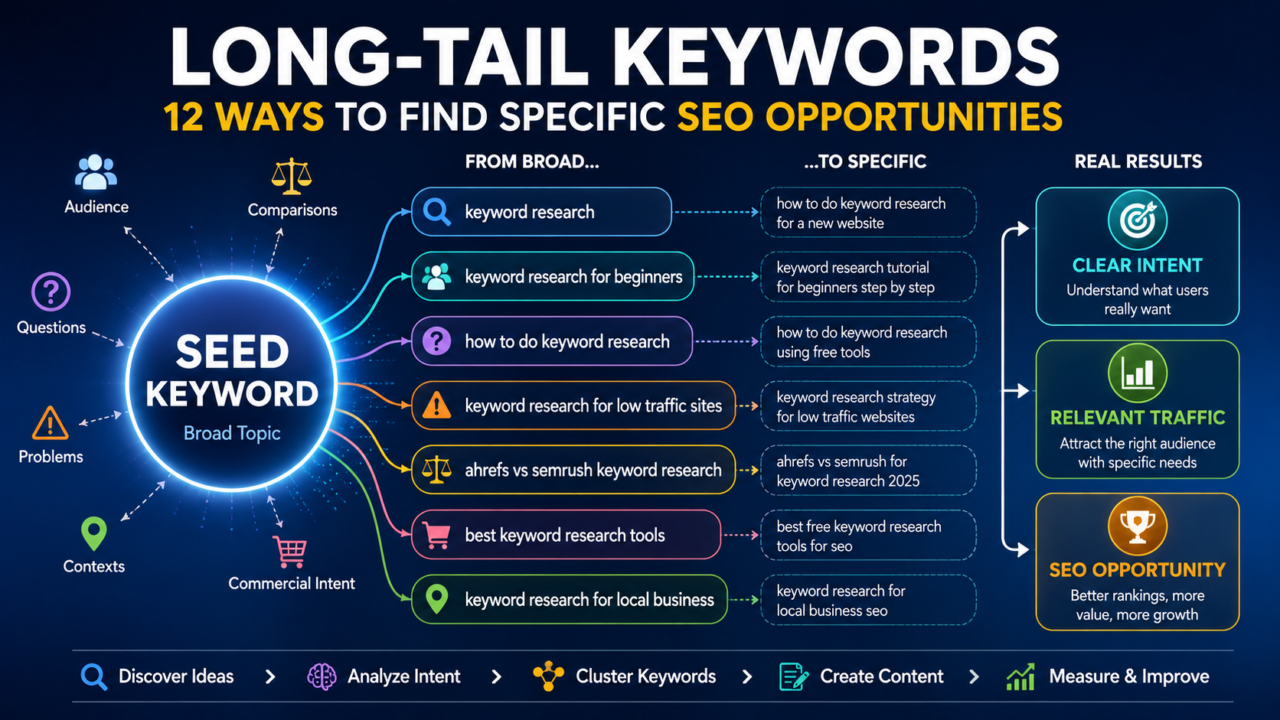
A single phrase such as:
keyword research
can lead to:
- keyword research for beginners
- how to do keyword research
- keyword research tools
- keyword research for local SEO
- ecommerce keyword research
- keyword research checklist
- competitor keyword research
- keyword clustering
- keyword mapping
That is why choosing useful seed keywords matters.
This guide explains what seed keywords are, how to find them, how to expand them, what mistakes to avoid, and how to turn a small seed list into a structured keyword research system.
What Are Seed Keywords?
Seed keywords are broad terms used as starting points for discovering additional keywords and topics.
They usually describe one of the following:
- a product
- a service
- a problem
- an industry
- a feature
- an audience
- a use case
- a topic
For example, suppose a company sells project management software.
Possible seed keywords might include:
- project management
- task management
- team collaboration
- project planning
- workflow software
Those seeds could later reveal more specific queries such as:
- project management software for small teams
- best task management app
- how to manage remote projects
- project planning software
- Asana alternatives
- project management templates
Seed keywords are therefore inputs, not necessarily final targets.
Why Are Seed Keywords Important?
Keyword research tools need something to start with.
If you enter a useful seed keyword, you can uncover:
- related searches
- longer queries
- questions
- modifiers
- commercial terms
- competitor topics
- subtopics
A weak seed list can limit your research.
A strong seed list helps you explore the market from multiple directions.
Seed Keywords Help You Discover Customer Language
Businesses often use internal terminology that customers do not.
For example, a company may describe its service as:
Revenue operations automation.
Potential customers may search for:
- automate sales follow-up
- CRM automation
- lead follow-up software
- sales pipeline automation
Starting only with the company’s internal terminology could hide important search opportunities.
Seed Keywords Help Build Topic Coverage
Seed keywords can also become the starting structure for broader topic research.
For example:
SEO
may lead to:
- keyword research
- technical SEO
- on-page SEO
- local SEO
- link building
Then:
Keyword Research
may lead to:
- seed keywords
- long-tail keywords
- keyword difficulty
- search volume
- keyword clustering
- keyword mapping
This is how a small set of broad ideas can eventually become a structured content architecture.
Seed Keywords vs Regular Keywords
Every seed keyword is a keyword.
But not every keyword is a useful seed keyword.
Consider:
SEO
This is extremely broad.
It can be a useful seed because it opens many discovery pathways.
Now consider:
how to find low competition SEO keywords for a new plumbing website
That could be an excellent search query.
But it is too specific to function as a broad seed in many research workflows.
A useful distinction is:
Seed Keyword
Used to generate ideas.
Example:
keyword research
Target Keyword
Selected for a specific page or campaign.
Example:
how to do keyword research
Long-Tail Keyword
A more specific query expressing a narrower need.
Example:
how to do keyword research for a new website
The stages often look like this:
Seed → Discovery → Evaluation → Target Keyword
If you have not completed the previous step yet, the Keyword Discovery guide explains how seeds fit into the broader discovery process.
10 Ways to Find Seed Keywords
You do not need an expensive tool to create your initial seed list.
Start with the business itself.
1. Start With Your Products
List what the business sells.
For an outdoor retailer:
- hiking boots
- backpacks
- tents
- sleeping bags
- camping stoves
For a software company:
- CRM
- email automation
- sales automation
- lead management
- reporting software
Do not worry about search volume yet.
At this stage, you are identifying the basic concepts connected to the business.
Break Products Into Categories
Suppose your product is:
Running shoes
Related seeds could include:
- road running shoes
- trail running shoes
- racing shoes
- stability shoes
- running footwear
One product can contain several meaningful subcategories.
2. List Your Services
Service businesses should list their core services.
For a digital marketing agency:
- SEO
- Google Ads
- social media marketing
- email marketing
- website design
- conversion optimization
For a plumbing company:
- plumbing repair
- drain cleaning
- water heater repair
- leak repair
- emergency plumbing
These are excellent starting seeds because they connect directly with commercial offerings.
Include Service Variations
People may describe the same service differently.
For example:
- SEO consultant
- SEO consulting
- SEO services
- search engine optimization
Do not assume the terminology used on your website is the only terminology customers use.
3. Start With Customer Problems
Sometimes the strongest seed is not a product.
It is a problem.
For an SEO consultant, customer problems might include:
- website not ranking
- traffic decline
- indexing problems
- low organic traffic
- Google ranking drop
For accounting software:
- bookkeeping
- invoices
- business expenses
- payroll
- tax records
Problem-based seeds help you discover searches from users who do not yet know which solution they need.
Think Like the Customer
Ask:
What would someone search if they had the problem but did not know the industry terminology?
For example:
Technical term:
Keyword cannibalization
Customer language:
Google is ranking the wrong page
Both can eventually lead to valuable keyword opportunities.
4. Use Your Website Navigation
Your existing website can provide a ready-made seed list.
Review:
- main navigation
- categories
- product categories
- service pages
- footer links
- blog categories
If your navigation contains:
- SEO
- Google Ads
- WordPress
- Shopify
- CRM Automation
you already have several seed topics.
But Do Not Assume Your Navigation Is Perfect
Existing categories may reflect internal company organization rather than search behavior.
Use them as a starting point, then validate them through actual keyword discovery.
5. Talk to Sales Teams
Sales conversations reveal how potential customers describe what they want.
Ask the sales team:
- What do prospects ask for?
- What problems do they mention?
- Which alternatives do they compare?
- What terminology do they use?
- Which questions appear repeatedly?
Suppose prospects frequently ask:
Can you help me get my business on Google Maps?
That could lead to seed topics such as:
- Google Maps SEO
- local SEO
- Google Business Profile
- local rankings
Sales language often exposes keywords that marketing teams overlook.
6. Review Support Questions
Support teams hear what customers struggle with after purchasing.
This can reveal:
- features
- problems
- use cases
- terminology
For a CRM platform, users might ask about:
- lead assignment
- pipeline automation
- email workflows
- contact imports
- reporting
Each concept could become a seed for deeper research.
Support data is especially useful because it comes from people actively using the product.
7. Study Competitor Categories
Review how relevant competitors organize their websites.
Look at:
- menu categories
- service pages
- product categories
- content hubs
- resource centers
Suppose multiple SEO websites consistently organize content around:
- keyword research
- technical SEO
- local SEO
- link building
- content marketing
Those categories can help identify seed topics you may have overlooked.
The goal is not to copy the competitor.
The goal is to understand how the market is structured.
Compare Multiple Competitors
One competitor may use unusual terminology.
If five credible competitors repeatedly cover a topic, that is a stronger signal.
8. Use Search Results
Search your broad business terms and study what appears.
If you search:
email marketing
you may notice related concepts such as:
- email automation
- newsletter software
- email campaigns
- email segmentation
- email templates
These can become additional seeds.
Search results are particularly useful because they help show how search engines and publishers connect related concepts.
9. Use Your Existing Search Data
If your website already receives impressions, Search Console can reveal unexpected seed topics.
Suppose your site appears for:
- technical SEO
- crawl errors
- indexing issues
- XML sitemap
- canonical tags
These could become seeds for deeper technical SEO research.
Your SEO Reporting guide explains how query and page data can reveal these opportunities.
Search Console is particularly valuable because the keywords come from your website’s actual search visibility.
10. Build Seeds From Audience Segments
The same product can create different search markets depending on the audience.
Take:
CRM
Possible audience-based seeds include:
- CRM for small business
- CRM for real estate
- CRM for agencies
- CRM for ecommerce
- CRM for consultants
Or start with the audience itself:
- real estate marketing
- dentist marketing
- restaurant marketing
- ecommerce marketing
Audience seeds can uncover highly relevant niche opportunities.
Use the Seed Keyword Expansion Formula
Once you have a seed, expand it systematically.
A useful framework is:
Seed + Audience + Problem + Intent + Modifier + Format
Let’s use:
keyword research
Audience
- keyword research for beginners
- keyword research for bloggers
- keyword research for ecommerce
- keyword research for local businesses
Problem
- find low competition keywords
- find keywords competitors rank for
- find keywords for a new website
Intent
- learn keyword research
- keyword research service
- keyword research tools
Modifier
- best keyword research
- free keyword research
- advanced keyword research
Format
- keyword research guide
- keyword research checklist
- keyword research template
One seed can quickly generate dozens of useful directions.
Expand Seeds With Questions
Add common question formats:
- what
- why
- how
- when
- where
- which
- can
- should
For example:
Seed: backlinks
Possible searches:
- what are backlinks
- why are backlinks important
- how to get backlinks
- which backlinks are good
- should I buy backlinks
Questions can reveal informational content opportunities that broad seed research may miss.
Use Search Intent to Expand Seeds
Seed keywords can lead to very different search intents.
Suppose your seed is:
CRM
Informational
- what is CRM
- how does CRM work
Commercial Investigation
- best CRM software
- CRM comparison
- HubSpot vs Salesforce
Transactional
- buy CRM software
- CRM pricing
- CRM free trial
Navigational
- HubSpot CRM login
- Salesforce login
Understanding intent prevents you from treating every variation as the same opportunity.
The Search Intent guide explains why different intents usually require different page types.
Seed Keywords for Content Sites
Content websites should begin with broad knowledge areas.
For example, a marketing website might begin with:
- SEO
- Google Ads
- WordPress
- email marketing
- social media marketing
- CRM automation
Then each seed expands into subtopics.
SEO
- SEO fundamentals
- keyword research
- technical SEO
- local SEO
Keyword Research
- keyword discovery
- seed keywords
- long-tail keywords
- keyword difficulty
- search volume
- clustering
- mapping
This approach helps build a content library systematically.
Seed Keywords for Ecommerce
Ecommerce stores should create seeds around:
Product Categories
- running shoes
- jackets
- backpacks
Product Attributes
- waterproof
- lightweight
- leather
- wireless
Audience
- women’s
- men’s
- kids
- beginners
- professionals
Use Cases
- hiking
- running
- travel
- business
Problems
- foot pain
- wet weather
- long-distance running
For example:
Seed: running shoes
can expand into:
- women’s running shoes
- trail running shoes
- waterproof running shoes
- running shoes for flat feet
- lightweight running shoes
This provides much richer research than starting with a single product name.
Seed Keywords for Local SEO
Local businesses can begin with:
Service + Location
Examples:
- plumber Dubai
- dentist Manchester
- electrician Austin
But do not stop there.
Other seeds might include:
- emergency plumber
- drain cleaning
- water heater repair
Location modifiers can be added during expansion.
A local keyword system might look like:
Service Seed → Service Variants → Problem Queries → Location Variants
Avoid creating dozens of near-identical location pages merely because keyword combinations exist.
Every page should have a genuine purpose.
Seed Keywords for SaaS
SaaS companies should think beyond product categories.
Useful seed types include:
Product
- CRM software
Feature
- lead scoring
- email automation
- sales pipeline
Problem
- manage leads
- automate follow-ups
Audience
- CRM for agencies
- CRM for real estate
Competitor
- Salesforce
- HubSpot
- Pipedrive
Alternative
- HubSpot alternatives
- Salesforce alternatives
This helps capture users across different stages of awareness.
Seed Keywords for B2B
B2B keyword demand can be smaller than consumer search demand.
That does not make it less valuable.
A seed such as:
manufacturing CRM
may have significantly less search volume than:
CRM
but the business relevance can be much higher.
B2B seed research should emphasize:
- industry
- role
- use case
- problem
- solution
- integration
Examples:
- CRM for manufacturers
- CRM for sales teams
- ERP integration
- sales pipeline software
- lead management system
Do not dismiss a seed simply because it looks niche.
Build a Seed Keyword List Before Using Tools
Before opening a keyword platform, create an initial manual list.
For example:
| Seed | Type |
|---|---|
| keyword research | Topic |
| SEO tools | Product category |
| low rankings | Problem |
| SEO consultant | Service |
| SEO for beginners | Audience |
| competitor keywords | Use case |
This gives the research process direction.
Then use keyword tools to expand, validate, and organize those concepts.
Without this step, keyword tools can easily lead you into unrelated topics.
How Many Seed Keywords Do You Need?
There is no perfect number.
You may begin with:
- 5 seeds for a small niche
- 20 seeds for a service company
- 100+ seeds for a large ecommerce store
The important factor is coverage.
Ask:
- Have we covered the main products?
- Have we covered services?
- Have we covered customer problems?
- Have we covered audiences?
- Have we covered use cases?
Do not collect hundreds of seeds simply to make the spreadsheet larger.
A small number of meaningful seeds can generate enormous keyword lists.
Broad Seeds vs Specific Seeds
A balanced seed list usually contains both.
Broad Seed
SEO
Useful for exploring the overall market.
More Specific Seed
technical SEO
Useful for deeper exploration.
Even More Specific Seed
JavaScript SEO
Useful for specialized research.
You can think of the structure like a tree:
SEO
→ Technical SEO
→ Crawling
→ JavaScript SEO
→ Rendering
Each level can become the seed for deeper research.
Turn Seed Keywords Into Topic Trees
This is one of the most useful ways to organize keyword research.
Suppose the root seed is:
Keyword Research
The topic tree may become:
Keyword Research
├── Keyword Discovery
├── Seed Keywords
├── Long-Tail Keywords
├── Keyword Metrics
├── Search Volume
├── Keyword Difficulty
├── Keyword Clustering
└── Keyword Mapping
Then each branch can be expanded further.
For example:
Long-Tail Keywords
- what they are
- how to find them
- examples
- tools
- local SEO
- ecommerce
This is much more useful than managing thousands of keywords as one flat list.
Do Not Confuse Seed Keywords With Primary Keywords
This distinction matters.
Suppose:
Seed: SEO
You would not necessarily optimize every page for the primary keyword:
SEO
Instead, the seed helps uncover specific page opportunities.
For example:
- SEO fundamentals
- SEO strategy
- SEO audit
- SEO reporting
- SEO forecasting
- SEO testing
Each page gets its own target.
The seed organizes the research space.
The primary keyword defines the focus of a specific page.
Use Seed Keywords to Find Competitors
Seeds can also help identify search competitors.
Search your main seed.
Record websites that appear repeatedly.
Then investigate:
- which topics they cover
- which pages attract traffic
- which subtopics appear frequently
- which opportunities they miss
A search competitor may not be a direct business competitor.
For example, an SEO consultant may compete in search results with:
- software companies
- publishers
- agencies
- educational websites
All of them may compete for attention around the same seed topic.
Use Seeds to Find Content Gaps
Once you expand a seed, compare the opportunity with your current site.
Suppose your seed is:
technical SEO
You discover:
- crawling
- indexing
- canonicals
- sitemaps
- redirects
- JavaScript SEO
Your website covers:
- crawling
- indexing
but not the others.
Those missing areas become potential content gaps.
Do not automatically publish every missing topic.
First evaluate:
- relevance
- intent
- business value
- competition
- overlap with existing pages
Seed Keywords and Keyword Clustering
Seed research eventually produces many related queries.
Do not turn each query into a page.
For example:
- seed keyword
- seed keywords
- what are seed keywords
- seed keyword meaning
- SEO seed keywords
These likely belong to the same intent cluster.
One comprehensive article can satisfy them.
The process is:
Seed → Expand → Group → Map
not:
Seed → Generate 500 Queries → Publish 500 Pages
That distinction is essential for sustainable content architecture.
Seed Keywords and Internal Linking
Seed topics can also help plan internal links.
If your broader seed is:
Keyword Research
then supporting articles such as:
- Keyword Discovery
- Seed Keywords
- Long-Tail Keywords
- Keyword Difficulty
- Keyword Mapping
should naturally connect.
For example, this article began with the discovery process and linked to the Keyword Discovery guide because readers need to understand what happens after seeds are identified.
When your Long-Tail Keywords guide is published, this article should also link forward from the expansion sections to that resource.
This creates a logical learning journey rather than isolated posts.
Seed Keywords and SEO Strategy
Do not select seeds in isolation from the business.
A useful SEO strategy determines which markets and audiences matter.
For example, a marketing consultant may discover huge demand around:
Instagram captions
But if the business specializes in enterprise technical SEO, that seed may have very little strategic value.
The question is not:
Can this keyword produce traffic?
The better question is:
Does this topic help us reach the audience we want?
Seed Keywords and Forecasting
After expanding your seeds into actual keyword groups, you can estimate opportunity.
Suppose:
Seed: Local SEO
The full cluster contains estimated relevant demand of:
50,000 monthly searches.
You might then model:
- potential impressions
- click share
- traffic
- leads
- business value
The SEO Forecasting guide explains how to turn keyword opportunity into realistic scenarios.
Do not forecast directly from one broad seed’s search volume.
Forecast the relevant query group.
Seed Keywords and Search Console
A mature website may discover entirely new seeds from existing visibility.
Suppose Search Console shows repeated impressions around:
- SEO ROI
- SEO cost
- SEO budget
You may realize there is a broader seed:
SEO investment
That seed could then lead to:
- SEO pricing
- SEO ROI
- SEO budget
- cost of SEO
- is SEO worth it
This illustrates why keyword research should be continuous.
Your own performance data can reveal topic areas you did not anticipate.
Common Seed Keyword Mistakes
Choosing Seeds Only From Keyword Tools
Start with business and customer knowledge.
Tools should expand your thinking, not replace it.
Using Only Very Broad Seeds
“Marketing” may be too broad to guide meaningful research.
Add narrower concepts.
Using Only Specific Keywords
If every seed is extremely narrow, you may miss broader opportunities.
Ignoring Customer Problems
Not every search begins with the name of a product or service.
Copying Competitor Seeds
Competitor topics may not match your business model.
Treating Seeds as Final Targets
Seeds are starting points.
Evaluate actual search intent before creating pages.
Creating One Page for Every Variation
Cluster related queries.
Choosing Seeds Based Only on Volume
Business relevance matters more than impressive numbers.
A Practical Seed Keyword Workflow
Use this process for a new project.
Step 1: Understand the Business
Document:
- products
- services
- audiences
- problems
- goals
Step 2: Create Manual Seeds
List the obvious topics without using tools.
Step 3: Expand the List
Use:
- customers
- competitors
- search results
- website data
Step 4: Enter Seeds Into Research Tools
Discover:
- variations
- questions
- modifiers
- related topics
Step 5: Classify the Keywords
Organize by:
- topic
- search intent
- audience
- funnel stage
Step 6: Cluster Similar Queries
Group keywords that should belong to the same page.
Step 7: Evaluate Opportunities
Consider:
- relevance
- demand
- difficulty
- business value
Step 8: Map Keywords to Pages
Decide whether:
- an existing page should target the cluster
- a new page is required
- multiple pages should be consolidated
This converts seed research into an actual SEO plan.
Seed Keyword Checklist
Before moving into deeper keyword research, confirm that your seed list includes:
Business
- products
- services
- categories
- features
Customers
- common problems
- questions
- terminology
- objections
Audiences
- industries
- personas
- use cases
Search Market
- broad topics
- subtopics
- competitor categories
Existing Data
- Search Console queries
- top landing pages
- internal searches
Expansion Potential
- questions
- modifiers
- problems
- comparisons
- long-tail opportunities
Strategic Relevance
- connection to products or services
- connection to intended audience
- connection to business goals
If your seeds cover these areas, you have a strong foundation for the next stage of keyword research.
Final Thoughts
Seed keywords are simple, but they are strategically important.
They determine where your keyword research begins.
A useful process looks like this:
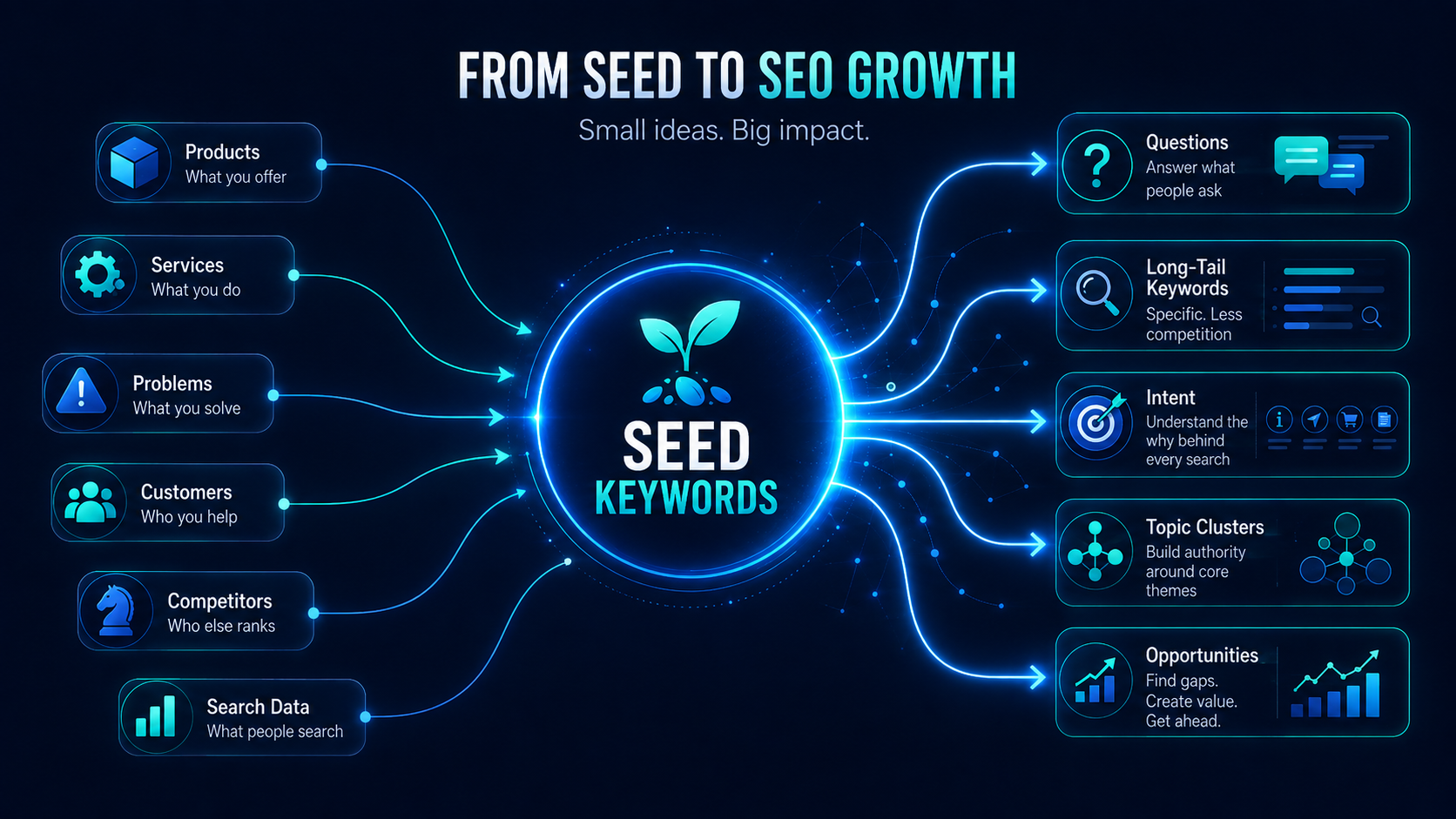
Business → Customers → Problems → Seed Keywords → Expansion → Search Intent → Clusters → Pages
Do not obsess over finding the perfect seed keyword.
Start with several meaningful concepts.
Then expand them.
Listen to customers.
Study search results.
Analyze competitors.
Review your own Search Console data.
Group what you discover.
And continually ask whether the search opportunity connects to the audience and business you are trying to grow.
The strongest seed keywords are not necessarily the ones with the highest search volume.
They are the ones that lead you toward relevant search demand worth understanding.
Once you have a strong set of seeds, the next step is to explore the more specific searches that grow from them—including long-tail keywords.