
Finding keywords is only the beginning of keyword research.
Once you have hundreds or thousands of possible searches, a harder question appears:
Which keywords actually deserve your attention?
A keyword may have:
- high search volume
- low apparent competition
- strong commercial value
- poor relevance
- declining demand
- an overcrowded SERP
- little realistic click potential
Looking at only one number can therefore lead to poor decisions.
This is where keyword metrics become useful.
Keyword metrics are data points that help you evaluate the potential value, demand, competitiveness, intent, and business relevance of a search query.
Common metrics include:
- search volume
- keyword difficulty
- CPC
- paid competition
- traffic potential
- search trends
- current ranking position
- SERP click potential
- business value
- conversion potential
But no metric should be treated as an automatic decision.
A keyword with 20,000 searches per month is not necessarily better than a keyword with 300 searches.
A keyword difficulty score of 25 does not guarantee that you can rank.
A CPC of $15 does not automatically mean the keyword will generate profitable organic traffic.
Keyword metrics work best when they help you answer a larger question:
Is this search opportunity relevant, realistic, and valuable enough to deserve a page, optimization effort, or place in our SEO strategy?
This guide explains the most important keyword metrics, how to interpret them, where they can mislead you, and how to combine them into a practical keyword-prioritization process.
What Are Keyword Metrics?
Keyword metrics are quantitative and qualitative signals used to evaluate a keyword or keyword cluster.
They help estimate factors such as:
- how often people search
- whether demand is increasing or declining
- how competitive the search results may be
- how valuable advertisers consider the query
- whether users are likely to click organic results
- how much traffic a ranking page could potentially attract
- how closely the keyword relates to your business
- whether your website already has visibility
Think of keyword metrics as decision-support data.
They do not make the decision for you.
A keyword tool might tell you:
Search volume: 5,000
Difficulty: 38
CPC: $4.50
But those numbers do not tell you whether the keyword:
- matches your audience
- deserves a blog post
- should be a product page
- overlaps with an existing URL
- could generate qualified leads
That requires judgment.
Why Keyword Metrics Matter
Without metrics, keyword selection can become guesswork.
You may choose topics because:
- they sound interesting
- competitors published them
- a tool suggested them
- the keyword contains your service name
Metrics add evidence.
For example, suppose you discover these keywords:
| Keyword | Search Volume | Difficulty | Business Value |
|---|---|---|---|
| what is SEO | 100,000 | High | Low |
| SEO consultant for SaaS | 500 | Medium | Very High |
| SEO meme examples | 8,000 | Low | Very Low |
If your goal is generating SEO consulting leads, the smallest keyword could be the most strategically valuable.
This is why keyword research should connect with your broader SEO strategy, not operate as an isolated spreadsheet exercise.
Keyword Metrics Should Be Evaluated at Cluster Level
One important principle is that pages can rank for many related searches.
Suppose you are researching:
long-tail keywords
Supporting queries might include:
- what are long-tail keywords
- long-tail keyword examples
- how to find long-tail keywords
- long-tail keyword research
- are long-tail keywords easier to rank for
Evaluating each phrase independently can underestimate the opportunity.
A more useful approach is often:
Keyword → Intent Group → Keyword Cluster → Page
The recently planned Long-Tail Keywords guide explains how specific searches can be grouped around broader user needs.
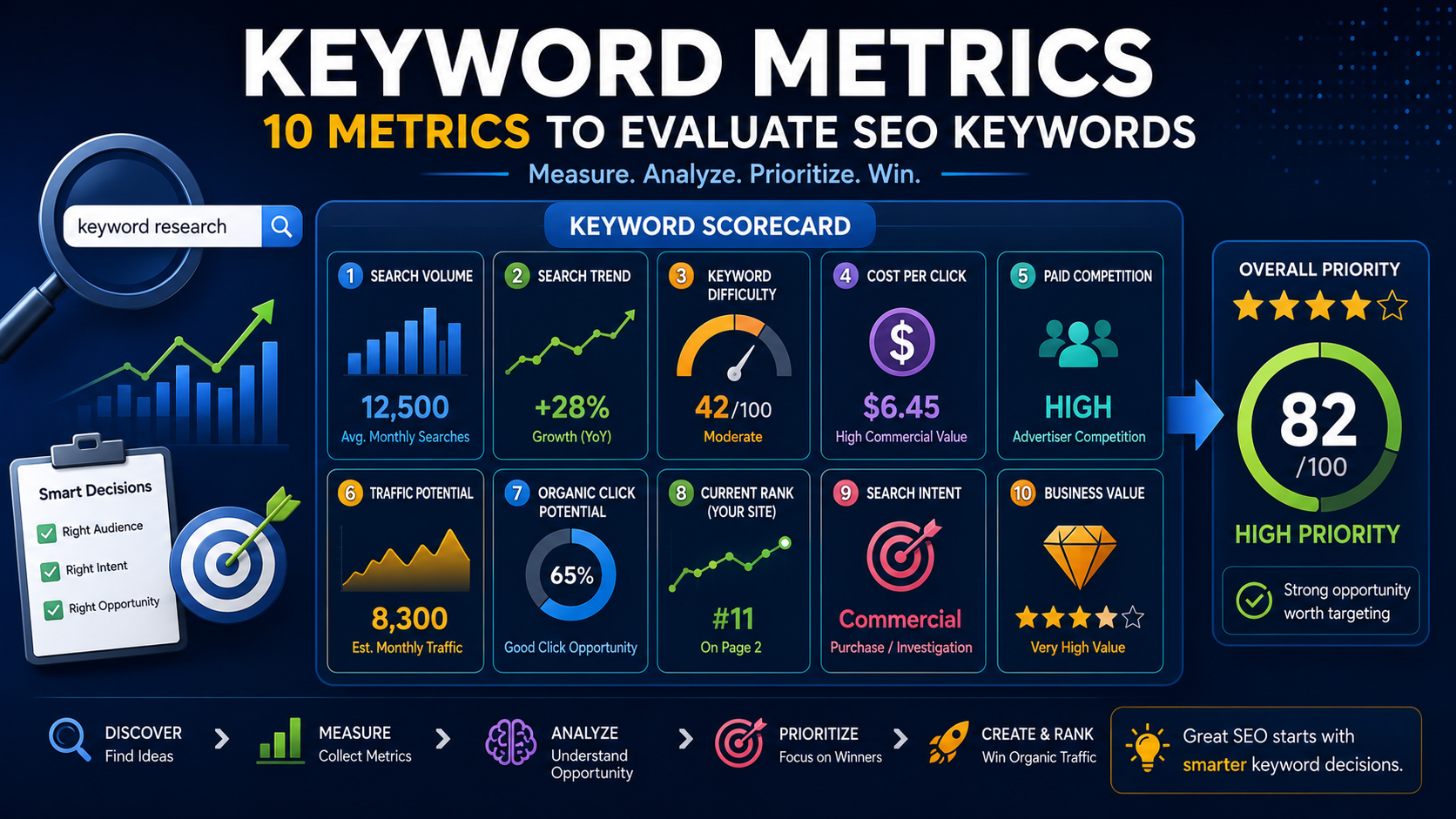
10 Keyword Metrics That Matter
1. Search Volume
Search volume estimates how often people search for a keyword during a particular period.
It is one of the most commonly used keyword metrics.
For example:
SEO audit — 10,000 estimated monthly searches
That number suggests there is meaningful demand around the topic.
But search volume needs context.
What Search Volume Can Tell You
It can help indicate:
- relative popularity
- market demand
- topic size
- seasonality
- comparison between related terms
What Search Volume Cannot Tell You
It does not tell you:
- how many visitors you will receive
- whether you can rank
- whether users will click your result
- whether the keyword will convert
- whether the keyword fits your business
Google’s Keyword Planner describes average monthly searches as an estimate based on the selected date range, location, and Search Network settings, and its default historical view averages search activity over a 12-month period.
That alone should remind you that search volume is an estimate, not an exact count of future traffic.
Search Volume Is Not Traffic
Suppose a keyword has:
10,000 monthly searches
Even if you rank well, you will not necessarily receive 10,000 visits.
Some searchers may:
- click ads
- click local results
- click shopping results
- click another organic listing
- get an answer directly in the SERP
- refine their query
Treat volume as demand, not guaranteed traffic.
2. Search Trend
Search volume is usually an average.
Trend data tells you how demand is changing.
A keyword can have strong average volume while declining rapidly.
Another keyword can have modest historical volume while growing quickly.
For example:
Keyword A
Average searches:
10,000
Trend:
declining 30% year over year
Keyword B
Average searches:
5,000
Trend:
growing 80% year over year
Depending on the topic, Keyword B may have more future potential.
Look for Three Types of Trend
Growth
Demand is increasing.
Decline
Interest is decreasing.
Seasonality
Demand rises and falls predictably throughout the year.
Seasonality is particularly important for industries such as:
- travel
- tax
- education
- fitness
- holidays
- events
- seasonal ecommerce
A keyword averaging 12,000 monthly searches could actually receive:
January: 30,000
June: 3,000
That changes how you plan content and campaigns.
3. Keyword Difficulty
Keyword difficulty is a third-party metric designed to estimate how difficult it may be to compete for a keyword organically.
Different SEO tools calculate difficulty differently.
They may consider factors such as:
- backlinks
- referring domains
- authority of ranking pages
- strength of competing domains
- SERP characteristics
A tool might report:
Keyword difficulty: 72/100
That generally suggests stronger competition.
But keyword difficulty is an estimate, not a Google ranking factor.
Why Difficulty Scores Can Mislead
A score cannot fully understand:
- your topical authority
- content quality
- search intent
- site architecture
- brand strength
- internal links
- SERP weaknesses
Two websites can look at the same keyword and face very different difficulty levels.
For example:
A new personal blog may struggle with a keyword where a highly established industry website has a realistic opportunity.
Article 17 will examine Keyword Difficulty separately, because this metric deserves deeper treatment than a single tool score.
4. Cost Per Click
CPC, or cost per click, is primarily a paid advertising metric.
It estimates what advertisers may pay for a click in paid search.
Why does an SEO professional care?
Because high CPC can sometimes indicate that advertisers see commercial value in the query.
For example:
Keyword A
SEO definition
CPC: relatively low
Keyword B
enterprise SEO agency
CPC: potentially much higher
The second query likely sits closer to a commercial decision.
Google Keyword Planner provides cost estimates alongside keyword demand data for advertisers.
CPC Is a Clue, Not Proof
A high CPC does not automatically make a keyword valuable to your business.
For example, a legal keyword might have extremely high CPC.
That does not make it relevant to an SEO consulting website.
Always combine CPC with:
- relevance
- intent
- audience
- business model
5. Paid Competition
Keyword tools may show advertising competition.
This is often misunderstood as organic SEO competition.
They are not the same thing.
Google describes Keyword Planner’s competition metric as the number of advertisers showing for a keyword relative to other keywords, based on the selected targeting.
So:
High paid competition
means many advertisers compete in paid search.
It does not directly mean:
This keyword is difficult to rank for organically.
However, paid competition can still be useful.
High advertiser competition may suggest:
- commercial intent
- valuable leads
- transactional behavior
Treat it as a commercial signal rather than an organic difficulty score.
6. Traffic Potential
Search volume measures demand for one query.
Traffic potential asks a broader question:
How much organic traffic might a strong page receive across all the queries it can rank for?
Suppose:
Primary keyword
search volume: 2,000
But the top-ranking pages also rank for:
- 500 related queries
- long-tail questions
- synonyms
- variations
The real page-level opportunity may be much larger than 2,000 searches.
This is why evaluating only the primary keyword can underestimate a topic.
Think Page First
Instead of:
How much traffic can this keyword generate?
ask:
How much traffic could a strong page satisfying this search intent generate across the full topic?
This aligns better with modern content planning.
7. Organic Click Potential
Not every search produces an organic click.
The SERP itself affects click opportunity.
Imagine a query with:
50,000 searches
but the results contain:
- paid ads
- local pack
- shopping results
- videos
- instant answers
- rich results
Organic click opportunity may be much lower than the search-volume number suggests.
Now compare a query with:
10,000 searches
and a mostly traditional organic SERP.
The second query might offer more realistic organic traffic.
Analyze the Actual SERP
Before prioritizing a keyword, search it.
Look for:
- ads
- featured elements
- maps
- videos
- shopping results
- forums
- image packs
- organic results
This is one reason keyword research cannot be completed entirely inside a spreadsheet.
8. Current Ranking Position
Existing rankings are one of the most useful keyword metrics for established websites.
Suppose Search Console shows:
| Query | Position | Impressions |
|---|---|---|
| keyword metrics | 14 | 8,000 |
| keyword metrics SEO | 11 | 2,500 |
| keyword research metrics | 16 | 1,800 |
This tells you something important:
Your site already has visibility.
Improving the existing page may be more efficient than pursuing a completely new topic.
Opportunity Zones
Queries ranking around:
Positions 4–10
may have opportunities for better CTR or ranking improvement.
Positions 11–20
may be strong optimization candidates.
Positions 20+
may require larger improvements or indicate weaker relevance.
These are not universal rules.
They are prioritization signals.
Your SEO Reporting guide explains how impressions, clicks, CTR, and average position work together.
9. Business Value
Business value is one of the most important keyword metrics—and one of the hardest to represent automatically.
You might score keywords from 0–3.
0 — No Business Connection
The query has little relationship to your products or services.
1 — Weak Connection
The audience is relevant but unlikely to convert.
2 — Moderate Connection
The topic supports a product, service, or customer journey.
3 — Strong Connection
The searcher is closely aligned with something you sell.
Example:
For an SEO consultant:
| Keyword | Business Value |
|---|---|
| what is Google | 0 |
| what is SEO | 1 |
| SEO audit checklist | 2 |
| hire SEO consultant | 3 |
This scoring is subjective.
That is okay.
The purpose is to force strategic thinking.
Without business-value scoring, SEO teams can become obsessed with traffic that never produces meaningful outcomes.
10. Conversion Potential
Business relevance is not the same as conversion potential.
A query may relate strongly to your services while still being early in the buying journey.
Consider:
what is technical SEO
versus:
technical SEO consultant for ecommerce
Both relate to technical SEO.
The second query has much clearer commercial intent.
Conversion potential considers:
- search intent
- audience
- funnel stage
- offer
- page type
A simple classification might be:
Low
Mainly educational.
Medium
User is researching solutions.
High
User is actively evaluating or taking action.
Your Search Intent guide provides the framework needed to interpret this properly.
Search Volume vs Traffic Potential
These metrics are often confused.
Consider:
Keyword A
Search volume:
5,000
The ranking page receives:
12,000 monthly visits across related queries.
Keyword B
Search volume:
20,000
The ranking page receives:
8,000 monthly visits.
Keyword B has higher individual volume.
Keyword A may have higher page-level traffic potential.
This happens because strong pages can rank for many semantically related searches.
Do not build content plans solely from one keyword’s volume.
Keyword Difficulty vs SERP Difficulty
A keyword tool may say:
Difficulty: 35
But when you inspect the SERP, you discover:
- major authoritative brands
- perfectly matched content
- recent comprehensive guides
- heavily linked pages
That may be harder than the score suggests.
Another keyword might show:
Difficulty: 55
But the SERP contains:
- outdated articles
- weak search-intent alignment
- forum threads
- thin pages
That could represent an opportunity.
Tool Score
Useful for filtering.
SERP Analysis
Necessary for decision-making.
This distinction becomes the focus of the next article on Keyword Difficulty.
CPC vs Business Value
High CPC is useful as a commercial clue.
But do not automatically prioritize the highest-CPC keyword.
Suppose:
Keyword A
CPC: $20
Business relevance: Low
Keyword B
CPC: $4
Business relevance: Very High
Keyword B may be significantly more valuable for your organization.
Paid advertisers value queries according to their own economics.
Your economics may be different.
Search Volume vs Search Intent
Consider:
Keyword A
marketing
Volume: huge
Intent: extremely broad
Keyword B
local SEO consultant for dentists
Volume: small
Intent: highly specific
If you sell local SEO services to dental practices, Keyword B could be far more valuable.
Volume measures how many searches may occur.
Intent helps explain why they occur.
Both metrics matter.
Metrics for New Websites
New websites have limited historical data.
You may not have:
- ranking history
- Search Console impressions
- conversion data
So prioritize:
- relevance
- search intent
- search demand
- SERP analysis
- business value
- difficulty
Avoid focusing exclusively on high-volume keywords.
A new website benefits from building coherent topic coverage.
Your current Keyword Research sequence demonstrates this approach:
Keyword Discovery → Seed Keywords → Long-Tail Keywords → Keyword Metrics
The structure builds understanding before moving into harder competitive analysis.
Metrics for Established Websites
Established websites have more useful signals.
Add metrics such as:
- current ranking
- impressions
- clicks
- CTR
- conversions
- existing backlinks
- page traffic
This can reveal opportunities that generic keyword databases cannot.
For example:
A tool may say a keyword has only 200 searches.
But Search Console may show your page receiving thousands of impressions from related variants.
Your own data should usually receive more weight than generic estimates.
Metrics for Ecommerce Keyword Research
Ecommerce keyword research should emphasize commercial metrics.
Useful signals include:
- search volume
- commercial intent
- CPC
- product relevance
- conversion potential
- revenue potential
For example:
shoes
may have enormous volume.
But:
men’s waterproof trail running shoes
could have much stronger product relevance.
A useful ecommerce score might consider:
Demand × Product Fit × Conversion Intent × Margin
not just volume.
Metrics for B2B SEO
B2B keyword research often requires a different mindset.
A query with 50 searches per month may look insignificant.
But if one customer is worth $100,000 annually, that keyword could be valuable.
B2B evaluation should consider:
- customer value
- sales qualification
- job role
- company size
- industry
- buying stage
Do not reject B2B keywords merely because they have small volume estimates.
Metrics for Local SEO
Local search volume can also look small in keyword tools.
But a query such as:
emergency plumber near me
can have significant commercial value.
Local keyword evaluation should consider:
- service relevance
- geographic relevance
- urgency
- local SERP layout
- conversion potential
Local businesses often care more about:
- calls
- bookings
- directions
- enquiries
than raw traffic.
Zero-Volume Keywords
What happens when a keyword tool reports zero searches?
Do not immediately reject the idea.
Zero can mean:
- demand is genuinely tiny
- the query is too new
- the market is niche
- the database lacks enough data
- similar variants are grouped elsewhere
The better question is:
Is there evidence this problem exists?
Evidence could come from:
- customer questions
- Search Console
- community discussions
- support tickets
- emerging trends
A low or zero-volume query can still be valuable if it attracts the right audience.
Keyword Metrics Across Different Tools
Different keyword platforms frequently report different numbers.
For the same query:
Tool A:
Search volume 4,000
Tool B:
Search volume 6,500
Tool C:
Search volume 5,200
This is normal.
Keyword tools use different:
- data sources
- estimation models
- clickstream data
- grouping rules
- geographic settings
- refresh schedules
Do not waste time trying to identify one universally “correct” number.
Use metrics directionally.
For example:
If all three tools show Keyword A as much larger than Keyword B, you have a useful relative signal.
Create a Keyword Score
You can combine several metrics into a simple prioritization system.
For example, score each factor from 1–5.
| Metric | Score |
|---|---|
| Relevance | 5 |
| Search Intent | 4 |
| Business Value | 5 |
| Search Demand | 3 |
| Difficulty Opportunity | 3 |
| Existing Authority | 4 |
Then calculate a total.
However, avoid creating a formula that produces false precision.
A keyword with a score of:
22.4
is not scientifically better than one scoring:
21.8
The score is a prioritization aid.
Use judgment.
A Better Keyword Priority Formula
A useful conceptual formula is:
Keyword Opportunity = Relevance × Intent × Business Value × Realistic Visibility
Notice what is missing:
Search volume is not the only input.
You could add it:
Opportunity = Relevance × Intent × Business Value × Demand × Ranking Feasibility
This emphasizes that a high-volume irrelevant keyword should not automatically win.
How to Compare Two Keywords
Suppose you have:
Keyword A
SEO tips
Search volume: High
Difficulty: High
Business value: Low
Intent: Informational
Current ranking: None
Keyword B
SEO audit consultant
Search volume: Low
Difficulty: Medium
Business value: Very High
Intent: Commercial
Current ranking: Position 18
Keyword A may produce more traffic.
Keyword B may be a much better business opportunity.
The correct choice depends on your objective.
Build a Keyword Metrics Spreadsheet
A practical keyword-research database might include:
| Column | Purpose |
|---|---|
| Keyword | Search query |
| Topic | Broad subject |
| Intent | User goal |
| Search Volume | Estimated demand |
| Trend | Growing, stable, declining |
| Difficulty | Estimated competition |
| CPC | Paid commercial signal |
| Paid Competition | Advertiser competition |
| Traffic Potential | Page-level opportunity |
| Current Position | Existing visibility |
| Business Value | Strategic relevance |
| Conversion Potential | Likelihood of action |
| Existing URL | Current page |
| Priority | Recommended action |
This gives you much more context than:
Keyword + Volume
alone.
Use Metrics After Keyword Discovery
Keyword metrics should not limit discovery too early.
During Keyword Discovery, your goal is to explore:
- customer questions
- seed topics
- competitors
- communities
- Search Console
- products
- services
Collect ideas first.
Then evaluate them.
A strong workflow is:
Discover → Measure → Interpret → Cluster → Prioritize → Map
If you reject every low-volume query during discovery, you may miss valuable niche opportunities.
Use Metrics After Finding Seed Keywords
Your Seed Keywords guide explains how broad starting topics create the research space.
Metrics help decide which branches deserve deeper investigation.
For example:
Seed: CRM
Expansion:
- CRM for agencies
- CRM for ecommerce
- CRM for consultants
- CRM automation
- CRM integrations
Keyword metrics then help determine:
- which audience has demand
- which terms appear commercially valuable
- which SERPs are realistic
- which pages deserve priority
Use Metrics With Long-Tail Keywords
Your Long-Tail Keywords guide focuses on specific user needs.
Long-tail queries often have low search-volume estimates.
Do not automatically discard them.
Evaluate:
- intent
- audience specificity
- business value
- conversion potential
A keyword with 80 searches per month that generates qualified enquiries may be far more useful than a keyword with 8,000 searches that attracts students researching definitions.
Use Keyword Metrics With SEO Forecasting
Once keywords are clustered, their metrics become inputs for forecasting.
For example:
Cluster
Keyword Research
Estimated relevant monthly demand:
100,000
Expected organic click share:
5%
Forecast:
5,000 organic clicks
Then:
5,000 clicks × 2% conversion rate
=
100 estimated conversions
Your SEO Forecasting guide explains why these models should use ranges and scenarios rather than guarantees.
Keyword metrics provide inputs.
Forecasting turns those inputs into possible outcomes.
Keyword Metrics and SEO Testing
Metrics also help identify pages worth testing.
Suppose Search Console shows:
- 20,000 impressions
- position 6
- CTR 1%
That could become a title or SERP-presentation test.
Or:
- position 14
- strong impressions
- weak internal linking
That could become an internal-link experiment.
The scheduled SEO Testing guide provides the framework for turning these opportunities into structured experiments.
Common Keyword Metrics Mistakes
Choosing Keywords Only by Search Volume
Big demand does not equal business value.
Treating Difficulty Scores as Facts
They are estimates created by third-party tools.
Confusing Paid Competition With Organic Difficulty
Google Ads competition measures advertiser activity, not organic ranking difficulty.
Assuming High CPC Guarantees Conversions
CPC is only a commercial signal.
Ignoring Search Intent
Metrics cannot replace understanding the user.
Ignoring SERP Layout
High volume may produce limited organic clicks.
Comparing Tool Numbers Too Literally
Different tools use different estimates.
Rejecting All Zero-Volume Keywords
Niche or new searches may still have value.
Ignoring Existing Rankings
Your fastest win may already be sitting on page two.
Tracking Individual Keywords Without Clusters
Pages usually compete across groups of related queries.
A Practical Keyword Evaluation Workflow
Use this process after discovering keyword ideas.
Step 1: Check Relevance
Does this topic matter to the intended audience?
If not, stop.
Step 2: Identify Search Intent
What does the user want?
Step 3: Review Search Demand
Use volume and trend data.
Step 4: Inspect the SERP
Analyze:
- page types
- competitors
- SERP features
- click opportunity
Step 5: Assess Difficulty
Use tool metrics as one signal.
Step 6: Evaluate Commercial Signals
Review:
- CPC
- advertiser competition
- commercial modifiers
Step 7: Score Business Value
How closely does the query connect with your business?
Step 8: Check Existing Visibility
Does the website already rank?
Step 9: Cluster Related Queries
Avoid creating duplicate pages.
Step 10: Prioritize
Choose the opportunities that best balance:
relevance + demand + feasibility + business value
Keyword Metrics Checklist
Before selecting a keyword or cluster, review:
Relevance
- Does it fit the audience?
- Does it fit the business?
Intent
- What is the user trying to accomplish?
- Is the right page type clear?
Demand
- What is the estimated search volume?
- Is demand growing or declining?
- Is the topic seasonal?
Competition
- What is the estimated difficulty?
- Who currently ranks?
- How strong are the pages?
Click Potential
- Are ads dominating?
- Are there major SERP features?
- Are organic results likely to receive clicks?
Commercial Value
- What is the CPC?
- Is advertiser competition high?
- Does the query indicate buying intent?
Website Opportunity
- Do we already rank?
- Do we already have a relevant page?
- Does the site have topical authority?
Business Value
- Could this traffic create meaningful outcomes?
- Is it worth the production effort?
Final Thoughts
Keyword metrics are valuable because they turn a large keyword list into something you can evaluate.
But metrics should support judgment—not replace it.
A practical decision framework is:
Relevance → Intent → Demand → Trend → Competition → Click Potential → Business Value → Existing Opportunity
Search volume tells you about demand.
Difficulty estimates competition.
CPC provides a commercial clue.
Traffic potential expands the opportunity beyond one exact query.
Current rankings reveal existing momentum.
Business value determines whether the traffic matters.
None of these numbers should be evaluated alone.
The best keyword is not necessarily:
- the biggest keyword
- the cheapest keyword
- the easiest keyword
- the highest-CPC keyword
The best opportunity is usually the keyword or topic cluster that combines:
the right audience + the right intent + meaningful demand + realistic competition + genuine business value.
Once you understand those metrics, the next step is to go deeper into one of the most misunderstood numbers in keyword research:
keyword difficulty.