
Finding a keyword with strong search demand is exciting.
Then you search it.
The results are dominated by established brands, authoritative publishers, large ecommerce websites, or pages with hundreds of backlinks.
Suddenly, the keyword does not look quite as attractive.
This is where keyword difficulty becomes useful.
Keyword difficulty is an attempt to answer a practical SEO question:
How difficult will it be for my website to compete for this search query?
Most SEO tools represent keyword difficulty as a numerical score.
You might see:
- 18 — Easy
- 42 — Moderate
- 71 — Difficult
- 90 — Very difficult
Those scores are useful.
But they are also easy to misunderstand.
A keyword difficulty score is not a Google ranking factor.
It is an estimate created by a third-party SEO platform.
Different tools calculate difficulty differently, and the same keyword can receive completely different scores depending on the platform you use.
More importantly, a keyword that is difficult for a new website may be completely realistic for an established authority in the same industry.
That means the real question is not:
Is this keyword difficult?
The better question is:
Is this keyword realistically competitive for our website, given our authority, content, resources, search intent, and ability to create something better?
This guide explains what keyword difficulty means, how SEO tools calculate it, how to evaluate the actual search results, and how to decide whether a competitive keyword is worth pursuing.
What Is Keyword Difficulty?
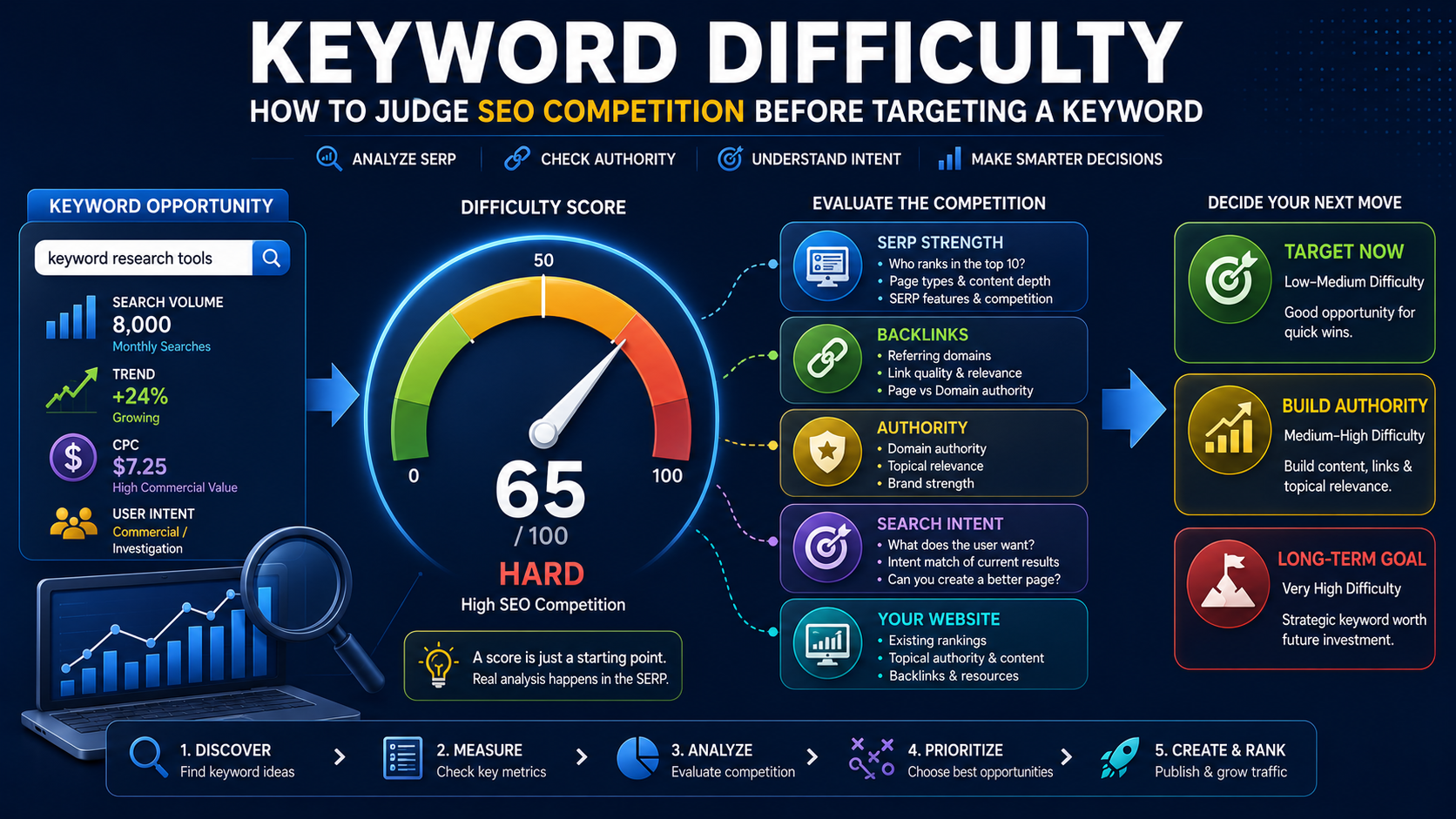
Keyword difficulty is an SEO metric used to estimate how challenging it may be to rank organically for a particular search query.
It is sometimes abbreviated as:
KD
Most keyword research platforms calculate a difficulty score based on characteristics of the pages already ranking.
Depending on the tool, these factors may include:
- backlinks
- referring domains
- authority of ranking pages
- authority of ranking domains
- SERP competition
- search intent
- content strength
The exact calculation varies between platforms.
That is important.
A score of:
45
in one tool is not necessarily equivalent to:
45
in another.
Keyword difficulty should therefore be treated as a relative indicator, not an absolute truth.
Why Keyword Difficulty Matters
Keyword difficulty helps you prioritize.
Imagine you discover 500 potential keywords.
You cannot realistically create excellent pages for every one of them immediately.
Difficulty can help answer questions such as:
- Which keywords might produce faster opportunities?
- Which topics require more authority?
- Where are competitors especially strong?
- Which keywords should be long-term targets?
- Which pages might need backlinks to compete?
- Which opportunities are realistic for a new website?
This is why difficulty belongs alongside the other keyword metrics you evaluate rather than being used alone.
A strong keyword decision considers several factors:
Relevance + Search Intent + Demand + Difficulty + Business Value + Existing Authority
Keyword difficulty is only one piece of that equation.
Keyword Difficulty Is Not a Google Metric
This distinction is essential.
Google does not provide an official organic “keyword difficulty” score.
The numbers shown by SEO tools are created by those companies.
That means you should not interpret:
Keyword difficulty: 32
as:
Google thinks this keyword is 32% difficult.
It does not work that way.
The metric is an SEO research shortcut.
It helps you quickly compare many keywords before doing deeper analysis.
The deeper analysis should happen in the actual search results.
How Keyword Difficulty Tools Work
Different tools use different formulas.
However, many difficulty models heavily consider backlinks and authority.
Suppose the top-ranking pages for a keyword have:
- hundreds of referring domains
- strong domain authority
- established brands
- years of history
A tool may classify that query as difficult.
Another query may have ranking pages with:
- few external links
- smaller websites
- weaker content
That may receive a lower difficulty score.
This can be useful.
But it creates limitations.
Backlinks Are Not the Entire Ranking System
A difficulty score focused heavily on backlinks may miss other important factors.
For example:
- search intent
- content quality
- topical relevance
- freshness
- internal linking
- website reputation
- page format
- brand recognition
A keyword can have a low backlink-based difficulty score but still be extremely challenging because the current results satisfy the search intent exceptionally well.
Likewise, a keyword may have a relatively high difficulty score but contain obvious content weaknesses that create an opportunity.
That is why SERP analysis matters.
Keyword Difficulty vs SERP Difficulty
These terms are related but useful to separate.
Keyword Difficulty
A numerical estimate created by an SEO tool.
Example:
KD: 58
SERP Difficulty
Your real-world assessment of the pages currently ranking.
You might evaluate:
- who ranks
- why they rank
- what type of pages dominate
- how useful those pages are
- whether the SERP matches your planned page
- whether there are obvious weaknesses
In practice:
Tool difficulty helps filter.
SERP difficulty helps decide.
You should use both.
Why Different SEO Tools Show Different Difficulty Scores
You may research the same keyword and see:
| Tool | Difficulty |
|---|---|
| Tool A | 32 |
| Tool B | 48 |
| Tool C | 61 |
This does not necessarily mean one tool is wrong.
Each platform may use different:
- backlink indexes
- authority calculations
- weighting systems
- SERP data
- refresh schedules
- formulas
Instead of asking:
Which number is correct?
ask:
What does this tool’s score tell me relative to other keywords in the same database?
For example, if Tool A shows:
- Keyword 1: KD 18
- Keyword 2: KD 42
- Keyword 3: KD 76
you can reasonably assume Keyword 3 appears more competitive according to that tool’s methodology.
The exact number matters less than the relative comparison.
How to Analyze Keyword Difficulty Properly
A professional keyword difficulty assessment should go beyond the tool score.
Use the following process.
Step 1: Check the Difficulty Score
Start with your keyword platform.
Record:
- keyword difficulty
- search volume
- traffic potential
- CPC
- search trend
This gives you a quick overview.
For example:
Keyword: keyword research tools
Volume: 8,000
Difficulty: 68
CPC: $7
At this stage, you know the topic appears competitive.
You do not yet know whether you should avoid it.
Step 2: Search the Keyword Manually
Look at the actual SERP.
Do not skip this step.
Ask:
- Which websites rank?
- What page types appear?
- Are results informational or commercial?
- Are there videos?
- Product pages?
- Tool pages?
- Forums?
- Comparison articles?
The SERP tells you what Google currently interprets the searcher as wanting.
For deeper intent analysis, use the framework in the Search Intent guide.
Step 3: Evaluate the Ranking Domains
Look at who currently ranks.
Suppose the top results are:
- Wikipedia
- HubSpot
- Semrush
- Ahrefs
That indicates a very different competitive environment from a SERP containing:
- small niche blogs
- independent consultants
- outdated forum threads
Strong Domains Do Not Automatically Mean Impossible
A major domain can rank with a weak page.
Your job is to evaluate the page, not only the logo.
Ask:
- Does the page satisfy the query?
- Is it outdated?
- Is it overly generic?
- Does it lack real examples?
- Is the format wrong?
Strong domains deserve respect.
They should not automatically discourage you.
Step 4: Evaluate the Ranking Pages
Now inspect individual results.
Look for:
Content Depth
Does the article comprehensively answer the search?
Search Intent Match
Does the page deliver exactly what the searcher expects?
Original Value
Does it include:
- firsthand experience
- data
- screenshots
- templates
- tools
- examples
Freshness
Is the information current?
User Experience
Is the page:
- readable
- fast
- well organized
- easy to navigate
Internal Authority
Does the site have a large related content cluster?
This is where keyword difficulty becomes less abstract.
You are not competing with a score.
You are competing with actual pages.
Step 5: Check Backlink Strength
External links can still be an important competitive signal.
Review the ranking pages.
Ask:
- How many referring domains link to them?
- Are those links high quality?
- Are links pointing to the exact page?
- Or mainly to the domain?
Suppose every page in the top five has:
300+ relevant referring domains
That is meaningful.
If your page has zero links and your website has little authority, you may need a longer-term strategy.
Now imagine the top pages have:
- 5 links
- 12 links
- 0 links
- 8 links
That may indicate a more accessible SERP.
Again, links are not the only factor.
They are part of the competitive picture.
Step 6: Evaluate Topical Authority
A website can be strong overall but weak in a specific topic.
For example:
A major news publisher may have enormous domain authority.
But an SEO-focused website may have:
- hundreds of SEO tutorials
- detailed technical guides
- original research
- strong internal linking
For an advanced SEO query, the specialist site may have an important topical advantage.
This is why your website architecture matters.
The Keyword Research pillar you are building creates relationships such as:
Keyword Discovery → Seed Keywords → Long-Tail Keywords → Keyword Metrics → Keyword Difficulty
As the cluster grows, each article supports the wider topical context.
Step 7: Evaluate Your Own Website
Keyword difficulty is relative.
Ask:
Do We Already Rank for Related Keywords?
Existing visibility suggests search engines already associate your site with the topic.
Do We Have Supporting Content?
A standalone article may be weaker than a page supported by a complete topic cluster.
Do We Have Relevant Backlinks?
Existing authority can make difficult keywords more realistic.
Do We Have Original Evidence?
Can we create something competitors cannot easily reproduce?
Examples:
- proprietary data
- firsthand testing
- screenshots
- templates
- case studies
Can We Create the Right Page Type?
If the SERP wants a tool and you can only create an article, the opportunity may be weak.
Step 8: Evaluate Business Value
High difficulty is not necessarily bad.
Some difficult keywords deserve investment because they can generate substantial business value.
Suppose:
Keyword A
Difficulty: 80
Potential customer value: $25,000
Keyword B
Difficulty: 20
Potential customer value: almost zero
Keyword B may be easier.
Keyword A may still deserve greater investment.
Difficulty should influence your strategy—not control it.
What Is a Good Keyword Difficulty Score?
There is no universal good score.
A common mistake is looking for rules such as:
Only target KD under 30.
That approach ignores context.
A KD 40 keyword might be easy for an established website.
A KD 15 keyword might still be difficult for a brand-new site if the SERP does not match your planned content.
A better framework is:
Low Difficulty
Potentially accessible, but inspect the SERP.
Medium Difficulty
Likely requires stronger content, relevance, internal authority, or links.
High Difficulty
Usually requires significant authority, resources, or long-term investment.
The numerical ranges differ by platform.
Use the tool’s own methodology rather than assuming one global scale.
Keyword Difficulty for New Websites
New websites need to be especially realistic about competition.
You may have:
- few backlinks
- limited content
- little brand recognition
- no historical rankings
That does not mean you should avoid every competitive topic.
You still need foundational content.
For example, a new SEO website needs pages explaining:
- SEO fundamentals
- keyword research
- technical SEO
even if those topics are competitive.
Why?
Because the content forms the structure of the website.
At the same time, you can support those broader topics with more specific opportunities from your Long-Tail Keywords guide.
A balanced approach is stronger than chasing only low-KD keywords.
Keyword Difficulty for Established Websites
Established websites can be more aggressive.
They may already have:
- backlinks
- authority
- relevant content
- ranking history
- internal links
- brand demand
Use Search Console to identify related keywords where the site already ranks.
For example:
Position 7
for a related keyword suggests stronger competitive potential than:
No visibility at all
Your site’s actual performance is often more informative than a generic tool score.
Difficulty for Long-Tail Keywords
Long-tail keywords are often described as easy.
Sometimes they are.
But specificity does not guarantee low competition.
Consider:
CRM
Broad and competitive.
Now:
best CRM for real estate agents
More specific.
But potentially still highly competitive because software companies and affiliate publishers see strong commercial value.
Your Long-Tail Keywords guide explains why long-tail should be interpreted as specific, not automatically easy.
Always inspect the SERP.
Keyword Difficulty and Search Intent
Difficulty changes depending on intent.
Consider:
email marketing
The SERP may contain broad educational guides.
Now:
best email marketing software
The SERP may contain:
- comparison sites
- software platforms
- review publishers
- affiliate websites
The second query has stronger commercial intent.
That often attracts stronger competition.
This is another reason why search intent must be analyzed together with difficulty.
Keyword Difficulty and Traffic Potential
Imagine two keywords.
Keyword A
Search volume: 10,000
Difficulty: 75
Traffic potential: 25,000
Keyword B
Search volume: 2,000
Difficulty: 30
Traffic potential: 3,000
Which is better?
It depends on:
- your authority
- your resources
- business value
- timeline
- strategic priority
Keyword A might be a long-term pillar.
Keyword B might be a faster supporting opportunity.
A good SEO strategy contains both.
Difficulty vs Business Value
Use a simple matrix.
| Low Business Value | High Business Value | |
|---|---|---|
| Low Difficulty | Optional quick win | Strong priority |
| High Difficulty | Usually deprioritize | Strategic investment |
This model prevents you from chasing easy keywords simply because they are easy.
Easy + Irrelevant
Not valuable.
Difficult + Highly Valuable
Potentially worth significant effort.
The objective is not to minimize difficulty.
The objective is to maximize meaningful opportunity.
Keyword Difficulty and Existing Rankings
Suppose a tool reports:
KD: 70
That sounds difficult.
But your website already ranks:
Position 12
This changes the situation.
Your page is already close.
Potential improvements could include:
- better intent alignment
- deeper content
- stronger internal linking
- backlinks
- title optimization
- content refresh
Current rankings can reduce the practical difficulty of an opportunity.
This is why Search Console data should be part of keyword evaluation.
Your SEO Reporting guide explains how to identify these near-ranking opportunities.
Keyword Difficulty and Internal Links
Internal links can influence your ability to compete.
Suppose you publish a new Keyword Difficulty article.
If it is isolated, it has limited contextual support.
Now suppose it receives relevant links from:
- Keyword Discovery
- Seed Keywords
- Long-Tail Keywords
- Keyword Metrics
The page becomes part of a clear topic cluster.
That helps:
- users navigate
- crawlers discover content
- establish relationships between topics
- distribute internal authority
Internal links do not magically make difficult keywords easy.
But strong architecture can improve your competitive position.
Keyword Difficulty and Backlinks
Should you avoid a keyword because the top pages have backlinks?
No.
Ask what type of links they have.
Relevant Editorial Links
These may be difficult to replicate and can indicate genuine authority.
Weak Directory Links
Less impressive.
Sitewide Links
May inflate backlink counts.
Links to the Domain Rather Than Page
Different from direct page authority.
The raw backlink number is rarely enough.
Quality and relevance matter.
Keyword Difficulty and Content Quality
Suppose the top-ranking article has:
- 150 referring domains
- strong domain authority
but the article is:
- five years old
- poorly structured
- missing important questions
- full of outdated screenshots
There may still be an opportunity.
Your page could provide:
- updated screenshots
- better examples
- original research
- clearer explanations
- tools
- templates
- current information
Do not assume backlinks make content unbeatable.
But also do not assume better writing alone will automatically overcome enormous authority differences.
Be realistic.
Keyword Difficulty and SERP Features
Difficulty scores often focus on competitors.
But SERP structure also matters.
Suppose a query has:
- four paid ads
- shopping results
- videos
- featured information
- organic results below the fold
Even if you rank organically, click potential may be limited.
Difficulty analysis should therefore include:
Can we rank?
and:
If we rank, will the result generate useful traffic?
These are different questions.
Keyword Difficulty and Brand Dominance
Some SERPs are dominated by specific brands.
For example, navigational searches such as:
Google Search Console
will naturally favor Google.
Trying to compete for that query with an independent informational article may make little sense.
Other queries may strongly favor:
- marketplaces
- software providers
- government websites
- medical institutions
This is why page-type and brand analysis matter.
The issue may not be backlink difficulty.
The issue may be that your page is not the type of result the searcher wants.
Keyword Difficulty and Freshness
Some SERPs reward frequently updated information.
Examples can include:
- software comparisons
- pricing
- statistics
- regulations
- current tools
A two-year-old page may struggle despite strong backlinks if the topic requires current information.
Look at publication and update dates.
Ask:
Does freshness seem important here?
If yes, your ability to maintain the page becomes part of the competitive assessment.
Keyword Difficulty and Content Format
Suppose the keyword is:
keyword difficulty checker
The SERP might contain interactive tools.
Publishing:
What Is Keyword Difficulty?
may not satisfy that intent.
The page could be excellent.
The format is wrong.
Difficulty is therefore not only:
How strong are the competitors?
It is also:
Can we produce the format searchers expect?
This is an important distinction.
Create a Personal Keyword Difficulty Score
Generic KD scores describe the overall SERP.
You can create a more useful internal score that considers your website.
For example:
Tool Difficulty
Score 1–5.
SERP Strength
Score 1–5.
Content Gap
Score 1–5.
Topical Authority
Score 1–5.
Existing Ranking
Score 1–5.
Business Value
Score 1–5.
Then evaluate the opportunity.
Suppose:
| Factor | Score |
|---|---|
| Tool Difficulty | 4 |
| SERP Strength | 4 |
| Content Opportunity | 5 |
| Existing Authority | 4 |
| Current Ranking | 3 |
| Business Value | 5 |
This gives you much more useful context than:
KD = 67.
Do not treat the final score as scientific precision.
Use it to structure decision-making.
Difficulty-to-Value Ratio
Another simple model is:
Opportunity = Business Value ÷ Difficulty
This is intentionally simplified.
Imagine:
Keyword A
Difficulty: High
Business value: Very High
Keyword B
Difficulty: Low
Business value: Low
Both may produce similar ratios.
But Keyword A might still become the more important strategic target.
Use ratios to prioritize—not automate your strategy.
Should You Avoid High-Difficulty Keywords?
Not necessarily.
High-difficulty keywords may deserve a place in your roadmap if they:
- define your core market
- support important products
- have strong commercial value
- strengthen your topical authority
- represent long-term strategic goals
The mistake is expecting immediate results.
A high-difficulty keyword can become a:
Long-Term Target
while supporting long-tail queries become:
Near-Term Opportunities
For example:
Long-term target:
keyword research
Supporting opportunities:
- how to find seed keywords
- keyword metrics
- keyword difficulty
- how to cluster keywords
The supporting content helps build the foundation needed to compete more broadly.
When to Target Low-Difficulty Keywords
Low-difficulty opportunities can be useful when they have:
- strong relevance
- clear intent
- useful demand
- strategic fit
They can help a newer website build:
- search visibility
- traffic
- content depth
- ranking history
But do not publish low-difficulty topics unrelated to your business simply because a tool labels them easy.
Easy traffic with no strategic value is still weak traffic.
When to Target High-Difficulty Keywords
A competitive keyword may deserve investment when:
- business value is high
- search demand is meaningful
- it fits your core expertise
- you can build supporting content
- you can earn authority
- you can create a superior page
Think of high-difficulty keywords as strategic assets rather than quick wins.
Keyword Difficulty for Ecommerce
Ecommerce difficulty analysis should consider more than links.
Look at:
- major retailers
- marketplaces
- product availability
- brand preference
- price competitiveness
- reviews
- category depth
If Amazon, Walmart, and manufacturer sites dominate the SERP, a small store needs a compelling reason to compete.
More specific product searches may offer better opportunities.
Keyword Difficulty for Local SEO
Local keyword difficulty behaves differently.
Search results may include:
- map packs
- directories
- local businesses
- organic service pages
Evaluate:
- proximity
- reviews
- local authority
- Google Business Profiles
- location relevance
- website strength
A generic SEO difficulty score may not fully capture local competition.
Manual SERP analysis becomes especially important.
Keyword Difficulty for B2B SEO
B2B keywords often have:
- low search volume
- high customer value
This means high difficulty may still be acceptable.
Suppose:
enterprise cybersecurity consultant
has only a few hundred searches.
If one client is worth $100,000+, the opportunity may justify significant investment.
Do not evaluate difficulty without business economics.
Keyword Difficulty for Informational Content
Informational keywords may attract large volumes.
But business value can vary significantly.
Consider:
what is SEO
This may be highly competitive and relatively low converting.
However, it could still be strategically valuable for an SEO education website because it supports:
- topical authority
- internal links
- audience acquisition
- brand exposure
This is where strategy matters.
Keyword Difficulty for Commercial Content
Commercial queries often justify more aggressive investment.
Examples:
- best CRM software
- SEO consultant
- keyword research tools
- hosting comparison
These queries can attract:
- advertisers
- affiliates
- software companies
- established publishers
Difficulty may be high because the economic incentive is high.
Commercial competition itself can be an indicator of value.
Use Keyword Difficulty With Forecasting
Once you understand difficulty, you can make your forecasts more realistic.
Suppose a keyword cluster has:
100,000 searches
A naive forecast might assume:
10% click capture
But if the SERP is extremely competitive and your website is new, that assumption may be unrealistic.
Your SEO Forecasting guide explains how to use conservative, expected, and aggressive scenarios.
Difficulty should influence those ranking assumptions.
Use Keyword Difficulty With SEO Testing
Existing pages can sometimes reduce difficulty faster than new pages.
Suppose your page already ranks:
Position 11
You might test:
- internal links
- title changes
- content expansion
- improved visuals
- search-intent alignment
The scheduled SEO Testing guide provides the framework for evaluating whether these changes actually improve performance.
Common Keyword Difficulty Mistakes
Treating KD as a Google Metric
It is a third-party estimate.
Comparing Scores Across Tools Directly
Different tools use different methodologies.
Avoiding Every High-KD Keyword
Strategically important topics may still deserve investment.
Targeting Every Low-KD Keyword
Easy does not mean relevant.
Ignoring Search Intent
You cannot compete effectively with the wrong page type.
Ignoring Your Own Authority
Difficulty is relative to the website.
Looking Only at Domain Authority
Evaluate the ranking pages themselves.
Looking Only at Backlinks
Content, intent, relevance, and architecture matter too.
Ignoring SERP Features
Ranking does not guarantee clicks.
Failing to Inspect the SERP
Never make a major keyword decision from a spreadsheet alone.
A Practical Keyword Difficulty Workflow
Use this process when evaluating a keyword.
Step 1: Check the Tool Score
Use it as an initial filter.
Step 2: Review Search Volume and Traffic Potential
Understand the size of the opportunity.
Step 3: Identify Search Intent
Determine what users expect.
Step 4: Inspect the Top 10 Results
Analyze:
- domains
- page types
- content
- freshness
Step 5: Review Backlink Strength
Look at page-level referring domains.
Step 6: Look for Content Gaps
Ask whether existing results can be improved.
Step 7: Evaluate Your Website
Consider:
- authority
- topical coverage
- existing rankings
- backlinks
Step 8: Score Business Value
Determine whether the opportunity is commercially or strategically meaningful.
Step 9: Decide the Timeline
Classify the keyword as:
- quick opportunity
- medium-term target
- long-term strategic target
Step 10: Build Supporting Content
Strengthen the wider topic rather than treating the page as isolated.
Keyword Difficulty Checklist
Before targeting a competitive keyword, confirm:
Tool Data
- keyword difficulty reviewed
- search volume reviewed
- traffic potential reviewed
Search Intent
- page type understood
- intent clearly identified
SERP
- ranking domains analyzed
- ranking pages reviewed
- SERP features considered
- freshness evaluated
Authority
- backlinks reviewed
- referring domains reviewed
- topical authority considered
Your Website
- existing rankings checked
- supporting content reviewed
- internal linking opportunity assessed
Business
- business value established
- conversion potential considered
- strategic relevance confirmed
Execution
- required content format is realistic
- necessary resources are available
- timeline expectations are reasonable
If the keyword still looks attractive after these checks, it may deserve a place in your SEO roadmap.
Final Thoughts
Keyword difficulty is useful.
But the number itself is not the decision.
A better framework is:
Tool Score → SERP Analysis → Competitor Strength → Search Intent → Your Authority → Business Value → Decision
Use difficulty scores to save time.
Use the SERP to understand reality.
Use your own website data to understand your competitive position.
And use business value to determine whether the opportunity is worth pursuing.
Do not ask:
Is this keyword easy?
Ask:
Is this keyword worth the effort required to compete?
Sometimes the answer will be no.
Sometimes a low-difficulty keyword will deserve immediate attention.
And sometimes the hardest keyword in your industry will still be one of the most important long-term investments you can make.
Good keyword research is not about avoiding competition.
It is about choosing which competition is worth entering.