

Keyword research does not have to begin from a blank spreadsheet.
Your competitors have already spent time creating pages, targeting topics, earning rankings, testing content formats, and discovering parts of the search market.
That creates a valuable source of information.
Competitor keyword research is the process of studying the search queries, topics, pages, and content areas that competing websites rank for so you can identify opportunities, gaps, weaknesses, and strategic priorities for your own website.
The goal is not to copy competitors.
It is to understand the search landscape.
A competitor may reveal:
- keywords you overlooked
- topics your audience cares about
- valuable long-tail queries
- commercial search opportunities
- content formats Google currently rewards
- weak SERPs you may be able to compete in
- topics that do not deserve your attention
Used properly, competitor research can make keyword discovery faster and more evidence-based.
Used poorly, it can turn your content strategy into a copy of someone else’s website.
This guide explains how to perform competitor keyword research step by step, distinguish business competitors from search competitors, evaluate competitor keywords, find realistic opportunities, and turn competitive data into an original SEO strategy.
What Is Competitor Keyword Research?
Competitor keyword research is the process of identifying and analyzing the keywords for which competing websites receive organic search visibility.
You may investigate:
- keywords they rank for
- pages generating organic traffic
- topics they cover
- keywords where they outrank you
- keywords you rank for but they do not
- commercial pages
- informational articles
- featured search results
- long-tail opportunities
A simple process looks like this:
Identify Competitors → Collect Their Keywords → Filter Relevant Topics → Compare Against Your Site → Evaluate Intent and Difficulty → Cluster Opportunities → Prioritize Pages
Competitor keyword research is therefore not just a keyword-export exercise.
The value comes from interpretation.
Why Competitor Keyword Research Matters
You can discover keywords through:
- seed keywords
- autocomplete
- customer questions
- communities
- Search Console
- keyword tools
Competitors add another useful perspective.
They show you search opportunities that are already producing visibility in your market.
For example, imagine you operate an SEO website and a competitor ranks for:
- SEO audit checklist
- keyword mapping
- technical SEO template
- ecommerce SEO audit
- local SEO reporting
- Google Search Console analysis
If several of these topics are relevant to your audience but missing from your site, you have discovered possible content gaps.
Your earlier Keyword Discovery guide explains how competitor research fits alongside customer questions, SERPs, Search Console, and other discovery sources.
Competitor Research Helps Validate Demand
A keyword tool may suggest thousands of ideas.
But a competitor ranking successfully for a topic provides additional evidence that:
- the topic exists in your market
- Google recognizes a relevant page type
- users may engage with that subject
- a content opportunity may be worth evaluating
That does not mean you should automatically target it.
It simply makes the opportunity more concrete.
It Helps You Discover Topics You Did Not Think Of
Businesses naturally develop blind spots.
You may understand your services very well but overlook how customers describe related problems.
Competitor pages can expose:
- alternative terminology
- supporting questions
- use cases
- comparisons
- audience segments
A CRM business, for example, may initially focus on:
CRM software
Competitor research could uncover:
- CRM for agencies
- CRM for real estate
- CRM with WhatsApp integration
- CRM for freelancers
- HubSpot alternatives
- CRM onboarding checklist
That creates a much richer view of the market.
Business Competitors vs Search Competitors
This distinction is one of the most important parts of competitor keyword research.
Business Competitors
Companies that sell similar products or services.
For example, two SEO agencies targeting similar clients.
Search Competitors
Websites that compete with you in search results.
These may include:
- publishers
- software companies
- marketplaces
- blogs
- forums
- educational websites
- government resources
A search competitor does not need to sell what you sell.
For example, an independent SEO consultant may compete in Google with:
- Ahrefs
- Semrush
- HubSpot
- Search Engine Journal
- YouTube
Those websites may not be direct business competitors, but they compete for the same searcher’s attention.
Good competitor keyword research should consider both groups.
12 Steps to Perform Competitor Keyword Research
Step 1: Define Your SEO Objective
Do not begin by exporting competitor keywords.
First decide what you are trying to accomplish.
Possible objectives include:
- build a new topic cluster
- find missing blog topics
- identify commercial keywords
- expand a product category
- improve a service page
- discover long-tail opportunities
- find keywords where competitors outrank you
For example:
Find keyword opportunities to expand the Keyword Research pillar.
is much more useful than:
Export every keyword from five SEO websites.
A clear objective keeps the research focused.
Step 2: Identify Your Real Competitors
Start with known business competitors.
Then search your important seed keywords manually.
For example:
- keyword research
- technical SEO
- local SEO
- SEO audit
Record websites that appear repeatedly.
Those recurring domains are important search competitors.
Build a Competitor List
A practical list may include:
- 3–5 direct business competitors
- 3–5 strong organic search competitors
- 1–3 specialist websites within individual topics
You do not need to analyze fifty websites.
A smaller, relevant set usually produces cleaner insights.
Step 3: Separate Domain-Level and Page-Level Competitors
A website does not need to compete with you across every topic.
For example:
A large marketing platform might be a competitor for:
SEO reporting
but not for:
local SEO for dentists
This is why page-level competitor analysis is valuable.
For each important query, look at the pages currently ranking.
This also connects with Keyword Difficulty, where the real competitive environment matters more than a generic domain-level score.
Step 4: Export Competitor Keywords
SEO tools can usually provide keyword data for a domain, subfolder, or individual URL.
Useful fields may include:
- keyword
- search volume
- ranking position
- ranking URL
- estimated traffic
- keyword difficulty
- CPC
- SERP features
A raw export might look like:
| Keyword | Competitor Position | Volume | Ranking URL |
|---|---|---|---|
| keyword clustering | 3 | 2,000 | /keyword-clustering/ |
| keyword mapping | 5 | 1,500 | /keyword-mapping/ |
| keyword research template | 7 | 800 | /keyword-template/ |
Do not treat this export as your content calendar.
It is raw research.
Step 5: Remove Irrelevant Keywords
Large websites rank for many unrelated searches.
Suppose an SEO software company also ranks for:
- office culture
- careers
- company news
- unrelated brand terms
Those searches may not matter to your strategy.
Filter keywords based on:
- audience relevance
- topic relevance
- product or service relevance
- geographic relevance
This is where your business strategy matters more than competitor traffic.
Step 6: Identify Keywords Competitors Rank for but You Do Not
This is often called a keyword gap.
Imagine:
Competitor Ranks For
- keyword clustering
- content gap analysis
- keyword mapping
- search intent
- seed keywords
Your Site Ranks For
- search intent
- seed keywords
- keyword clustering
Potential gaps:
- content gap analysis
- keyword mapping
That does not mean you automatically need both pages.
The gaps become candidates for evaluation.
Your next article in this series—Content Gap Analysis—will go deeper into this process.
Step 7: Find Competitor Keywords Where You Already Rank
Competitor research is not only about missing keywords.
Suppose:
Competitor:
Position 2
Your website:
Position 11
This can be more valuable than pursuing a completely new keyword.
You already have relevance.
Investigate:
- content depth
- search intent
- internal links
- backlinks
- page format
- freshness
You may discover a realistic improvement opportunity.
This is where your SEO Reporting guide becomes useful because current impressions, clicks, CTR, and positions provide your side of the comparison.
Step 8: Analyze the Competitor’s Top Pages
Instead of only analyzing individual keywords, identify competitor pages receiving meaningful organic visibility.
A strong page may rank for hundreds of related searches.
For each page, ask:
- What is the primary topic?
- What type of page is it?
- Which keyword cluster does it rank for?
- Why might it be successful?
- Can we create something genuinely different or better?
Example
A competitor’s article:
Complete Technical SEO Checklist
may rank for:
- technical SEO checklist
- technical SEO audit checklist
- technical SEO tasks
- SEO technical checklist
- website technical SEO checklist
Do not create five separate pages.
Recognize the cluster.
Your Keyword Clustering guide explains how to convert large keyword sets into page-level search-intent groups.
Step 9: Evaluate Search Intent
Do not copy a competitor’s topic until you understand the query.
Suppose the keyword is:
SEO audit
The SERP may favor:
- guides
- services
- tools
- templates
depending on the query variation.
Ask:
What is the user trying to accomplish?
Your Search Intent guide provides the framework for separating informational, navigational, commercial, and transactional searches.
The correct page type matters more than simply using the competitor’s keyword.
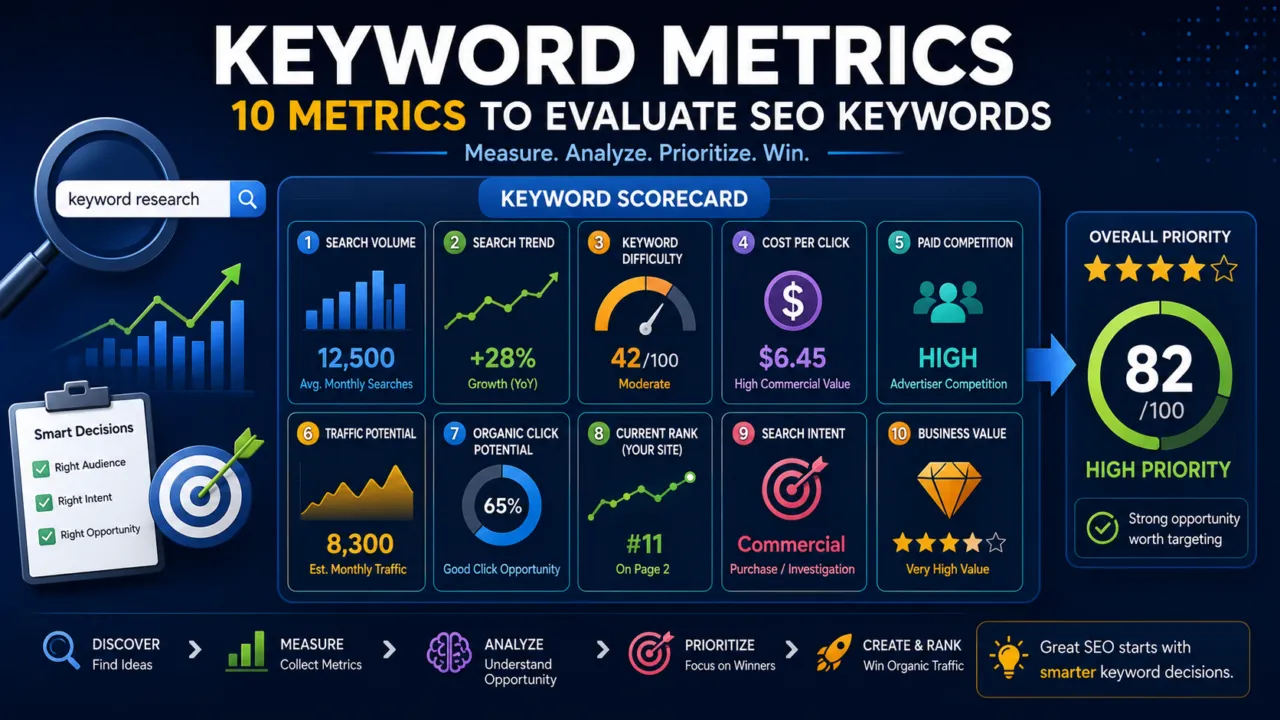
Step 10: Evaluate Keyword Metrics and Difficulty
Now assess whether the opportunity is worth pursuing.
Review:
- search volume
- trend
- keyword difficulty
- traffic potential
- CPC
- current ranking
- business value
Your Keyword Metrics guide explains why no single number should determine the decision.
For example:
Keyword A
Volume: 10,000
Difficulty: 80
Business value: Low
Keyword B
Volume: 700
Difficulty: 45
Business value: High
Keyword B may deserve higher priority.
Step 11: Study Why the Competitor Page Ranks
This is where competitor research becomes strategic.
Do not ask only:
Which keywords do they rank for?
Ask:
What makes this page competitive?
Possible advantages include:
- stronger intent match
- better page format
- deeper coverage
- original data
- backlinks
- internal links
- strong brand authority
- useful tools
- better UX
- stronger topical coverage
You may also find weaknesses.
Examples:
- outdated screenshots
- weak explanations
- missing examples
- poor structure
- outdated statistics
- excessive promotional content
Those weaknesses can become opportunities.
Step 12: Turn Research Into an Action Plan
The final output should not be a CSV containing 50,000 keywords.
It should be a prioritized plan.
For example:
| Opportunity | Action |
|---|---|
| Keyword mapping | Create new guide |
| Search intent | Improve existing page |
| SEO audit template | Add template to audit guide |
| Keyword clustering tools | Future commercial comparison |
| Local SEO pricing | Not relevant currently |
Competitor research is useful only when it leads to decisions.
Analyze Competitors at Three Levels
A strong competitor analysis works at three levels.
Level 1: Domain
Questions:
- What topics does the entire site cover?
- Where does it have authority?
- Which categories drive visibility?
Level 2: Subfolder
For example:
competitor.com/seo/
Questions:
- Which SEO topics perform?
- How is the content organized?
- What clusters exist?
Level 3: Individual Page
Questions:
- Which keywords does this page rank for?
- What search intent does it satisfy?
- Why is it competitive?
Different levels reveal different insights.
How to Find Competitor Keywords Without Paid Tools
Paid SEO platforms make competitor analysis easier, but they are not the only option.
You can use manual research.
Google Search
Search important queries and record recurring domains.
Competitor Site Navigation
Review:
- categories
- service pages
- resources
- guides
Site Search Operators
Queries such as:
site:competitor.com keyword research
can help identify related content.
Search Console
Your own query data can reveal competitors indirectly.
Search your important ranking keywords manually and identify which pages appear above you.
Competitor Sitemaps
Public XML sitemaps may reveal:
- article topics
- category structures
- recently published pages
These methods take longer but can still produce useful intelligence.
Competitor Keywords vs Competitor Content
These are not the same.
A competitor may have a page but receive little organic visibility.
Another page may attract thousands of search queries.
Therefore, avoid copying a competitor’s content calendar based only on published URLs.
Ask:
Is this page actually successful in search?
Then:
Is the topic relevant to us?
Both conditions matter.
Identify Competitor Quick Wins
One useful category is competitor quick wins.
These may include queries where:
- competitor ranks strongly
- your page already ranks 8–20
- SERP competition is reasonable
- business value is meaningful
For example:
Competitor:
Position 4
You:
Position 12
Instead of creating a new page, improve the existing one.
Potential improvements:
- stronger search-intent alignment
- better internal links
- updated content
- more examples
- improved title
- clearer structure
Existing momentum can make these opportunities particularly attractive.
Find Competitor Long-Tail Keywords
Broad terms are often highly competitive.
Competitor pages can reveal more specific queries.
For example:
A competitor targeting:
local SEO
might also rank for:
- local SEO for small businesses
- local SEO checklist for beginners
- how to improve local rankings
- local SEO for multiple locations
These more specific searches can reveal useful supporting content.
Your Long-Tail Keywords guide explains why specific queries often provide clearer intent even when they have lower individual search volume.
Study Competitor Commercial Keywords
Do not limit competitor research to informational blogs.
Look at commercial pages.
Examples:
- service pages
- product categories
- software comparisons
- pricing pages
- alternatives pages
These can reveal keywords closer to business outcomes.
For example:
Informational:
how to perform keyword research
Commercial:
keyword research service
Both matter.
They serve different stages of the customer journey.
Competitor Brand Keywords
Competitors may receive large amounts of traffic from branded queries.
Examples:
- competitor name
- competitor login
- competitor pricing
- competitor reviews
Be careful when evaluating this traffic.
Branded search demand does not automatically represent an opportunity for your site.
However, some branded queries can create legitimate comparison opportunities.
Examples:
- Competitor A vs Competitor B
- Competitor A alternatives
- Competitor A review
Only create such content if you can provide accurate, fair, useful comparisons.
Competitor Comparison Keywords
Comparison searches can have strong commercial intent.
Examples:
- Ahrefs vs Semrush
- Shopify vs WooCommerce
- HubSpot vs Salesforce
These queries deserve careful research.
A useful comparison should include:
- meaningful criteria
- accurate information
- limitations
- clear differences
- suitable audiences
Do not simply declare whichever product pays the highest affiliate commission the winner.
Competitor Keyword Research and Keyword Clustering
A competitor export may contain thousands of phrases.
Before planning content, cluster them.
Example raw keywords:
- competitor keyword analysis
- competitor keyword research
- analyze competitors keywords
- find competitor keywords
- competitor SEO keywords
These probably belong to one cluster.
Do not create five pages.
The process should be:
Competitor Export → Relevance Filter → Intent Analysis → Keyword Clustering → URL Mapping
This prevents competitor research from creating unnecessary content duplication.
Competitor Keyword Research and Keyword Difficulty
A competitor ranking for a keyword does not mean you can immediately compete.
Suppose a competitor has:
- strong topical authority
- hundreds of referring domains
- ten years of brand history
You may need more resources.
Use the process in the Keyword Difficulty guide to evaluate whether the opportunity is:
- near term
- medium term
- long term
Competition should influence timing, not automatically eliminate valuable targets.
Competitor Keyword Research and Business Value
Competitors may rank for enormous traffic-generating topics that have little value to your business.
Example:
A marketing competitor ranks for:
inspirational marketing quotes
Search volume may be large.
But if your goal is attracting SEO consulting clients, the business value could be weak.
A smaller keyword such as:
technical SEO consultant
may be much more valuable.
Never confuse competitor traffic with business opportunity.
Competitor Keyword Research for New Websites
New websites lack much of their own search data.
Competitor research can therefore be particularly valuable.
Use it to understand:
- major topics
- search intent
- content formats
- audience language
- market structure
However, do not copy established sites page for page.
A new website needs focus.
Choose a narrow authority area and build depth.
For example:
Keyword Research
instead of attempting every digital marketing topic simultaneously.
Competitor Keyword Research for Existing Websites
Established websites should focus heavily on comparative gaps.
Classify competitor keywords into:
Missing
Competitor ranks, you do not.
Weak
Both rank, competitor is stronger.
Strong
You outperform competitor.
Unique
You rank, competitor does not.
This creates a much richer picture than simply finding missing keywords.
Competitor Keyword Research for Ecommerce
Ecommerce competitor research can reveal:
- product categories
- product attributes
- use cases
- comparison terms
- buying guides
- filters
For example, a footwear competitor may rank for:
- trail running shoes
- waterproof trail shoes
- running shoes for flat feet
- marathon shoes
Analyze whether those searches should map to:
- categories
- products
- guides
- filters
Do not create indexable pages for every product variation automatically.
Competitor Keyword Research for SaaS
SaaS competitors can reveal high-value query types such as:
Category
CRM software
Feature
CRM with WhatsApp integration
Audience
CRM for real estate
Alternatives
Salesforce alternatives
Comparison
HubSpot vs Salesforce
Problem
how to automate lead follow-up
These different intents should be separated into appropriate page types.
Competitor Keyword Research for Local SEO
Local competitors can reveal:
- service terms
- location modifiers
- neighborhood searches
- problem-based searches
Example:
A plumber may discover competitors ranking for:
- emergency plumber
- drain cleaning
- water heater repair
- leak detection
Then location modifiers can be evaluated.
Avoid creating thin location pages simply because competitors have them.
Analyze whether those pages provide actual local value.
Competitor Keyword Research for B2B
B2B search volumes are often smaller.
Competitor analysis can help uncover highly specific commercial queries.
Examples:
- CRM for manufacturing
- warehouse software for distributors
- SEO agency for SaaS
- marketing automation for law firms
These terms may receive modest volume but represent highly valuable customers.
Business value matters more than raw traffic.
How Many Competitors Should You Analyze?
There is no fixed number.
A practical starting point is:
- 3 direct competitors
- 3 organic search competitors
- several page-level competitors for strategic queries
Adding more competitors eventually creates diminishing returns.
When the same keyword patterns repeatedly appear, you likely understand the major search landscape.
How Often Should You Repeat Competitor Keyword Research?
Competitor analysis should not be a one-time task.
Revisit it when:
- entering a new topic
- planning a new content cluster
- rankings decline
- new competitors appear
- your market changes
- refreshing strategy
A quarterly review may be useful for active SEO programs.
Larger or fast-moving markets may require more frequent analysis.
How to Prioritize Competitor Keyword Opportunities
A simple scoring framework can include:
Relevance
Does the keyword fit your audience?
Search Intent
Does the query support the right user journey?
Search Demand
Is there meaningful interest?
Difficulty
Can you realistically compete?
Business Value
Could the traffic support your goals?
Existing Visibility
Do you already have momentum?
Content Fit
Can you produce something genuinely useful?
A conceptual formula is:
Opportunity = Relevance × Business Value × Search Demand × Ranking Feasibility
Do not treat the resulting number as scientific truth.
The purpose is prioritization.
What Not to Copy From Competitors
Competitor research should inform—not replace—strategy.
Do not automatically copy:
- titles
- article structure
- examples
- screenshots
- wording
- claims
- designs
- conclusions
Use competitor content to understand the market.
Then add:
- your own explanations
- original examples
- experience
- visuals
- data
- frameworks
Your goal is not to become the second-best version of an existing page.
Common Competitor Keyword Research Mistakes
Analyzing the Wrong Competitors
Business competitors and search competitors can differ.
Exporting Too Much Data
Millions of keywords are useless without filtering.
Copying Every Competitor Keyword
Their business strategy may be different.
Ignoring Search Intent
Similar keywords can require different pages.
Looking Only at Search Volume
Business value matters.
Ignoring Existing Content
You may already have the right page.
Creating One Page Per Keyword
Cluster overlapping searches.
Assuming Competitor Rankings Are Permanent
Search performance changes.
Copying Competitor Content
Research is not permission to duplicate.
Ignoring Competitor Weaknesses
Do not only ask what they do well.
Look for what they fail to answer.
A Practical Competitor Keyword Research Workflow
Use this process:
1. Define the Goal
Decide what you want to discover.
2. Identify Relevant Competitors
Combine business and organic competitors.
3. Export Competitor Keywords
Collect keyword, URL, position, volume, and difficulty data.
4. Remove Irrelevant Queries
Keep the dataset aligned with your market.
5. Compare Against Your Site
Classify:
- missing
- weak
- strong
- unique
6. Analyze Search Intent
Determine what users actually want.
7. Cluster Similar Keywords
Group shared intent.
8. Evaluate Difficulty
Inspect the actual SERP.
9. Score Business Value
Prioritize meaningful traffic.
10. Analyze Competitor Pages
Find strengths and weaknesses.
11. Map Opportunities
Assign clusters to new or existing URLs.
12. Create the Action Plan
Decide what to:
- create
- improve
- consolidate
- ignore
That final step turns competitor intelligence into SEO strategy.
Competitor Keyword Research Checklist
Before finishing your analysis, confirm:
Competitors
- direct competitors identified
- organic competitors identified
- page-level competitors reviewed
Keywords
- competitor keywords exported
- irrelevant terms removed
- branded keywords separated
- long-tail opportunities reviewed
Your Website
- existing rankings compared
- missing keywords identified
- weak rankings identified
- current URLs reviewed
Search Intent
- informational queries separated
- commercial queries separated
- transactional opportunities identified
Competition
- keyword difficulty reviewed
- SERPs manually inspected
- page quality analyzed
- backlink strength considered
Architecture
- similar keywords clustered
- page ownership defined
- cannibalization risk checked
Business
- relevance confirmed
- business value assessed
- conversion potential considered
Execution
- opportunities prioritized
- new pages identified
- existing pages selected for improvement
- irrelevant topics excluded
Final Thoughts
Competitor keyword research is not about copying what another website ranks for.
It is about using competitors as evidence.
A practical process looks like:
Competitor → Keywords → Relevance → Search Intent → Metrics → Clusters → Gaps → Priority → Action
Study competitors to discover opportunities.
Then apply your own strategy.
Ask:
- Is this topic relevant to our audience?
- Does it support our business?
- Can we create something meaningfully better?
- Does an existing page already cover it?
- Is the competition realistic?
- Does the opportunity belong in our current roadmap?
The best competitor research does not end with:
Competitor X ranks for 50,000 keywords.
It ends with:
These are the specific opportunities worth pursuing, these existing pages should be improved, and these topics should be ignored.
That is what turns competitive data into useful SEO intelligence.
The next step is to take the competitor data you have collected and systematically identify what your website is missing through a structured content gap analysis.